GAA TV rights remains a complex issue
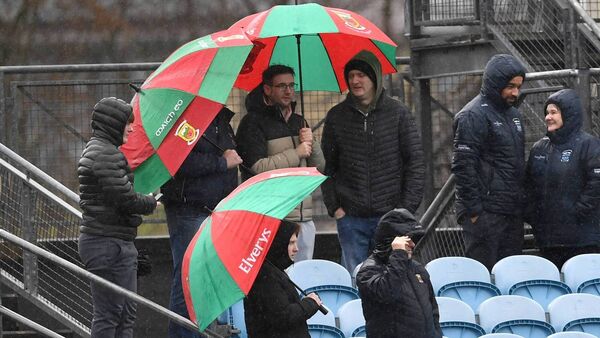
Mayo fans shelter from the atrocious weather conditions during the Allianz National Football League fixture between Mayo and Armagh at Hastings Insurance MacHale Park earlier this month. Picture: David Farrell Photography
There was a collective sigh of relief throughout Mayo early last week when it was revealed that Saturday’s league clash with Kerry in Tralee would, after all, be ‘on the telly’.
More games than ever before are now broadcast live and with that reality has come heightened expectations.
We’re lucky in Mayo. Because our footballers are still relatively top-tier, though perhaps not the box-office outfit of a decade ago, a good chunk of Mayo games are live on TV, be it via TG4 and RTÉ in the league or RTÉ and the GAA+ streaming service in the championship.
Counties further down the pecking order are much less likely to be able to view their games live, and that is primarily a decision made on the basis of a likely TV audience.
Mayo, as we have grown to appreciate, rarely provoke indifference and are a big hit for national media across broadcast, print and online.
But on the relatively rare occasions Mayo games are not available live, there are considerable levels of frustration and annoyance about this.
A regular contrast used is the high number of club and college games that can be streamed live, often involving a fee (typically €10).
The Mayo club championship has been widely streamed in recent years to a very good standard through Mayo GAA TV and their production partners, StreamSport.
Last summer, it was possible to watch up to six Mayo GAA club championship games in the one weekend. Therefore, it stands to reason that people will wonder aloud how we can watch Kilmaine and Hollymount/Carramore in an intermediate championship group game in Garrymore on a Friday night yet Mayo’s two home league games so far, against Dublin and Armagh, could not be viewed anywhere. Nor could some of Mayo’s championship games last year. You had to rely on Michael D and Martin Carney on the wireless (and that is a great fallback) or attend in person.
The key distinction, however, is the broadcast rights element when it comes to the inter-county games.
Right now, county boards are relatively free to choose if they want to stream a club game or not (though this is being explored as we speak). Live streaming has become a significant revenue driver for county boards and Mayo is no exception. Mayo made a profit from streaming of €137,152 in 2025. That’s a sizeable help to any balance sheet.
However, when you move to the inter-county game, you have much clearer and stricter broadcast rights deals. RTÉ and TG4 are two of the main players while the GAA’s own streaming service, GAA+ has grown considerably in recent years, evolving from GAA GO, which was a far from ideal partnership between the GAA and RTÉ that raised obvious questions about conflicts of interest. BBC Northern Ireland are a player too.
Broadcasters like RTÉ want exclusivity. If there is a live league game on RTÉ 2 on a Saturday night but seven other league games are available online, the audience for RTÉ will inevitably shrink. People will be far more inclined to watch their own county or might just prefer to watch a different game than the one RTÉ selected (they might be showing a hurling game and you might prefer to watch a football match).
If you are RTÉ, then the value of that game has greatly reduced and what you are willing to pay for a broadcast rights deal will reduce accordingly. And you may rethink whether to invest in covering that game at all, with the production costs that go with a quality live sports broadcast.
On a purely financial level, can the GAA recoup that money via streaming platforms? Is there sufficient demand in every county to justify the production costs? What standards should the production costs have to reach?
All things worthy of consideration.
Another thing that will factor into decision-making from the GAA’s perspective is the impact on live attendances at the games themselves.
People paying at the turnstiles is more cost-effective than streaming. The game is going on anyway so whatever money comes through the gate is a bonus and fans generally pay more at the turnstiles than the corresponding streaming fee. Streaming a game then involves additional production costs.
Trying to calculate the likely crowd based on whether a game is available to watch on TV or online is never simple but it is fair to say that fewer people will pay through the turnstiles if the game is on TV. The fact that 15,197 people went through the turnstiles for the Dublin game is evidence of this, as is 12 people shy of 11,000 for the Armagh game in a biblical downpour.
The counterargument sometimes used is that just over 7,000 people attended Mayo’s home All-Ireland group game against Cavan last May and yet it was not broadcast anywhere. That is probably an outlier and indicative of the malaise among Mayo supporters at the time.
It is a tricky counterbalance between providing games on TV and ensuring there is not a substantial impact on attendances. The whole debate sits in the big, grey area of competing interests in the GAA of commercial imperatives and a community organisation which is built on volunteerism and an amateur ethos.
The current broadcast deal runs to the end of 2027 and will clearly have to be honoured. It will be fascinating to see what happens with the next broadcasting rights agreement. It is a complex issue and, as such, there is no simple solution.
Last week the GAA ‘tightened up’ arrangements around streaming which would seem to suggest that if there is an inter-county game live on RTÉ, a club game on at the same time cannot be streamed for fear it might impact on eyeballs watching the TV. This does seem excessive and unwieldy but it shows pushback from GAA top brass on the issue. They are also targeting the sponsorship of streamed games by companies who may be seen as rivals to the GAA’s own main commercial partners.
But whatever about live games, there should be a greater ability to consume footage of games. RTÉ’s and highlights shows often have to cram in too many games into one edition. Whether there is enough interest in a second show midweek is hard to judge but perhaps incorporating such an offering as part of a GAA+ subscription would be a good way to test the water. I certainly would sign up. Or more footage can be released on social media.
But highlights shows in general have seen a fall in viewing numbers for many reasons, not least the fact that there is a greater range of live inter-county games on offer now than ever before so the thirst for highlights will naturally diminish.
Live sport remains a massive draw for TV stations at a time when so many other programmes are suffering because of streaming services like Netflix and on-demand television, and you can appreciate why they might seek to protect such a strong part of their brand, even if many of us would love to be able to consume more games.
For those of us who can attend games in person, the GAA’s advertising slogan remains prescient - nothing beats being there.
But for those looking to watch at home, unless the GAA can find a way to stream more games without eating into revenue, frustration over what games are ‘on the telly’ will continue.