A rare insight into the election of a Pope
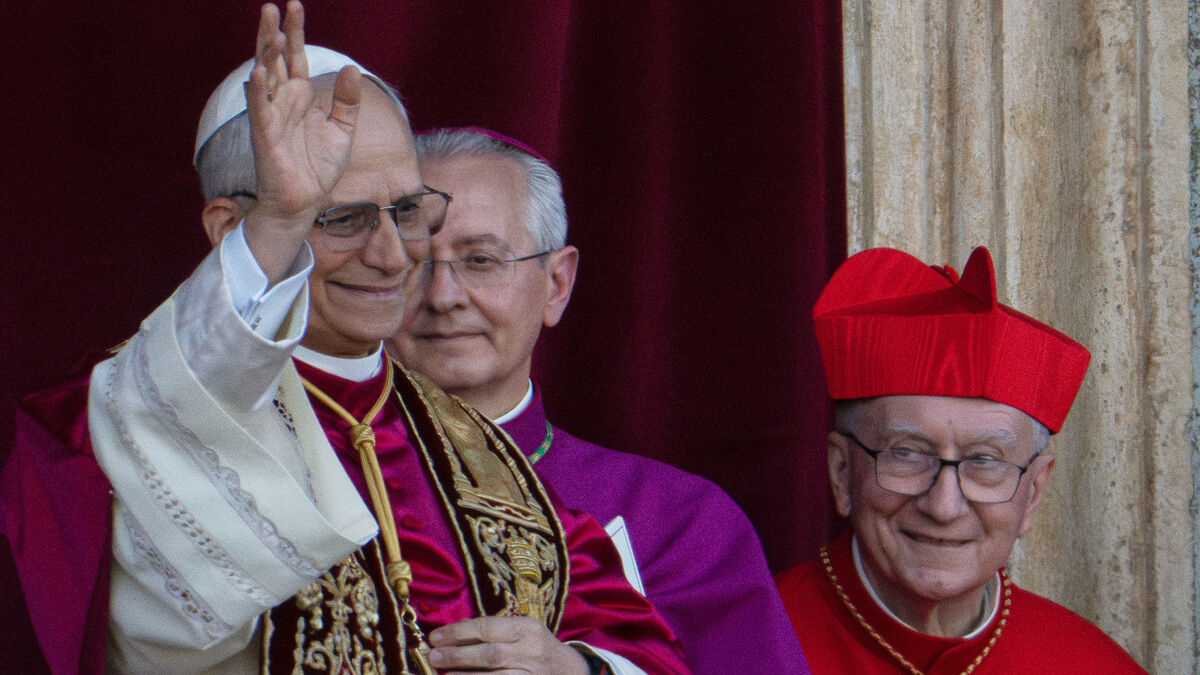
Newly elected Pope Leo XIV, left, formerly Cardinal Robert Francis Prevost, appears with, from left, Master of Ceremonies Archbishop Diego Giovanni Ravelli, and former Vatican Secretary of State Cardinal Pietro Parolin on the central loggia of St Peter's Basilica at the Vatican shortly after his election as the 267th pontiff of the Roman Catholic Church on Thursday, May 8, 2025. Picture: AP Photo/Domenico Stinellis
The election of a pope is one of the most secret elections in the Catholic Church. As the College of Cardinals gather into the Sistine Chapel surrounded by a plethora of terms and conditions, rafts of regulations around what to do and what not to do are ringing in their ears. Every possible effort is made to ensure that what is regarded as an exercise in finding out who God wants to be the next pope is shrouded in mystery and respect for the holy process. Anything and everything that can possibly be done to keep secret the most secret of electoral procedures is not left undone.
That said cardinals talk before and during and after a conclave. And while, during the election, information about how it’s progressing is impossible to decipher, once it’s over the cardinals spill the Vatican beans and all, or almost all, is revealed in forensic detail. The story of the conclave is then pieced together bit by bit and a year or so later, seasoned vaticanistas paint the full picture in a few usually best-selling books.
If you, dear reader, picture yourself in that role, anxious to get the full detail of how and why the votes mounted as they did in last year’s conclave that elected Pope Leo, then you need to get your hands on two books out this month: by Gerard O’Connell and Elisabetta Piqué and by Christopher Lamb. Alternatively, if you’d prefer an analytical guided tour of the gist of those two books you can read a stunning account by Austen Ivereigh in the March 7 issue of entitled . Or, if you want an even shorter account you will find it in the 600 or so words that make up the remainder of this column. So hold on to your hat!
We often accuse the Vatican - and by extension the Catholic Church - of being incapable of organising anything. But, in this instance, that’s not the case. It took the Anglican Church eleven months to elect Sarah Mullally as Archbishop of Canterbury – she will be formally installed this week – but the Catholic Church had a new pope done and dusted in three weeks and the last three conclaves were over in 48 hours!
The trick is what happens before the conclave in the discussions that build the beginning of a clear consensus. If the consensus is matched by the presence of an obvious candidate, what Ivereigh calls ‘the carousel of news, leaks and rumours’ begins to reveal ‘the mind of the Church’.
While the cardinals swear an oath ‘of absolute and perpetual secrecy’ before they enter the Sistine Chapel, and are faithful to not disclosing what happens behind closed doors, they’ll share the atmosphere, their feelings and what Ivereigh calls ‘some choice anecdotes’, for example like the moment Cardinal Prevost put his head in his hands when he knew he had been elected. The presumption of many is that the ballot tallies are part of the oath but some cardinals give themselves a moment of grace as they take the view that the tallies should be part of the historical record.
In March 2013, when Francis I was elected pope 115 cardinals voted with 77 votes needed for election. The 2013 election seemed to be a two-horse race between Cardinal Bergoglio (Francis) and Cardinal Scola of Madrid. But a later publication based on a revelation by a cardinal elector revealed that Cardinal Marc Quellet, from the Vatican Curia, was a third candidate in contention. However the election came down to a tussle between Bergoglio and Scola with Scola ahead on the first ballot 30/26, but Bergoglio consistently moving ahead in the later rounds by 45/38, 56/41, 67/32 and, in the final round, by 85/20.
In the last conclave in 2025, 133 cardinals were voting with 89 votes needed for election. For this ballot there were no exact votes shared afterwards by co-operating cardinals but the picture is clear in the two books (mentioned above). In the first vote, the three cardinals in contention – Pietro Parolin (Italy), Peter Erdo (Hungry) and Robert Prevost (American) – each scored between 20 to 30, with Erdo in a narrow lead. In the second ballot, Prevost moved into the lead, Parolin came second and Erdo, third. In the third vote, Parolin versus Prevost, Parolin picked up Erdo’s votes and Prevost held his. And in the fourth and final vote, Prevost swept past Parolin with 108 votes to 89.
Apart from the historic election of the first North American pope, the 2025 conclave was significant in that it was the second election in succession of a Latin Americann pope after two previous elections of two European popes – John Paul II (1978) and Benedict (2005). An interesting question is how did the centre of influence in the Catholic Church move from Europe to Latin (South) America in less than 50 years?
Two issues seem significant. One is that as the number of cardinals increased, the number of European cardinals (especially Italian) decreased. Two, the Church tired of the failure to introduce the reforms of the Second Vatican Council and in less than a generation decided to replace the old, rich, tired, drifting Church represented by John Paul and Benedict’s pontificates with a more reformist Church driven by a combination of European reformers and a Latin American focus on a pastoral Church of the poor. Though in 2025 Parolin was the favourite he wasn’t acceptable in that he wasn’t like Francis.
The hunger for change represented by the election of Francis and Leo has now placed the Latin American Church – described by Ivereigh as ‘a united body and brimming with joy and confidence’ – in the ascendant and, hopefully, powering the People’s Church with its focus on serving the poor for generations to come.