GAA report the latest alarm bell on rural depopulation
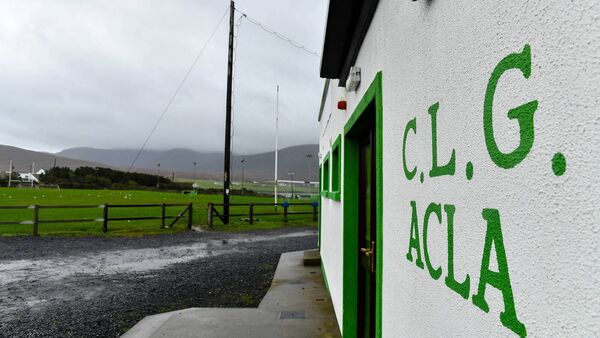
A general view of the clubhouse at Davitt Park, home of Achill GAA club, at Achill Sound. Picture: Brendan Moran/Sportsfile
News of the extent of the challenges faced by the GAA with rural depopulation won’t be news to a lot of gaels in Mayo. They are living the experience of it and have been for some time.
But the thorough and detailed GAA National Demographics Report is to be welcomed in the hope it will illuminate the extent of the problem to those outside of such struggling rural areas and, if we were to dream, that it might register with central government in this country and force meaningful action.
Politicians in the west have been active in highlighting many of the challenges but they often seem to lose a numbers game as a consequence of the patterns outlined in the report.
With an increasingly greater concentration of population on the east coast and, one must add, in Cork, home of the Taoiseach, the weight of that electorate and the political clout that such a numbers game ensures, has meant a vicious circle.
More and more people migrate from the west to the east of the country, meaning more and more money is thrown at infrastructure in the east and, particularly at the moment with Micheál Martin in the highest office in the land, in the south.
The west, as I outlined last week with the case of the Western Rail Corridor, has to fight like hell to get anything. And so more and more are forced to leave, exponentially increasing problems in the east coast around housing and general quality of life issues while the west remains neglected, almost as if, like the Lord of the Rings, the eye of Sauron, in Dublin, cannot scan this far.
The report is the latest in a long line of calls to arms on this issue. The fact that it is titled ‘No One Shouted Stop – Until Now’ is a tragic irony. It is a tribute to John Healy’s seminal book, , released all of 57 years ago.
Healy’s brilliant assessment of the slow dying of his hometown of Charlestown and many like it should have shaken the government of the day, every government since and the permanent government in the form of the high-ranking civil servants in various government departments into meaningful and significant action. Instead, Ireland has repeatedly taken a broadly laissez-faire approach to spatial strategy, regional development and economic growth and here we still are, shouting stop.
The result of that laissez-faire approach has been a hyper concentration of development, employment and population based around our capital city. We have one of the most centralised economies in the EU, i.e. centralised to the capital city.
Yet while the overall quality of life for people across the country has improved significantly since John Healy’s tour de force, the undeniable reality is that the level of progress in the west has been much slower and we have continued to bleed our brightest and best.
Chronic underspending by successive governments has perpetuated and accelerated the problems.
The data is there to prove it. The Northern and Western region (Connacht plus Donegal, Monaghan and Cavan) was regarded as a ‘lagging region’ by the EU in 2022 with a GDP of just 71% of the European average.
You would think that would accelerate the need for investment in the region, particularly infrastructure. But, you would be sorely mistaken. In terms of infrastructural development, the Northern and Western Region is ranked an alarming 218th out of 234 regions across Europe, the bottom 7%. Those are figures which cannot be denied and cut to the reality of the issue.
The impact has been clear to see at the grassroots of the GAA in Mayo and in the communities they serve. Over decades, many clubs have gone from thriving to struggling.
The Mayo All-Ireland winning teams of 1950 and ’51 had a much more rural bent to it. There were players from Lacken, Ballycastle, Killala, Kiltane and Carramore. All of those clubs are now part of amalgamations across the board or at underage and it is hard to see too many county players coming from there nowadays.
Lacken were in a Mayo senior club championship final in the 1980s and only Ballina had more representatives on the Mayo team in the 1989 All-Ireland final than the club based where Humbert landed in 1798. Now, they are part of a four-club amalgamation at underage and, at adult level with Kilfian, play under the Northern Gaels banner.
The report speaks of the need to preserve club identities where clubs are struggling but I am not sure they fully understand how important these identities are. Even though neither Lacken or Kilfian can field in their own right, forcing them into an official amalgamation would be a sad day for both and their own footprint and pride in the parish remains very important.
We have used schools figures to reveal the extent of the decline in certain areas as overall population figures can mask both an elderly population and immigration. So a decline in population might not be as obvious but the school figures reveal where things are heading.
The three schools in the parish of Kiltane recorded a staggering fall in numbers from 1994 to 2024, from 336 down to 112, exactly one-third of what they were in 1994. In Achill, the figures now compared to 40 years ago are almost as low as one-quarter. These patterns are repeated all along the west and north coasts of Mayo.
Areas around Castlebar and Westport and south Mayo towns like Claremorris and Ballinrobe have witnessed either an increase in school-going population or have remained constant which, with smaller families sizes, is a sign of a growth in of itself. Proximity to Galway and to employment in Castlebar and Westport have been big factors in this.
But the new GAA report reveals troubling figures across the county. They have examined the population of each county in the 0-5 cohort and Mayo has less than 2% of the full island cohort with 9,474 kids in that age group, according to the latest Census figures. Galway has over twice that. That should be a cause for alarm not just in rural areas but across the whole county.
Fundamentally, the report makes a lot of positive GAA-led suggestions but arguably does not go far enough in advocating for what needs to change at a macro level to reignite struggling rural communities and, on a broader level, struggling regions.
It hopefully will spark debate and create a greater awareness of the issues, but forgive those of us who are skeptical about the meaningful change required actually happening.