GAA paywalls are not the problem
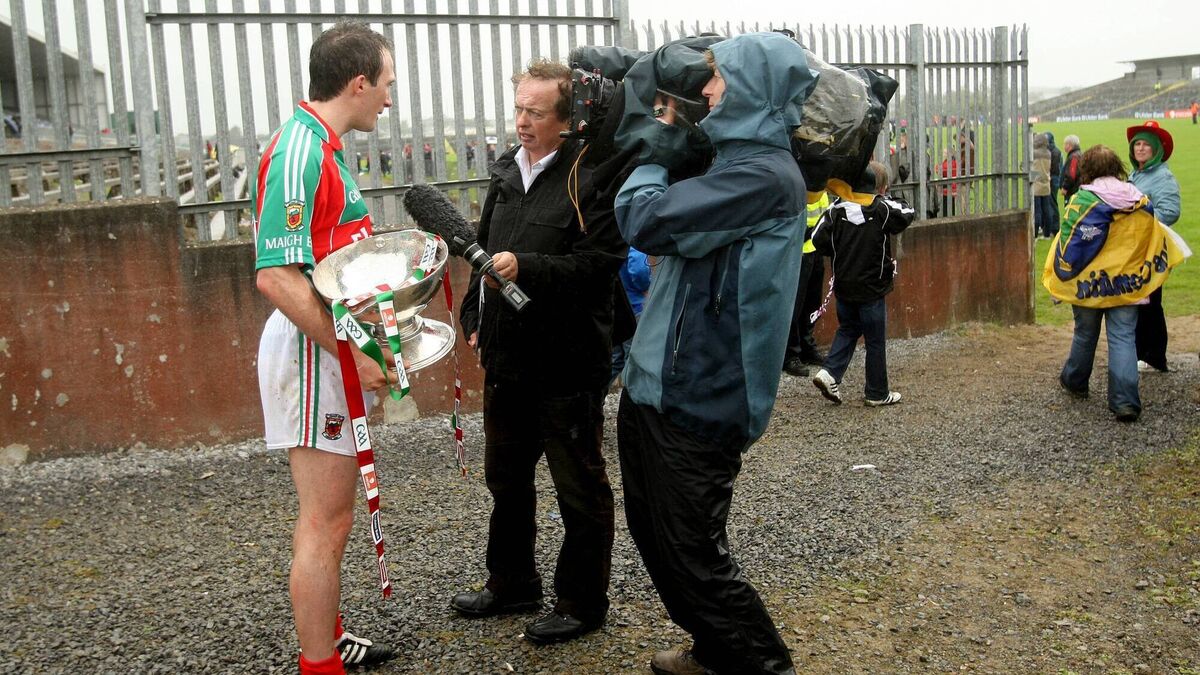
Mayo captain Alan Dillon speaks to RTÉ's Marty Morrissey after the Connacht Senior Football Final against Roscommon at Dr Hyde Park in 2011. Picture: INPHO/James Crombie
When Sky Sports got rights to broadcast Gaelic football and hurling games in 2014, there was outrage across the country about our games being sold down the river.
I wasn’t one of the outraged. There was a widely held belief that GAA games should always be free to air.
There were a few problems with this. There were simply more GAA games available for broadcast than RTÉ themselves could air.
TV3 came into the market to broadcast games in 2008 and while there was initial criticism of this, it was ultimately seen as more acceptable than Sky because TV3 were also free to air.
TV3 was the first line in the sand – and it meant more games than ever were broadcast for viewers. Going to Sky changed the game further – people had to pay to watch games for the first time.
There was a lot of complaining when certain big games were only available on Sky. But fundamentally the deal worked. More games were broadcast than ever before and Sky brought a level of production and analysis that greatly enhanced coverage. Crucially, there remained a balance. RTÉ still got a strong share of the marquee fixtures while Sky had enough attractive games to justify its investment.
However, now, we’ve seen things go too far in the other direction. After GAA GO, the joint venture between RTÉ and the GAA that replaced Sky in 2022, we now have GAA+.
The GAA GO arrangement was a real conflict of interest but now GAA+ is entirely run by the GAA. Instead of an even split, what we have seen in recent weeks is GAA+ getting first pick at games of a weekend and RTÉ having to make do with whatever is left over.
Any broadcaster like GAA+ or Sky Sports for that matter cannot expect to survive on a diet of Tailteann Cup games. A subscription service in particular needs attractive content.
The issue is not that. The issue is that GAA+ now appears to be getting not only first pick, but often the second and third most attractive fixtures as well.
Mayo benefitted from it the weekend before last. Of the four Round 1A games played, Mayo’s game with Monaghan was the only game RTÉ got. Dublin v Louth, Armagh v Derry and Westmeath v Cavan were on GAA+. The previous weekend the contrast was even starker. Kildare v Galway was comfortably the weakest of the four Round 1A games and that was the only one given to RTÉ. The box-office Kerry v Donegal clash was on GAA+ but so too was Cork v Meath and Roscommon v Tyrone, both of which were excellent games.
Those of us who have a GAA+ subscription were able to watch as many of the four games as we wanted but it is difficult to understand how RTÉ are content with this arrangement.
Their broadcast deal, which is set to last until the end of the 2027 season, suddenly looks much weaker. And the GAA have made a fundamental change. Instead of an auxiliary broadcaster merely helping to ensure more games are broadcast (like TV3, Sky Sports and GAA GO), the auxiliary broadcaster has been given an elevated position over terrestrial TV.
There has not been anything like the backlash that greeted Sky's arrival. Yet I find the current arrangement far more objectionable.
Selling rights to Sky Sports was seen by many as the GAA selling their soul but it was, for me, a pragmatic decision. Money was a part of it but the balance was kept on a decent line. It allowed more games to be broadcast. This current situation appears to be much more ruthless commercially and it raises an interesting question.
As far as many people are concerned, it was sacrilege that GAA games be put behind a paywall. Because the GAA is a community-based organisation, there is a feeling that commercial imperatives should not come into it.
But I don’t see much of a difference in principle from charging at the gates to asking people to pay for some of the games they view from the comfort of their sitting room.
Striking a good commercial deal for broadcast rights makes a lot of sense but the balance is important.
RTÉ is very different to any paywall whether it is Sky, GAA Go or GAA+. It is the shop window for the games. The diehard will gladly pay to watch Westmeath v Cavan followed by Armagh v Derry and the ‘do not disturb’ sign will likely be up on the sitting room door.
But there is a very important audience in the casual supporter who turns on the TV on a Sunday afternoon because a game they would like to see is on.
This person does not buy subscriptions. If the biggest games increasingly disappear behind a paywall, there is a massive risk for the GAA that they only talk to people who already care deeply about it. They leave the majority of the audience that would watch the same game on RTÉ behind and the prestige and profile of the games greatly diminish.
While the GAA may be able to make more money on 40,000 watching on GAA+ than whatever they get from a broadcast deal for a game watched by 400,000 on RTÉ, there has to be a value attached to eyeballs on games for the growth of the game. The GAA is not the Premier League. It cannot assume a market and demand for its games.
If only one game out of four is on RTÉ on a weekend and that game is the weakest of the four, then the exposure the GAA receives falls considerably.
Paywalls are here to stay and, when properly used, are certainly a net positive for the games. However, if the GAA continues to chase subscription revenue above and beyond the reach of the wider population, then that reach will inevitably diminish. The balance that existed in the Sky era was not perfect for everyone but it was much closer to the right one than what we are seeing now.