GAA in danger of killing the golden goose
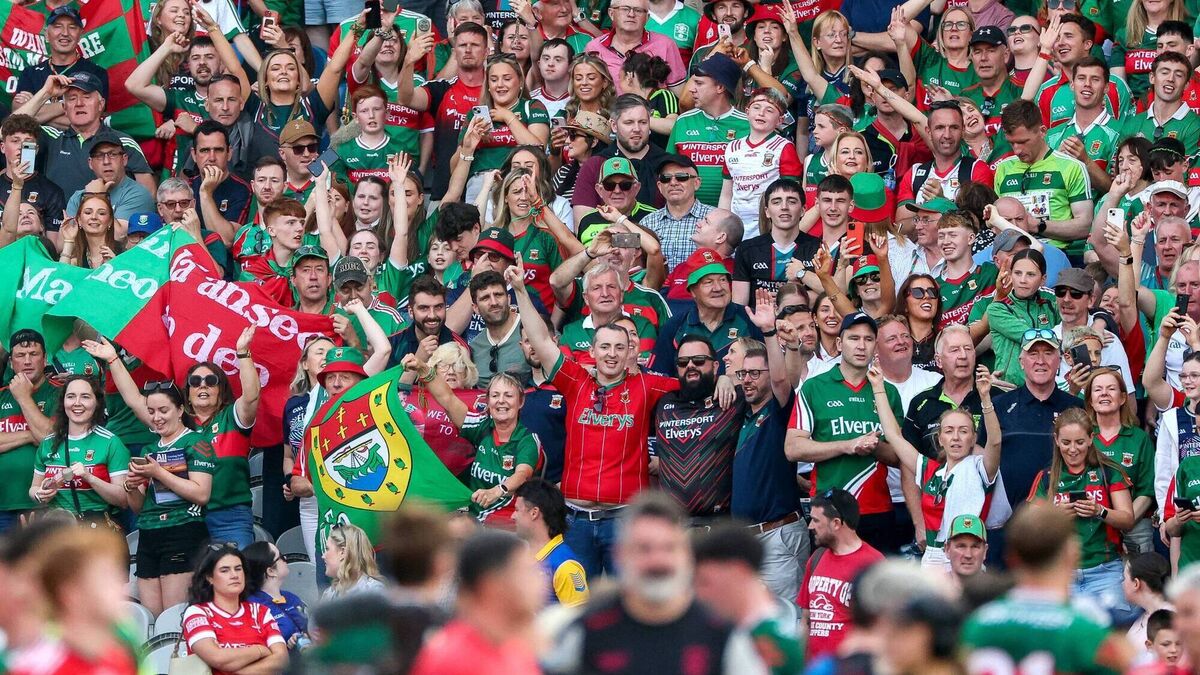
Mayo fans celebrate after their county defeated Louth in the GAA All-Ireland Senior Football Championship Semi-Final at Croke Park on Saturday, July 11th. Picture: INPHO/James Crombie
If you’re wondering how to measure the performance of the main sporting associations in Ireland, two outstanding recent successes would immediately suggest that the highest accolade should be awarded to the GAA. One, due to the dramatic success of its imaginative revision of the rules of Gaelic football in a root and branch refinement, which (extraordinarily) has received almost universal approval; and two, the financial success of the All-Ireland football semi-finals, each of which on successive days attracted capacity attendances of 82,000-plus spectators - in two days a joint total of 164,000-plus fans paying €60 a ticket generated an estimated income of almost €10 million. On every possible metric, it seems that the GAA is widely regarded as an outstanding success.
Not really. In the 2026 Ireland Reputations Index, a reputable and credible authority which measures how the Irish public views the country’s largest and most influential organisations, the three main Irish sporting associations were listed as follows: the IRFU (Irish Rugby Football Association) in second place overall; the GAA (Gaelic Athletic Association) in 18th position; and the FAI (Football Association of Ireland) at 66th.
While the Irish sporting public is embedded in GAA affairs, underlying problems that have over the years elicited noted criticism are illustrated by the popular use of the GAA alias of ‘Grab All Association’. During the present season's championship two factors have exacerbated that pointed criticism of the GAA. One was the unreasonable admission charge of €32 for every child accompanying their parents into the stand at the Connacht championship semi-final match between Mayo and Roscommon in MacHale Park, Castlebar; and the other is the GAA+ (pay to view television coverage) which for obvious reasons effectively removes accessible television coverage from the elderly and those who are not tech savvy.
While both of the above might make good business sense, they illustrate an obvious PR deficit. Even though the GAA+ fiasco might well represent a convenient milking of a ‘cash cow’ it is, in its implications, effectively rubbishing the invaluable contributions of generations of faithful GAA supporters whose achievements for the association are being officially consigned to the dustbin of history - a dangerous precedent that will not be lost on those who now effectively sustain the GAA through their voluntary unpaid input.
At a time of widespread cost-of-living worries for families and of fear of the elderly being removed out of sight and out of mind both decisions ring loud bells for associations that place undue focus on market-driven thinking or ‘commercial bean-counting’, as it is now called, to the exclusion of fundamental respect for all involved, a less tangible but ultimately more important consideration.
Now Mayo, after a thrilling ending of an unimpressive championship campaign – that no one foresaw except possibly the Mayo manager, Andy Moran, who may have dreamt it – has brought a roller-coaster season to a satisfying conclusion. It was a stunning transition from plumbing the depths of despair in Dr Hyde Park on April 26 last when Roscommon outscored them in the second half by 1-17 to 0-7, with Mayo eventually losing by ten points, to the triumphs of the latter stages of the championship when by comparison what seemed a completely different Mayo team exhibited performances of such grace and purpose.
Suddenly, as another Mayo team makes it all the way to another All-Ireland final in Croke Park, the experts who all failed to predict the advent of this latest sporting phenomenon are now pondering the possibility that in this strange year, 2026, might begin another extended Mayo season with multiple opportunities for at last achieving the unmentionable Holy Grail of a fourth All-Ireland title after God knows how many years.
As some of my loyal readers may remember, I’ve argued before in this space that, in view of the narrow margins of Mayo’s successive defeats, when by common consent the greatest county football team not to win an All-Ireland delivered for Mayo supporters season after season, I suggested that I wouldn’t swap the excitement of that memorable decade of Mayo football for Mayo winning one All-Ireland. My musings were dismissed as at best trying to write straight with crooked lines.
But while part of the attraction of any sporting occasion is the sweet taste of victory – in anticipation if not in reality which participants and supporters (including Mayo supporters) naturally are keen to enjoy – I worried that the compelling almost insatiable need to win, can damage the real enjoyment of sport. I worry particularly that the essence of sport for children is being compromised because sport has become infected with that winning-at-all-costs virus. Fair play, winning with grace, losing with dignity seem more likely part of a lost legacy in sport today.
Once sport wasn’t just about winning or even just participating but about building character and learning what it means to become a team player and how much real satisfaction depends on including everyone.
That’s why this Sunday is such a golden opportunity for Mayo to win again the elusive prize of becoming All Ireland Champions after 75 years. And if this is not to be that we show our best selves to the world, enriched by the joy of experiencing the glorious expedition that Andy Moran and his team have brought us all on – an astonishing and exhilarating journey that we would have snatched at in the early days of 2026.
.