Forget those crazy exercise regimes and just enjoy life

January usually arrives in the west of Ireland like an uninvited spinster aunt, cold, judgmental, and determined to make you feel terrible about yourself. The sleet-laden wind comes at you sideways off the Atlantic, the kind that doesn't so much blow as assault, and somewhere between the third and fourth Quality Street, you catch your ageing reflection in the kitchen window and think a corset might be a good idea for New Year's.
This is how the annual ritual of self-loathing begins, which the fitness industry has monetised with efficient glee. Everywhere you look in the media, there are these gleaming specimens of humanity, telling you that transformation is just twelve weeks and several hundred euros away.
Being a man of a certain age, let's say the age where the barber automatically trims your ear hair, I thought I'd give it a try. Not the full conversion, you understand. I wasn't about to join a gym and subject myself to the fluorescent horror of grown men grunting at mirrors. No, I'd be clever about it in a strategic manner. I'd find something gentle, something ancient and wise, and Tai Chi, I decided, was perfect.
Have you seen those videos? Impossibly serene Chinese people in parks at dawn, moving through forms with the liquid grace of calligraphy being written in the air. It looks like yoga, but vertical, a hybrid of meditation, but mobile. This is a civilised exercise, I mused, where the indignity of Lycra can be avoided.
So I downloaded an app on a whim and dutifully set the phone on the mantelpiece and immediately encountered the first problem. I'd set aside my glasses because wearing them felt somehow incongruous, like wearing leather brogues to gym class. I squinted at a tiny, blurry figure dressed in what looked like loose-fitting black pajamas, possibly warming up to assassinate the viewer while waving methodically with oriental poise.
The voice emerging from my iPhone was enticing, so calm, female, vaguely Californian despite the Chinese pedigree. She recommended that I root down through my tailbone and soften my already softened gaze. My gaze was so soft it was practically liquid. Was that my left leg, or had the furniture moved? The postures had wonderful names, White Crane Spreads Its Wings, Grasping the Sparrow's Tail, but mostly what I was grasping was the furniture, and what was spreading was my sense of ridiculousness.
The phone kept going dark as I'd forgotten to disable the timeout, so every ninety seconds I had to lunge forward like a man catching a bus he doesn't really want to catch, tap the screen with a finger, then shuffle back to my spot. This, I’m fairly sure, was not part of the ancient Chinese tradition. On the third session - and I use the term loosely - I attempted something called Parting the Wild Horse's Mane and instead parted company with a side table, sending three generations of family photographs clattering to the floor in what can only be described as catastrophically un-Zen.
Right, I thought. Different tack entirely.
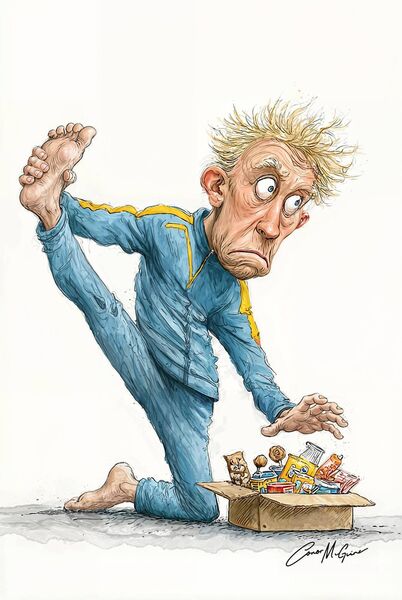
Chair workouts for seniors came up on YouTube. Now, technically, I'm not a senior, but I'm close enough that I qualify for certain Tesco discounts if I don't shave for a few days and look appropriately beleaguered. The appeal was obvious: you never leave the chair. Given the Irish climate and my natural disposition, this seemed almost too perfect.
The instructor was American, inevitably. Americans have cornered the market on fitness enthusiasm, just as the Germans have on engineering precision. This woman had teeth that could signal aircraft, and the kind of manic energy that made you exhausted just by witnessing it.
I was using tins of beans, Heinz beans, if you're interested. Not because I'm poor, you understand, but because buying actual weights seemed like a commitment I wasn't prepared to make. What if this didn't work out? Then I'd have two or three 3-kilo dumbbells gathering dust next to the rowing machine we bought in 2003, now primarily used as a place to throw old coats.
"Feel that BURN!" she commanded from the laptop screen. I felt many things, foolishness for one, a slight twinge in my left elbow, powerful urge to get up and make tea, but burn wasn't featuring prominently.
I stuck with the programme just short of a week, days of sitting down and lifting things while a woman who'd clearly never met a carbohydrate she couldn't decline shrieked encouragement. At the end, all I had for my efforts was a renewed appreciation for sitting down without having to lift another can of beans.
Then, in my wisdom, I tried speed walking, which seemed perfectly reasonable as there was no equipment, no apps, and no evangelical Americans instructing my every move. Just me and the road and the simple act of walking with forced urgency. Except I looked demented because speed walking isn't walking, not as normal humans do it. It's that studied but peculiar, demented gait that makes you look like you're late for a meeting while simultaneously needing a toilet. Your arms pump with martial intensity, your hips sway and everyone you pass stifles a grin or looks genuinely concerned for your welfare.
I did it twice before accepting defeat.
Having meandered to no avail through the fitness industrial complex like a blind goat through a greenhouse, I've arrived at something approaching sense. Sod the programmes and the routines, I'm just going to walk, not like I'm being chased or desperately searching for a lavatory, just walking at a pace that acknowledges I'm fifty-something and have no particular reason to hurry, so strolls and ambles are the order of the day, the kind of walking that doesn't require special shoes or permission from your core muscles or improved glutes.
And I’m back to swimming, the occasional dip at the local pool. Not proper swimming - not lengths in the sense that competitive people mean it. Just a gentle breaststroke up and down the slow lane, moving through the water with all the urgency of kelp. The real attraction is the view through the glass partition into the gym upstairs as people hurl themselves at machines with desperate intensity. The treadmills turn and turn while the rowing machines go nowhere as everyone grimaces at screens showing some rolling meadow. I must admit I find it oddly mesmerising, as if I'm privy to watching an aquarium of the damned.
Eventually, I abandon even the pretense of exercise and settle into the embrace of the Jacuzzi, which is where I truly belong. Horizontal yet delightfully buoyant, gently poaching like an egg while the jets make encouraging gurgling noises.
The gym people occasionally shoot me furtive glances, these lean, Lycra-wrapped specimens with their water flasks and protein powders, and I can see the dark judgment in their eyes... or is it envy? I settle into my bubbles and realise, from where I'm floating, they're the ones who look decidedly absurd.
There is something that middle age teaches you if you're paying attention. Most of what we're sold as necessary to maintain optimum health and fitness is just expensive noise. Your body doesn't need to be punished or forced into unnatural movements by people half your age; it just needs to move and to be occasionally outside. To feel the weather and see things, not because some app has decided you need to burn calories before lunch, while paying for the privilege.
I know the fitness evangelists won't approve, but I'll still be shuffling along the Mayo coast road, time and hour forgotten, stopping unpredictably to look at the wild flowers, moving at the speed of actual life rather than trying to outrun it.
Turns out the secret to fitness at fifty-something isn't finding the right programme. It's giving yourself permission to stop looking.