Echoes of Irish history in ICE's cold killing
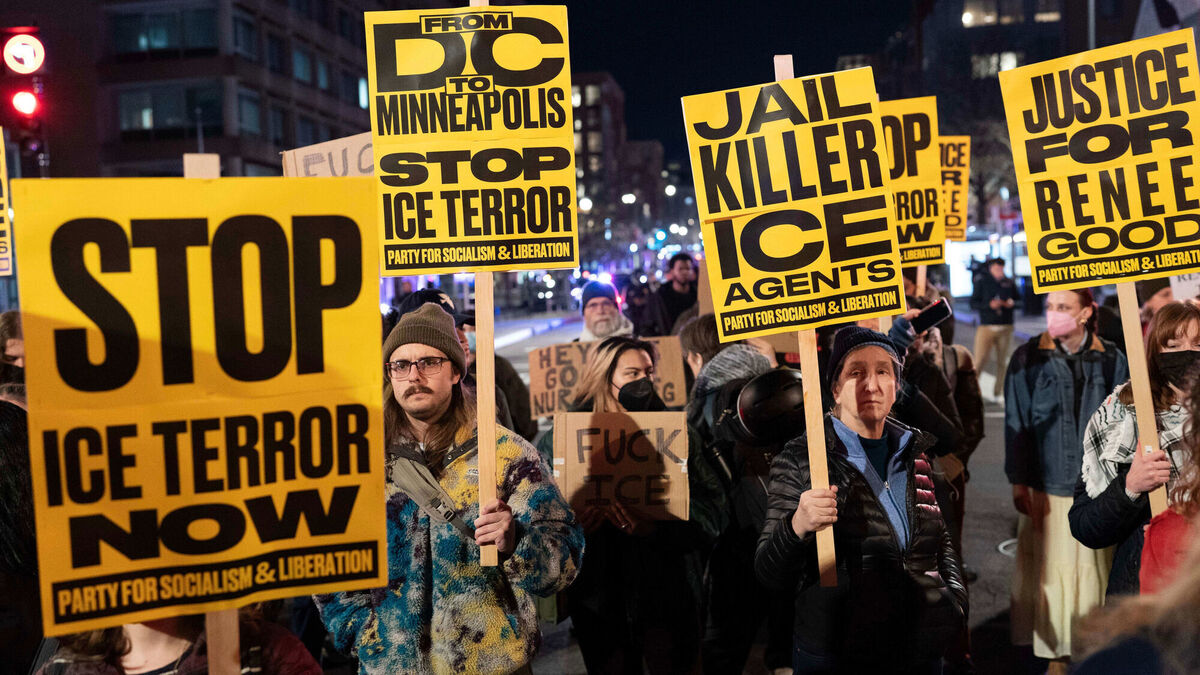
Demonstrators march to the White House in Washington as they protest against the Immigration and Customs Enforcement (ICE) agent who fatally shot Renee Nicole Good in Minneapolis earlier this month. Picture: AP Photo/Jose Luis Magana
When unpopular law enforcement turns lethal, history doesn’t shock.
It shrugs.
Officer Rowland Davis was circumspect about why he left his position and fled his home following a large protest against his agency’s attempt to seize a popular local man. Davis told his superiors that he “was obliged to abscond on account of a woman being killed in the same riot”, but neglected to mention that it was he who had actually shot Mary Jenkins when the protest suddenly and fatally escalated. Army Sergeant George Harkness confirmed he ‘brought him off from a numerous mob who attempted to take away his life’ as the military beat a retreat from the furious crowd.
At first glance, this incident feels very contemporary - a symptom of our uniquely febrile political moment in the United States.
Yet it is separated by from us by thousands of miles and 275 years.
Officer Davis was not on duty during the ICE protest in Minneapolis city, Minnesota, during January 2026.
But during April 1751, in rural Dromahair in Co Leitrim.
Same scene. An enforcement operation carried out by the state, angrily opposed by a vitalised crowd. A protesting woman shot and killed.
Both deaths followed protests against raids by government agents widely regarded as unjust. Both involved officers backed by armed force. In both cases, a moment of confrontation escalated suddenly, violently, and fatally. And in both, a woman who was not the original target of enforcement ended up dead.
On January 7, 2026, in Minneapolis, Renee Nicole Good, a 37-year-old US citizen and mother of three, was shot and killed by an officer of US Immigration and Customs Enforcement during a federal enforcement operation.
Good was driving in a residential neighbourhood when federal agents confronted her and others nearby. Video footage and eyewitness accounts show her vehicle moving away from the scene when a single ICE officer fired multiple shots into the driver’s side, killing her. The officer, Jonathan Ross, a veteran agent with nearly two decades of service, later claimed he acted in self-defence, alleging the vehicle posed a threat.
That account was immediately disputed. Video evidence suggested the shots were fired as the car was turning away. Protests erupted in Minneapolis and across the country. The FBI assumed control of the investigation. Lawyers were hired. Statements were issued. The machinery of the state shifted quickly from enforcement to damage control.
Within days, the violence spread. In Portland, ICE and border patrol officers were attacked during further immigration operations. A man was shot and wounded by federal agents during a traffic stop and later charged with assaulting an officer. The cycle tightened: enforcement, protest, escalation, injury.
In late April 1751, excise officer Rowland Davis, accompanied by a detachment of the army, attempted to arrest a man convicted of illicit brewing in the Dromahair area of Co Leitrim.
Local residents gathered to resist the arrest. During what officials called an “assault and rescue,” Davis used lethal force, killing a woman named Mary Jenkins. While disturbances linked to excise enforcement were common in the west of Ireland at the time, fatalities were rare. Jenkins’ killing was the moment everything changed.
The crowd erupted. Soldiers and the excise officer were chased as they retreated. Davis later claimed he was forced to flee because locals attempted to seize and kill him. Military reports confirm he was extracted under threat.
In the aftermath, the familiar process began. Officers petitioned for medical expenses and legal costs. Despite initial institutional backing, Davis was later accused of acting illegally. He was tried at the Summer Assizes of 1751 on a charge of murder and formally indicted the following year. Reduced to last resorts, revenue officials sought a royal pardon on his behalf. The record does not tell us whether it worked.
What links these two deaths is not politics or ideology, but human behaviour under orders, under protest, under pressure.
Crowds protest laws they believe are unjust. Officials enforce laws they did not write. Armed authority arrives to impose order and instead sharpens fear. A single officer overreacts in a moment of stress. A woman dies. The crowd radicalises. The state closes ranks.
What is perhaps most striking is what happens when the justice system turns its attention back on the enforcers themselves. In 1751, despite panic and institutional self-protection, Rowland Davis was not simply exonerated; he was tried for the murder of Mary Jenkins, formally indicted, and ultimately reduced to pleading for mercy to the highest authority available - the King’s pardon from George II - as his fellow officials scrambled to shield him. Will the FBI’s investigation of Officer Ross follow the same path?
President Donald Trump, whose administration has driven ICE’s immigration surge, has defended federal agents’ actions and described the Minneapolis shooting as “sad to see on both sides", while stopping short of committing to whether he would pardon an ICE agent if convicted, choosing instead to let legal proceedings play out before weighing intervention. Trump’s broader posture has been to justify aggressive immigration enforcement while making clear that, whatever the outcome in court, the ultimate authority now rests in the executive’s hands, just as it once did with a king.
In Ireland, neither the protests nor the Revenue raids stopped after 1751. There would be many more unfortunate killings like Mary Jenkins’ into the 19th century. Poitín - the very thing those raids sought to crush - was not legalised until 1997, long after resistance had burned itself out.
America now faces a similar question. Will protests against immigration enforcement fade quietly, or will they continue to generate the same escalations, injuries and deaths that history tells us follow when authority hardens and patience runs out?
History does not repeat itself exactly.
But when the state reaches for force to enforce an unpopular law, it has an old habit of rehearsing familiar actions in the red hot febrile atmosphere of resistance, provocation and escalation.
History echoes - sometimes with the cold sound of gunfire.
Ice Cold Killing.