Church must reconnect with growing cohort
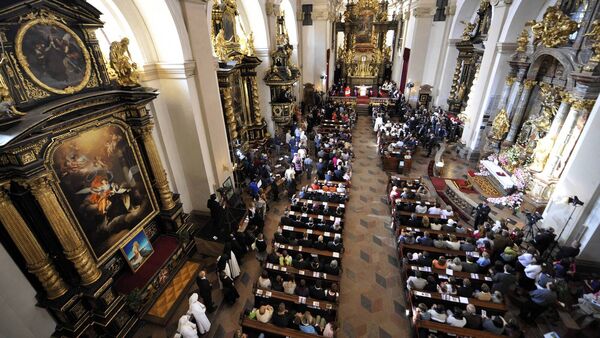
A general view of Our Lady Victorious Cathedral in Prague, as Pope Benedict XVI sits on the throne in front of the main altar on September 26, 2009 during the then pontiff's first public appearance in the Czech capital. Picture: Attila Kisbenedek/AFP via Getty Images
Around the time I was ordained in 1973 a major survey on religious practice in Ireland was published. Its main finding was that over 90% of Irish Catholics attended Mass every Sunday. (At the time there was no Saturday vigil Mass). Incredibly, some commentators were disappointed at ‘the decline’ in numbers compared to 1961 when almost 95% had identified as Catholics in the Irish Census.
After ordination I was appointed a curate in Keenagh in Crossmolina parish and, Ben McLoughlin, the most benign of parish priests, gave me responsibility for two churches: Keenagh and Eskeragh.
Every Sunday I said Mass in both churches and occasionally covered Mass in Crossmolina. At the time, almost invariably, all Masses were packed, often with people standing at the back. Now, almost invariably, only Masses at Christmas produce ‘a full house’.
At the time, apart from the very elderly and those who were ill, it was taken for granted that every Catholic in Ireland was at Mass every Sunday – and those who weren’t were rounded up every few years by a Redemptorist at the parish mission. The only comparison with the past is that even though with churches half full or quarter full or even sometimes almost empty, there are still a few standing at the back – keeping alive an ancient tradition!
At that time, there were four priests in Crossmolina parish – even though in comparison with workloads on priests today, it was then ‘easy lifting’. Sometimes I wonder how the four of us found something to do. Now there are just two priests, both in their 70s but, wise men that they are, they’re happy to facilitate the talents of their parishioners by sponsoring a number of ‘lay-led’ ministries, including lay Funeral Ministers for funerals and lay-led liturgies.
What we didn’t advert to in the past was that, as attendance at Mass was then ‘a command performance’ – with no less than a mortal sin attached to it (or so we were told) – so our Sunday congregations were not just for the devout (and other Catholics) but atheists, agnostics and those otherwise unaffiliated – or (those with no religion) the ‘Nones’ as they came to be categorised.
In the 2022 Census, the number of Catholics in Ireland registered at 69% – the lowest recorded in an Irish Census with 14% of the population recording themselves as irreligious or ‘Nones’ up from 0.1% of Nones in 1961 – the second largest category after Catholics.
Clearly the ‘Nones’, a remarkable phenomenon that has led to sociologists giving them that collective label, are now a declared and ever-increasing constituent of the Irish population - most of whom, in the past, religiously or irreligiously, attended Mass with a complement of atheists, agnostics and others giving the impression that their attendance was voluntary rather than pressured by the social expectation that everyone, apart from Protestants, had to be Catholics! It must have been a strange and lonely obligation that many Nones reluctantly and unreasonably felt obliged to fulfil every Sunday.
According to the Catholic theologian, Tomas Halik, in , Nones are now after Catholics the third largest group on the planet today and they represent an extraordinarily diverse range of non-religious ‘beliefs’. In the Czech Republic, the Nones strongly outnumber those who subscribe to various churches and various religions but Halik, a Czech himself, writes that it would be a mistake to regard them as either agnostic or atheist. Halik suggests that it is better to regard Nones as simply ‘dechurched'.
There’s an important truth in that distinction. In the Czech Republic, as in Ireland, there is a significant constituency of the ‘unchurched’: apatheists (those indifferent to religion); agnostics (those unsure if they believe); those religiously illiterate (absence of even elementary religious knowledge); anti-clericals (those with an allergy to priests and church); and a variety of substitute spiritual beliefs including a search for belonging.
I think this has lessons for us. Nones don’t always ‘leave the Church’ and even when they do it’s because they tend to look for forms of spirituality not on offer from the Church. What has driven them away from Catholicism is not just our inability to respond to their needs but the scandal of recent sexual abuses cases that was the last straw even for those who fell into the category of ‘belonging without believing’.
In the past those who became alienated from Catholicism usually joined another Christian denomination but now they seem more content to become Nones – still believers but with no church affiliation. They want to distance themselves from churches which they regard as having lost credibility and their disillusionment with churches is based on a felt need for a spirituality that they sense is beyond their former church to provide. Yet the longing remains. (It’s why some Nones continue to cite Christianity as their religion in surveys and in censuses.)
What confirms for Nones the wisdom of breaking the connection with church is the way churches depend on proselytism and mission – in Halik’s words, ‘to squeeze Nones into existing church boundaries rather than freeing them up to other possibilities’. The obvious example is young people who despair of the church’s ability to recognise or respond to their needs or respect their wishes and resent the effort ‘to get then back to Mass’ instead of listening to them and loosening up to allowing their spiritual needs to be heard.
Charles Taylor, in , has shown that in many instances Gospel ideas only become part of our culture when the Church has lost its power and influence. Tomas Halik reminds us that on the eve of his election as pope, Francis I quoted Jesus’s words, ‘I stand at the door and knock’ and Francis added that today Jesus knocks from within the Church and wants to go out, especially to the poor, marginalised and wounded of our world. As the young would surely agree - ‘it seems the way to go’.