Catholic Church must embrace female equality
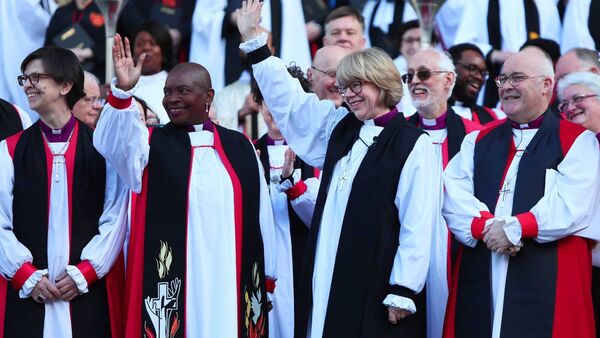
The new Archbishop of Canterbury Sarah Mullally waves to wellwishers outside St Paul's Cathedral in London after her confirmation on January 28 last. Picture: Alishia Abodunde/Getty Images
Before calling the Second Vatican Council (1962-65), Pope John XXIII warmly welcomed the then Archbishop of Canterbury Michael Ramsey, head of the Anglican Church, on a visit to the Vatican. After the Second Vatican Council, Pope Paul VI warmly welcomed Archbishop Ramsey again, as a new and historic relationship between the two denominations seemed possible – after centuries of unease, distrust and sometimes enmity of one another.
Such then was the confident hope of a new religious dawn that the two Churches sponsored an official study by theologians of outstanding difficult issues between them.
Established in 1969, ARCIC as it was called - the Anglican Roman Catholic International Commission – sought to make ecumenical progress between the two churches over a number of years. However, despite finding an extraordinary level of convergence between the Churches, when the Church of England ordained the first women to the priesthood in 1994, the Catholic Church in something approaching a panic took to the hills.
The possible alignment if not eventual unity of the two churches perished on the vine as formerly contentious issues like transubstantiation and papal infallibility seemed less important than the ability to stomach the ordination of women. Further issues included the decision of the Catholic Church, under Benedict XV, to extend an official welcome to Protestant clergy discommoded by the ordination of women in the Church of England.
Life moves on. Progress rarely involves waiting for others to catch up. So once women were ordained in the Church of England, it was inevitable that in time some would be ordained as bishops. So inevitably too some male Anglican clergy in the Church of England who to avoid the nightmare of women priests escaped what they regarded as a fate worse than death. They absconded to the ambivalent embrace of Catholicism and fought a series of defensive campaigns against women’s ordination in order to avoid like the plague what they regarded as an intolerable intrusion into their lives. It goes too without saying that those working towards the ordination of women in the Catholic Church were unimpressed by Pope Benedict’s decision to welcome significant numbers of apparently closet clerical misogynists.
Inevitably too, as there is no impediment to promotion for women priests (and bishops) in Anglicanism, it was only a matter of time until women priests would ambition a role in the leadership of their church, including the top position of Archbishop of Canterbury. That took some years to happen, and it just has, as in this coming March, Sarah Mullaney, formerly Bishop of London, will be enthroned (installed, I suspect, is a more modest description) as archbishop. As a result, priests and bishops in both the Anglican and Catholic worlds and in both churches are suitably over-joyed or appalled to a greater or lesser degree.
Interestingly, whatever relationship develops now between Archbishop Sarah and Pope Leo will be instructive. Last October in Rome as part of a worldwide meeting of synodal teams, I witnessed a dialogue between Leo and an Austrian female theologian, Klara-Antonia Csiszar. The latter raised the issue of women in the Church and in particular the issue of the women diaconate – what has become a litmus test indicator of minimal Catholic movement on a long journey ahead.
Leo’s response placed a focus on cultural resistance to change and the need to respect the pace of change possible in different parts of the world. But, whereas Klara-Antonia was optimistic and comfortable in her forensic analysis of the options available in terms of responding to the glaring needs around the role of women and the pastoral and other dividends that would accrue to the Church if such was given a fair wind, Leo’s response though gracious and respectful lacked credibility.
Like a rugby full-back desperately clearing his lines as a battalion of opposing players descended on him, Leo kicked for touch. At a time when the role of women in the Church is the most obvious and most important challenge facing Catholicism, suggesting the need for further study or defending (for what look like increasingly specious reasons) a go-slow policy of closing down expectations instead of opening up avenues of possibility is simply not credible anymore.
The overall sense was that Klara-Antonia was explaining what was possible while Leo was left searching for credible reasons why so little was possible even when so much is generally perceived as necessary. In a session where a number of experts in different areas questioned Leo, his responses were not clear and credible. But he knows what way the wind is blowing and he knows too that failure to respond to the inevitability of necessary change is increasingly compromising the future of the Catholic Church.
But while, in the words of Jesuit theologian, Gerry O’Hanlon, writing recently in the (February, 2026), Leo is right ‘to name cultural resistance and the different pace of change in various parts of the world, as Church we need to take responsibility for our own role in this culture: why are we laggards in the matter of female equality, as we once were in climate chance?’ O’Hanlon concludes: ‘The Irish Catholic Church has an opportunity to give leadership here’. And, I would add, not just an opportunity but a responsibility as well.
In a world that has generally got over a cultural diminishment of women and that names with ease and purpose the fading evidence of institutional misogyny, the Catholic Church seems peculiarly reticent about the damage it is doing to itself by not embracing female equality – in O’Hanlon’s words, by effectively ‘reinforcing a culture of inequality as in the all-male liturgical celebrations of the death of Pope Francis and the inauguration of Pope Leo.
There are interesting opportunities ahead for endorsing female equality – the Irish Synodal Assembly in October, the next Synod in Rome in 2028 and not least the first historic meeting between the Pope and the first woman Archbishop of Canterbury.
That said, it will take time, I suspect, for an even more historic meeting to emerge between two women holding those respective positions.