Catholic Church change comes dropping slow
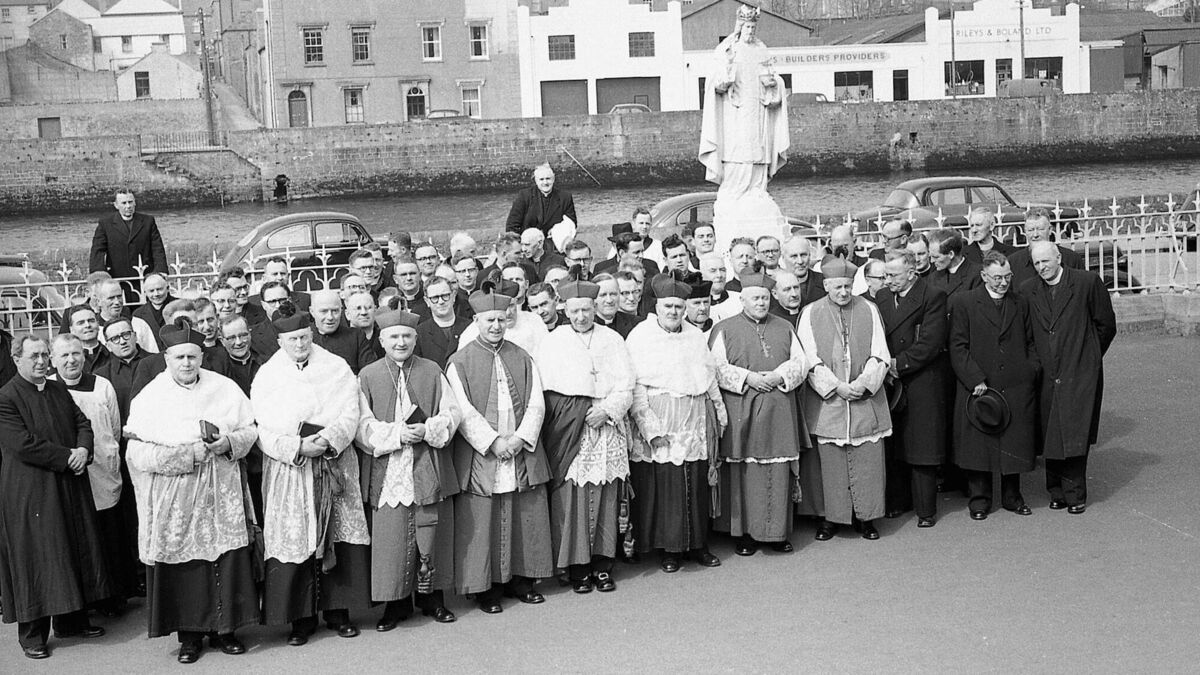
Priests and bishops pictured near St Muredach's Cathedral, Ballina at the Christus Rex in 1958. Picture: Western People Archives
Since the awkward amalgamation of Galway and Clonfert dioceses in February 2022, a different strategy has been adopted by the Catholic Church - a ‘merging’ rather than an ‘amalgamation’. The policy has progressed, albeit at caterpillar-pace - Achonry and Elphin, Killala and Tuam and soon Ossory and Ferns - with an ecclesiastical version of ‘the sword of Damocles’ hanging sometimes alarmingly over a number of dioceses and their present occupants. While priests worry about having to add another parish or two or more to their ever-increasing responsibilities, for bishops adding another diocese (and soon possibly another) seems a fate beyond reason.
Nonetheless clerical rumours abound with the southern dioceses of Cork, Kerry, Cloyne, Cashel and Waterford already mentioned in dispatches and northern dioceses – Raphoe, Derry, Down & Connor and Raphoe – in the mix as well, but claiming (as northern Catholics usually do) special exemptions. With a working target of 200,000 Catholics as an ideal size for a diocese, the calculators are out in the Nunciature on the Navan Road and in the appropriate Vatican dicastery in Rome.
It’s an unenviable task as the idiosyncratic diocesan boundaries drawn over 900 years ago make little sense now and are (I suspect) impervious to sensible merging as the spectre of synodality hangs accusingly on any process that fails to meet the new spirit level of satisfactory consultation.
A question that no one wants to answer is: when will the merging be completed? As with almost every Vatican policy, this carries an ‘It depends’ warning which, effectively, means that specific timelines are never agreed so it could go on almost forever.
Indications so far, for example in Killala, are that, even with significantly less consultation than that envisaged along the future synodal pathway, how long a merging takes is equivalent to the proverbial ‘piece of string’. (Like WB Yeats’ sacrifice, too long a merging can make a stone of the heart.) Indeed it doesn’t seem inconceivable that, as statistics go, at least half of the priests of Ireland will have gone to God before this particular file is closed.
Almost two years ago, Archbishop Francis Duffy of Tuam, after a brisk unsynodal consultation, was appointed Apostolic Administrator of Killala and plans were set in train for the next stage of the process of the Killala-Tuam merger - his installation as bishop of Killala.
A further stage will be the legal dissolution of the diocesan entities previously known as ‘Killala’ and ‘Tuam’ and their replacement with a completely new legal entity comprising one diocese, as yet unnamed. It seems that the installation stage will take place within the next few months but there is no specific timescale agreed on the completion of the final stage - part of the necessary delivery of which will involve the legal transfer of all properties of the former dioceses into the new diocese. (Yes, I know, shades of the new Children’s Hospital timescale. Or Dev promising to drain the Shannon.) Meanwhile, Killala diocese is preparing for the future with two important projects, the purpose of which is to hold, in the words of Archbishop Duffy, ‘the past in precious memory and to honour the legacy of those who have walked this path before us’.
The first project is a diocesan publication, appropriately entitled, , which will trace nine centuries of history and tradition, mark the installation of Archbishop Duffy as bishop of Killala and anticipate the impending merger with Tuam.
In 260 A4-size pages, will include a chronology and a summary history of Killala Diocese, a foreword by Archbishop Francis Duffy, lists of Killala bishops, priests, religious brothers and sisters as well as an index of Killala diocesan history sources and recent church refurbishments. In full colour, will be available in all the parishes of Killala diocese at least a month in advance of the installation of Archbishop Duffy, and will be a limited edition.
The second project – becoming a ‘synodal church’ – is already in hand. It involves a root and branch reform. Please indulge me if I explain! The Church of the past, as we know, was dominated and controlled by clerics. The image that model of church represented was a pyramid: the pope was on the top tier; bishops were on the second; priests were on the third; and ‘lay’ Catholics were at the base of the pyramid. Authority moved from the top to the bottom of the pyramid.
At the Second Vatican Council (1962-65), the greatest teaching authority in the Church – the pope and the bishops of the world gathered in a General Council – decided to introduce a completely different model of Church – a very different way of being church.
It’s based not, as heretofore, on a tiered authority from the top down but a church where clergy and laity together exercise co-responsibility for the Church. The Church as modelled by the teachings of Vatican Two is a church in which the clergy and the laity together listen to each other, together discuss with each other, together discern what God wants and together decide what to do. The new focus is on walking together and working together and sharing co-responsibility for the Church.
Pope Francis championed this new way of running the Church, what is called ‘a synodal way’. In simple terms, a synodal church comprises people and priests working together.
After the Second Vatican Council there was significant push-back against this co-responsible way of running the Church but with the pontificates of Pope Francis and now Pope Leo the clear intention is to become a ‘synodal’ Church.
Flipping the pyramid - changing from a church dominated and controlled by clergy to a church where all the people (clergy and laity) work together - has already generated a mixed response.
Inevitably so, as the process of change is extensive and wide-ranging in its scope. It will take time as people, priests, bishops and cardinals agree to accept and implement a ‘synodal way’ of being Church - at every level. And in the intervening period between a church of Then and a church of Now, tension is inevitable - especially while at the same time the merging of dioceses is continuing apace.
The more important project is ‘synodality’ because while merging dioceses is important by way of tidying up outdated structures, synodality is about introducing wide-ranging, essential reforms for the future of the Catholic Church. It is essential that we’re clear that the second project is more important than the first.