Another kick in the teeth for Catholic women
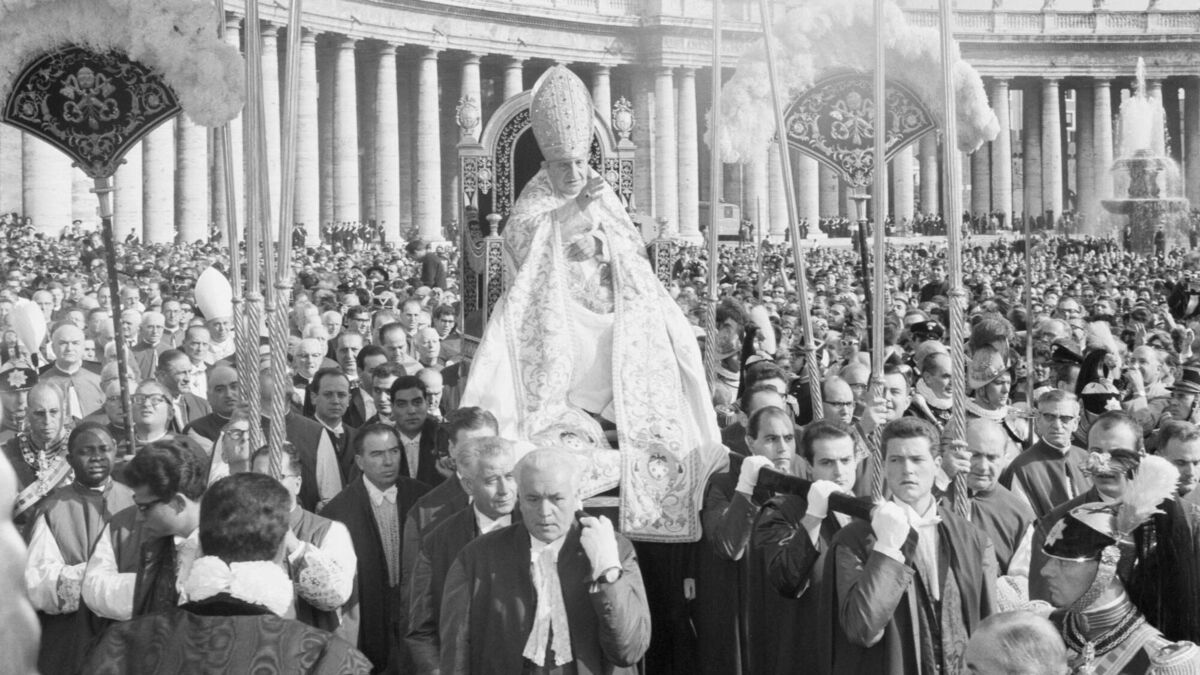
Pope John XXIII is carried ceremoniously to St Peter's Basilica for the inauguration of the 21st Ecumenical Council, the Second Vatican Council.
It’s now generally accepted that for Catholics ‘the way of being Church in the future’, as Pope Francis described it and as Pope Leo has confirmed, is ‘the synodal way’. By that is meant a Church where all the baptised – people and priests – listen to each other, ‘walk’ together, work together, discern together and decide together.
Effectively, synodality means co-responsibility for the Church, with people and priests co-leading the Church – as the documents of the Second Vatican Council (1962-5) implied.
Theoretically everyone is on board – pope, bishops, priests – and this new kind of church underlines shared authority, shared governance, etc. It is, as Francis once memorably commented, ‘the only way of being church in the future’.
Well, yes and no.
The Catholic bishops of England and Wales would be expected to embrace this new kind of church. But not so, it seems. Yes, they are officially on board for the process that will implement synodality and that process will conclude with an October 2028 worldwide assembly in Rome in 2028. But all is not as it seems.
A recent plenary session of the English and Welsh bishops concluded that they had two priorities: (i) synodality and its expression in the life of the Church in England and Wales and (ii) the development of lay ministries of Lector, Acolyte and Catechist. This coupling and its implied equivalence of a fundamental and essential reset for the Catholic Church (synodality) with developing minor (though important ministries) gives the game away.
Anyone seriously concerned with implementing a synodal way of being Church would not mention the development of lector, acolyte and catechist, in the same sentence as synodality – much less suggest an equivalence between the two.
The bishops’ ambivalence about synodality was confirmed when their spokesman later indicated that ‘the way synodality was to be implemented was being left to individual dioceses’. That’s how much synodality matters to the dioceses of England and Wales.
To be fair, they seem to be upfront about it. In Ireland the same honesty doesn’t apply. Theoretically the Irish bishops are on board the synodal pathway but it’s clear that the commitment is, let’s say, more measured. Some bishops are applying to parishes and to priests the same loose directives as the bishops of England and Wales are applying to dioceses – in effect, whatever ye think yourselves.
Some Irish dioceses and many Irish parishes have never heard the word ‘synodality’ mentioned, much less explained or endorsed. This policy was driven, it seems, by the belief that, once Francis had gone to God, synodality would disappear like the snow of last year.
That’s not to say that dioceses and parishes were not officially on board. There were committees, of course, as specified. There were fine words spoken to keep the troops happy. There were even occasional glimpses of what synodality could achieve, given a fair wind. There were reports and meetings and strategies and directives and more reports and more meetings and a level of unsustainable frenetic activity that never quite disguised the context of insidious ‘pushback’ from bishops – and priests.
Bishops tended towards a necessary silence in case the thinning numbers of clergy might take offence at anything as outrageous and necessary in religious leaders as a passionate conviction for reform and renewal.
Last week I attended a meeting in Knock of representatives of diocesan synodal committees from seven west of Ireland dioceses. A programme of activities – meetings, reports, strategies, etc – are planned for the next three years, leading up to the worldwide assembly in Rome in October 2028 that’s listed to implement synodality – and all of that is not even taking preparations for the Irish National Synod in October 2026 into account.
I wondered to myself, if the Knock meeting was taking place after last Thursday – when the Vatican announced that a study-group to assess whether women (like men) could be ordained deacons had voted by 7 to 1 to reject that possibility with a firm NO – how many would be present at the meeting in Knock?
Very few I would imagine because the NO decision was making clear that regardless of how credible reform is, our church almost inevitably says NO – while dressing it up with a few conditional possibilities (like not sure if the decision is definitive!) to keep the troops happy.
What really irked me was that, trotted out with the blunt NO, was the possibility of the three sisters Lector, Acolyte and Catechist (of England and Wales fame) becoming super-ministries that might assuage the disappointment of the Catholic women. They don’t even know the half of it.
A patronising series of spectacularly insubstantial gestures by way of consolation can serve only to further annoy women whose gifts are so badly needed to give momentum and a renewed sense of purpose to our Church, and to perpetrate the belief that we still have not come to terms with an embedded misogyny that has warped our refusal to own the treasures so often offered to and rejected by an unthinking male clerical elite.
After three study-groups on Women Deacons, and after three conclusions counselling further study, and with less light than when we started, the compelling question now is: how we can keep going?
One thing is clear. We need something different from successive study-groups who invariably manage to produce different arguments and yet arrive again and again at the word NO.
What seemed an obvious, natural and necessary first step towards the future of our Church has suddenly been shuffled to the sidelines. Another opportune moment to move the dial of reform forward has been missed. Another example of church leadership unable or unwilling to further real change. Another kick in the teeth for Catholic women.
And, more importantly, if a church can’t live with women deacons, what chance has it of making a go of a synodal Church? Very little if anything at all after the hit that reform of our Church has just taken.