A life reporting the facts of life in Mayo
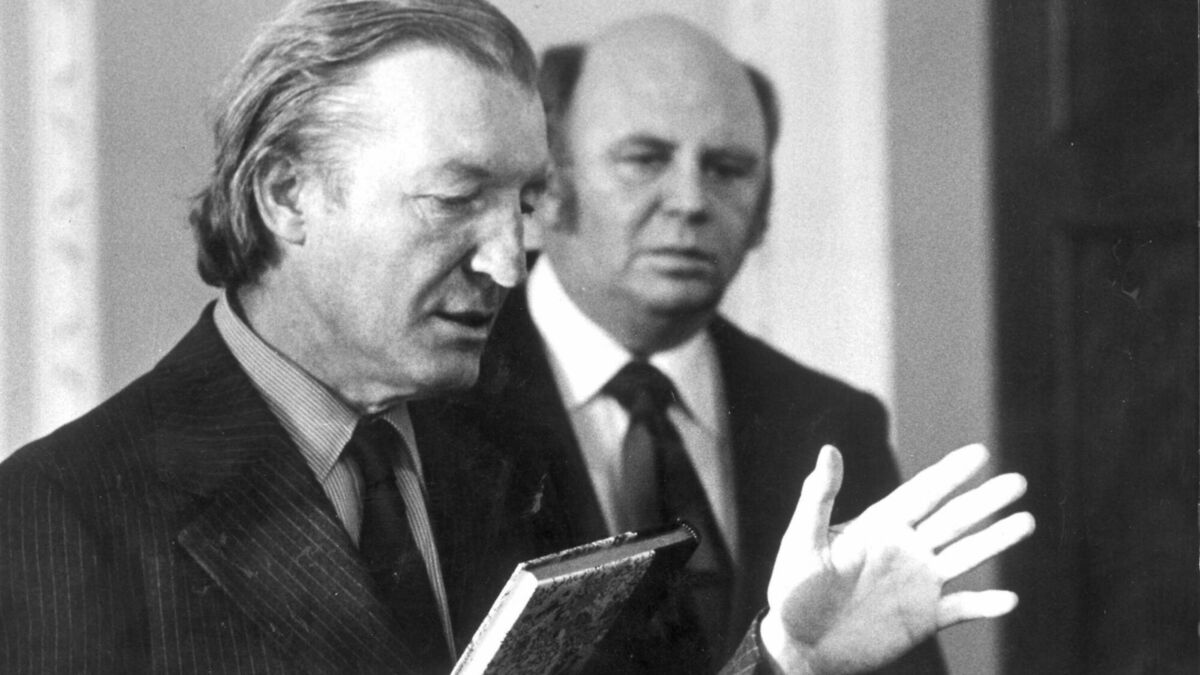
Mayo-born journalist John Healy (right) with the then Taoiseach Charles J Haughey in 1979.
In today’s world of fake news, it is important to know the facts and therein lies the problem. The dictionary definition of a fact is an event or thing that is known to have happened. But, who decides that something has happened leaves us in a difficult position because not everyone will agree with the person or event that is said to have happened. So it is extremely difficult to pin down the fact, not to mind the facts.
One has to have sympathy with the twelve men/women of the jury in our legal system who are charged with deciding the facts of a case that might have life and death implications (well, to be factual, in our jurisdiction life or part-life imprisonment). Judges have the simple job of deciding what the laws is, but the jury must confront the difficult job of deciding the facts.
The jury is presented with the facts by the prosecution which generally relies on imperfect witnesses to lay out the case. And that case is then undermined or misrepresented by the legal eagle defending the particular case. It is not a simple matter for a jury to decide the facts. Once pinned down, however, facts can be extremely stubborn to uproot. In fact, facts are sacred and indivisible.
Now, you might wonder what these laboured thoughts on facts have to do with anything and I’m a little perplexed myself. I have spent a pleasant, if not very fruitful, life in journalism and never once doubted my ability to come up with the facts of a story, but, as we can see very readily, when we look at the people in charge of the world today one man’s facts are another man’s fallacies.
While career journalists are under obligation to seek the truth and to print it without fear or favour, it is, in my view, an unfortunate fact of life that, with the advent of social media, there is now no such obligation on people to search for a modicum of fact before publishing. Every man and woman with a phone is now a journalist. On social media, opinions have become facts and so Donald Trump can say what he likes and there is no recourse for his critics other than to hit back with their own opinions, which can be equally disputatious. It is a merry-go-round which make facts of faux news depending on your particular opinion on any given day. Remember, opinions change unlike immutable facts.
The good old , for all its faults, holds itself to a fairly rigorous standard of searching for truth as indeed do the and the . We are fortunate in this county to have been served over a century and a half by creditable and credible purveyors of the news. All three publications were and are unashamedly committed to the advancement of Mayo and the West, supporting Davitt and the Land League and later the quest to break British Dominion in Ireland.
Names such as Fred and Vincie Devere, William and Patrick Doris and James Daly and Thomas H Gillespie are synonymous with the proud history of Mayo and Irish journalism. They were standard bearers and carried weight with the authorities when it came to advancing the economic and social life of Mayo and its neighbouring counties.
All three publications spawned and nurtured a veritable production line of top class journalists who made their names in Mayo before going on to establish themselves in national newspapers or national radio and television. Before my time there were giants of journalism such as John Healy, John Anderson, Paddy Leamy, Jim Maguire, Patrick Gallagher, Tom Hennigan, Denis Coughlan, ivory-tickling Mick Finlan, from Ardnaree and Dave Halloran who joined the .
Also, there was Damien McHugh (I replaced Damian in Castlebar for the . Damian went rogue and became a barrister), John MacHale, Liam Molloy, Tom Rowley, Benny McHale (Benny also went rogue and became a priest), Vincent Cribbin, Orla Ryan, Michael Mullen, Liam Horan (went and returned), Tom Shiel (went and returned) Declan Varley, Jonathan Mullin, Shane McGrath, Mike Finnerty (we could also claim Sally Rooney as a journalist though more famous as a novelist).
There were others who stayed at home, among them the late, great lamented and ever helpful Tom Courell, Ger Bracken, Terry Reilly, Sean Staunton, Tom Gillespie, Sean Rice (the Sports Voice of the West), Ivan Neill, Martin Curry, Denis Daly, James Laffey, Denise Horan, Michael Duffy, John Melvin, Tom Kelly, Michael Commins, Deirdre Kelly, Aidan Henry, Edwin McGreal, Joan Geraghty, Michael Gallagher and Anton McNulty.
No doubt, there are others whose names I have omitted, my memory not being great, while there is currently another crop of journalists operating for the three Mayo titles whose names I see in by-lines under stories of considerable import or none, but who continue the great Mayo tradition of journalists fairly reporting the news and keeping the Mayo public informed.
I was lucky enough to have entered journalism while the ownership of newspapers in the county was still in the hands of local interests. In the case of the WP it was the gracious Rita Devere who was the public face of the proprietors. Her accountants made sure that Mrs Devere did not dispense her largesse frivolously, so times were tough but great.
The same was true in Castlebar under the stewardship of (old) Tom Gillespie, the proprietor/editor, and in Westport where things were somewhat different with FNT running the show and printing , the Irish language paper of the day. But there were always avenues for supplementing incomes and people got on with the job.
There has been considerable change in the ownership of the Mayo newspapers in recent years. The is now owned by The Irish Times DAC (DAC-don’t ask me!), the by Celtic Media Group (don’t ask me!) and the by Iconic Media Group (again, don’t ask me!). Lots of jobs have been lost in the areas of preparation and printing of the papers but at least the papers continue to survive and serve the people of Mayo and beyond.
Life has been made somewhat easier for the newspaper industry by the support received in recent times from Coimisiún na Meán, the independent media regulator. The remit of the media regulator includes supporting the local and national print media and the financial support provided has enabled the local papers, the only ones I’m interested in, to build on their reporting resources. So, you see court cases and local council reportage increased and improved in the papers.
That support is obviously welcome but there is always the danger that the government could get on its high horse and withdraw funding from the regulator if it is not satisfied with how the media is covering the news as it effects the public perception of how the government is doing. That’s a danger that it is only myself would raise and, for now, it is not an imminent danger.
Things are looking a little bit rosier for the local media industry. That has to be a good thing.
I think I’ll come back to life in the local media sometime. The old memory is not great but perhaps with a bit of work on the little grey cells I may be able to drum up some stories from a life reporting the facts. Well, the facts as I understood them at the time.
- New York Sun.