Problem gambling is on the rise in Mayo
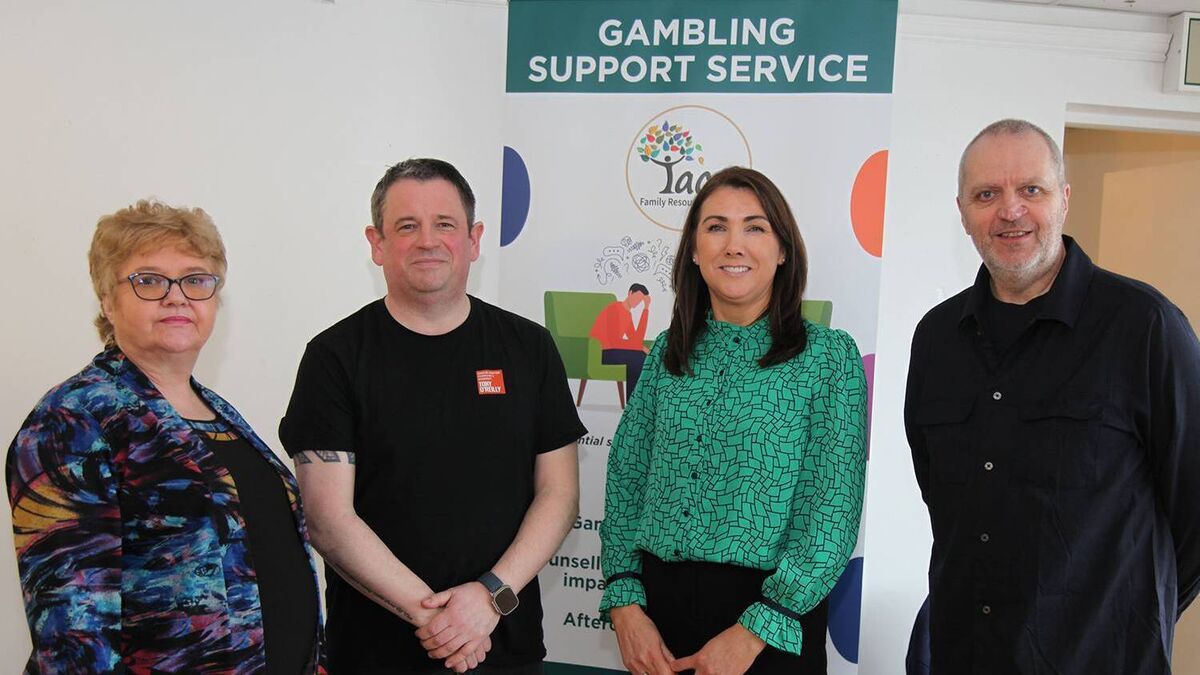
At the launch of the Gambling Support Service for Mayo, hosted by Tacú Family Resource Centre in Ballinrobe in partnership with Gambling Awareness Trust and Family Resource Centre National Forum, were, from left: Mary Jackson (Tacú Project Co-ordinator), guest speaker Tony O'Reilly (gambling addiction counsellor), Bernie Heneghan (gambling addiction counsellor) and
Problem gambling is on the rise in Mayo but there is only one counsellor in the county helping gambling addicts to escape their addiction.
Ballinrobe-based Bernie Heneghan is a psychotherapist who spends half her time on gambling therapy but feels that such is the need she could go full time. She is employed for the past two years as a gambling therapist at the Ballinrobe Tacú Family Resource Centre, her work funded by the Gambling Awareness Trust (GAT), which is itself funded by the gambling industry to, in Bernie’s words, “treat gambling-related harm”.
The GAT is funded via the Gambling Regulatory Authority, which was established under a new Gambling Regulation Act passed in 2024 as government sought to modernise legislation to fit modern gambling patterns.
Remarkably, Bernie is the only gambling therapist covering Mayo at the moment, though trained counsellors in places like Foxford-based Hope House also help treat gambling addiction. Bernie has been very busy this past year and feels more gambling therapists are needed in the county.
“The need is especially acute among young men in the 20 to 40-year-old age bracket, but all ages are affected," she explanis.
Worryingly, Bernie has seen an increase in teen gambling.
“Online gaming is the gateway… with its loot boxes and skin purchases in games,” she explains. “It opens up the pathways to the brain. It mimics the excitement and escapism of gambling.”
Bernie has also witnessed an increase in female gambling problems. This has been prompted by the increased online accessibility of gambling, she believes.
Gambling addiction is increasing in Mayo, affirms Dolores Duggan, a member of the Congregation of the Sisters of Mercy who runs Hope House in Foxford. Worse, gambling addictions are often prompted by or contribute to other addictions, such as the consumption of drugs and alcohol.
“Lately, those who come to us with a cocaine addiction also very often also have a gambling problem,” said Sr Dolores. “They substitute one for the other very, very easily.”
The ease of online gambling has worsened problem gambling, says Bernie Heneghan.
“It is 24-7 at your fingertips. Years ago, the bookie shops closed at night, now you have online betting which can be accessed 24 hours a day.
“You also have casinos in small towns. Casinos are banned in Ireland, but that law has been sidestepped by the establishing of private members clubs. You will find them in most towns in Ireland... there is one in Castlebar.”
Those in the grip of a gambling addiction “chase the dopamine hit”, said Bernie, a reference to the neurotransmitter in the brain often referred to as the “feel-good” hormone.
“It is similar to drug addiction... The brain needs bigger risks to get the same hit. More gambling is needed to feel the same excitement.”
The hardest step in Bernie’s clients’ recovery is the initial reaching out.
When do gamblers seek her help?
“Usually, it’s when their mental and physical health are affected, relationships are breaking down and they are in serious financial trouble. This delay in reaching out may be prompted by fear of judgment, by the stigma of losing or owing money. When it’s bigger amounts and things feel out of control that’s when they come to seek help.”
It’s easy to see why an individual might feel shame given the scale of some of the losses. Bernie recalls helping a young man in his 20s who lost all of a €25,000 inheritance in one night of online gambling.
“In the morning, he started, gambling on horses and football. By 10pm he knew that he was losing but kept going, trying to win back the money he had lost. By the early hours of the morning, it was all gone.”
The counselling when it starts involves the problem gambler, but support is also available for affected family members.
“Sometimes the problem gambler is not ready to seek help, but a family member is.”
Gamblers who come for help have often run out of options.
“You might have loan sharks after you and you might have legal problems. You are doing things you would not normally do, you are taking money from family members, lying, cheating, you are taking money from bank accounts which you are not supposed to take. You are desperate, you owe money.”
It’s to protect such vulnerable addicts that the government has sought to control gambling. Implemented from last month, the 2024 Act also includes a ban on credit card gambling, stricter advertising rules, and a National Gambling Exclusion Register to protect public safety.
Bernie Heneghan thinks the regulations are necessary. As regards their effectiveness however, “it’s early days yet”, she says. And some of the legislation has yet to be implemented.
“But it is going in the right direction. More funds need to be contributed towards education to broaden people’s understanding of the dangers of gambling. Knowledge is power.”
According to Bernie, one in thirty adults of the Irish population has gambling problems while 200,000 people have a modest gambling problem. This, however is a “conservative estimate”, she notes, as the last study was published in 2023.
“For each problem gambler there’s six people directly impacted,” she adds.
Bernie offers one-to-one support.
“Typically, we meet once per week and if they think they need more we put a plan in place. The first few months in recovery are often the hardest in the recovery process. I meet the person where they are at, we together establish what they need. They are met in a nonjudgmental, safe space.
“We start with the basics; it might be by putting a gambling ban app on the phone. Putting a trusted person in charge of their finances, it differs for everyone. I can signpost to other services like MABS [Money Advice and Budgeting Service] and mental health services if needed.
"We establish coping mechanisms to help them distract from the temptation to gamble.”
She recalls one of her clients, a Mayo man in his 70s who is using sport and fitness to control his urge to gamble.
“He still gets the urges, but he knows how to manage them. He has replaced his gambling with that. When he is vulnerable, he goes for a gym session or a walk.”
Addicts come to Hope House for 30-day residential treatment which is followed by a two year outpatient aftercare programme. Residents attend daily one-on-one counselling sessions but also sit in groups where they get peer support.
Some of the gambling addicts at Hope House have their stays paid for by the Gambling Awareness Trust, set up at the prompting of the state’s recent legislative push to control gambling. The Trust will be replaced this year by a new Social Impact Fund, which will also be supported financially by the gambling industry, though the industry’s contribution has yet to be decided.
Help for the families of gambling addicts may be crucial to their recovery.
“Problem gambling can contribute to suicide,” said Bernie. “And it can cause severe depression and panic, not to mention drug abuse and alcoholism which go hand in hand with gambling.
“It causes huge pressure and effects all relationships. When you are with your family, you are not present because you are worrying all the time. It feels like a double life.”
Bernie recalls when faced with such stress one of her clients could not sleep at night. He was sweating profusely but he did not correlate it with his gambling at the time. Since he came into recovery he is now sleeping well. He’s doing counselling sessions and going to Gamblers Anonymous meetings. He has said it saved his life.
A study in 2025 found that gambling was a contributing factor in 23 suicides.
“When a person is caught in gambling it can lead to severe depression and panic, not to mention the co-occurrence of drug abuse and alcoholism which go hand in hand with gambling.”
One of the worst aspects of gambling is the secretiveness, explains Sr Dolores Duggan. “Family may not see it so quickly, often a lot of financial and emotional damage is done before they discover [the addiction].”
Some 95 percent of gambling addicts are functioning in full-time jobs, said Sr Dolores, usually with no immediate outward signs of addiction.
On a more hopeful note, she points out there are three weekly meetings of Gamblers Anonymous in Mayo, in Hope House on Tuesday and in Castlebar on Friday. The organisation also meets on Monday and Saturday in Claremorris.
If you or a loved one is struggling with problem gambling, you can contact Bernie Heneghan at gawarenesstacufrc@gmail.com and 087-7005811.