Mayo-born Napoleonic wars commander’s 200-year-old jewel up for auction
For Irish historians and readers, the jewel’s significance lies not only in its royal association but also in the remarkable life of the man with whom it is connected.
A remarkable jewel believed to have been presented by Tsar Alexander I of Russia (1777–1825), to Lieutenant General Sir Robert Arbuthnot (1773–1853), an Irish born British military commander, is set to come to auction in London, more than 200 years after it was created.
The Imperial Russian diamond and enamel jewel has descended through Arbuthnot’s family line and is now being offered for sale directly by his family, preserving a rare personal connection to one of Ireland’s military figures of the Napoleonic era.
Born at Rockfleet Castle in County Mayo on 19 November 1773, Arbuthnot served in some of the most significant military campaigns of the late 18th and early 19th centuries.
His career took him from the Irish Rebellion of 1798 to the battlefields of the Iberian Peninsula, where British and allied forces fought against Napoleon’s armies. The jewel offers a fascinating connection between his Irish origins, the Russian Imperial court and the international events that helped shape modern Europe.
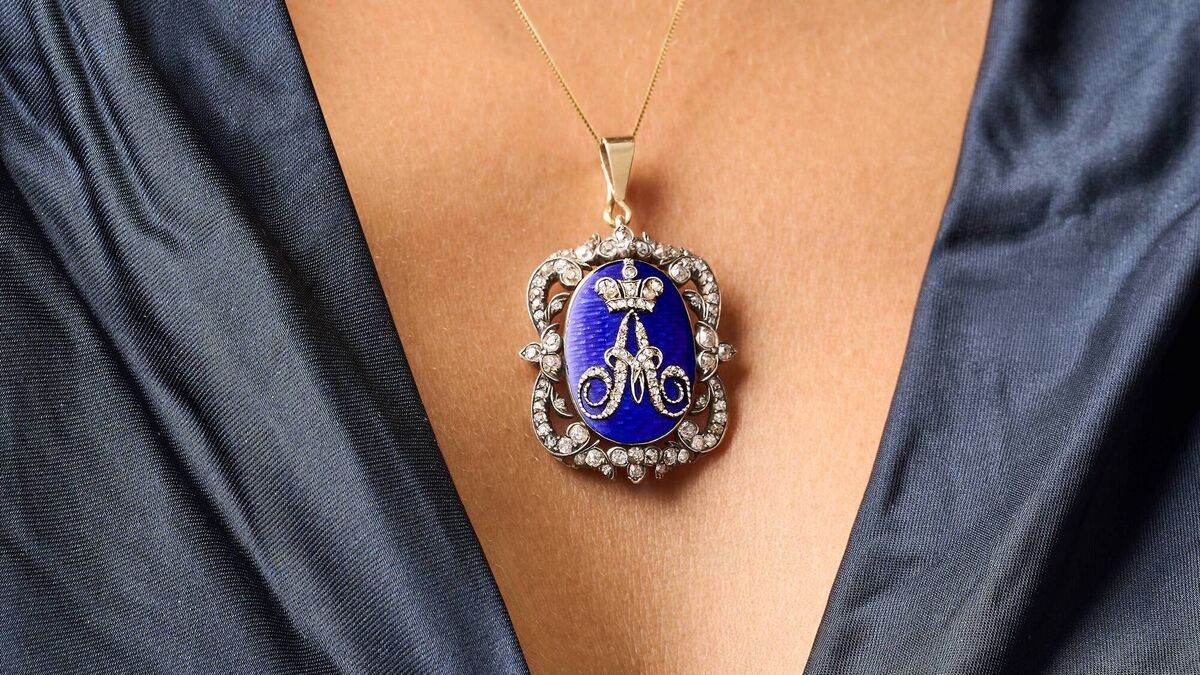
Decorated with vibrant blue guilloché enamel, the oval pendant bears the crowned initial ‘A’ of Tsar Alexander I, framed by an elaborate foliate border set with old and rose cut diamonds.
Crafted in yellow gold and silver, it measures 4.1cm and weighs 9.3g. Dating to circa 1810, it reflects the refined craftsmanship and ceremonial splendour associated with the Russian Imperial court. It is being offered in London auctioneers Elmwood’s Fine Jewellery sale on October 28th2026, with an estimate of £6,000-£8,000.
Joe Kendrick, Head of Sale at Elmwood’s, said: “This is a particularly fascinating jewel, combining the exquisite craftsmanship of the Russian Imperial court with a remarkable story rooted in the Napoleonic Wars. Its association with Tsar Alexander I and Lieutenant General Sir Robert Arbuthnot gives the piece a compelling historical dimension, connecting a personal object of Imperial splendour with the extraordinary events that shaped early 19th century Europe.
"The vibrant blue guilloché enamel, crowned diamond set initial and intricate foliate frame make it an especially striking example of antique jewellery, while its direct descent through the same family adds another layer of interest for collectors.”
Arbuthnot’s military service extended across several continents, but it was his role in the Peninsular War that became a defining part of his career.
He served as aide-de-camp and subsequently military secretary to General Sir William Beresford, participating in numerous engagements against Napoleon’s forces.
These included the battles of Corunna, Busaco and Albuera, the sieges of Ciudad Rodrigo and Badajoz, and the later battles of the Nivelle, Nive, Orthez and Toulouse.
At the Battle of Albuera in 1811, Arbuthnot distinguished himself by intervening when British and Spanish troops mistakenly began firing on one another.
He helped stop the friendly fire and alerted Beresford to a critical French troop movement.
His wider service earned him significant military honours, including the Army Gold Cross with three clasps and the Military General Service Medal with two clasps, alongside Portuguese and Spanish distinctions.
In 1815, he was appointed a Knight Commander of the Order of the Bath.
He subsequently rose to the rank of lieutenant general and continued his military career overseas, commanding British troops in Ceylon, now Sri Lanka, in 1838 and serving as a general officer in Bengal. In 1843, he was appointed colonel of the 76th Regiment of Foot. Arbuthnot died in 1853, aged 79. More than 170 years later, the jewel associated with his life and service survives as a tangible link to his story, preserved through his family across generations.