A shining light on our Atlantic seaboard
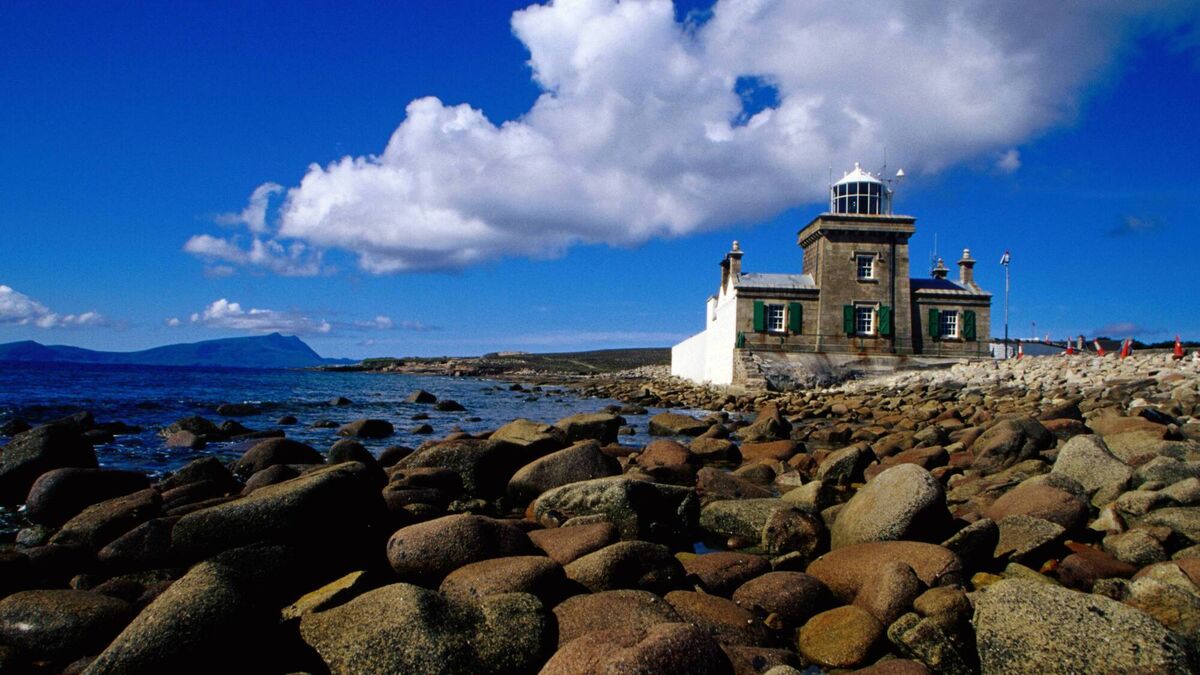
Blacksod lighthouse has been a sturdy sentinel on the Erris coastline since 1866.
- George Bernard Shaw.
Blacksod Lighthouse first cast its light across the bay on June 30th, 1866, one hundred and sixty years ago. Silently, its bright white light shone out on the approach to Blacksod Harbour, its red shade facing Ardelly point. Constant and external, silent and safe. Whilst lighthouses look old and venerable on the outside, a nod to distant times, their inner apparatus and workings are of the most modern and cutting edge technology in keeping with the current times.
Local Belmullet business man Bryan Carey tendered £2,100 in 1864 to secure his bid and build the lighthouse at Blacksod Point for the Board of the Commissioners of Irish Lights. Work commenced soon thereafter, granite from the nearby Blacksod Quarry was sourced for its construction. A small gauge railway was constructed to ferry the stone from the quarry to the construction site. The granite at Blacksod Quarry is rare and sought after. Pinkish to red in colour, its stone has helped build the Houses of Parliament in London, the coastguard station in Blacksod, the pier and boathouse amongst many other municipal buildings and bridges in the area.
The Erris region has four lighthouses within its spread. Blackrock Lighthouse and Eagle Island off its wild coastline, Ballyglass Lighhouse on the Erris peninsula's head, and Blacksod Lighthouse at its toe. All of those lighthouses are intrinsically linked through history, fisherman, boat contractors and shop keepers, bound with familial light-keeping family connections. The same names, be they keepers' families, shopkeepers or boat contractors crop up time and time again as if to reassure the region of its constant continuity.
In the early years the lighthouse at Blacksod was manned by the keepers ashore from Blackrock Lighthouse. They lived in what’s known locally as The Dwellings, four fine houses constructed for light keepers' families. The lighthouse was powered by an original oil lamp until 1930 when it switched to an unwatched acetylene station.
In November 1933, the legendary Ted Sweeney took charge of the lighthouse, a tradition and name that comes down to this day. The new acetylene powered light had a spin off effect on the village. The slaked lime from the carbide was drained into a sludge tank beside the lighthouse. Ted’s generosity saw the village supplied with barrows and buckets of this sludge which was converted into whitewash with water, thus ensuring scoured out and clean sheds, whitewashed walls along the old coastguard station, known locally as the Barracks and the long wall at the lighthouse amongst other uses.
Whilst Blacksod Lighthouse seemingly stands alone that would be a false impression. In pre-mobile and modern instant communication days, the radio room in the lighthouse was the main connection to both Eagle Island Lighthouse and Blackrock. From there the offshore light-keepers kept contact with the mainland, radioed in their food orders, reported issues regarding sea, storms and shipping and assisted in search and rescue. The coordination of a shipping disaster involving the Stiente Mensinga off Eagle in 1961 being an example. Blacksod Lighthouse also coordinated the other lighthouses, life boats and air and sea rescue involved along with the recent tragic helicopter Rescue 116 in March 2017.
Though quite famous for the D-Day weather report via Maureen and Ted Sweeney that helped end World War II, the lighthouse always kept a weather and benign eye on all things marine. Tom McClean, the man who first rowed the Atlantic solo west to east in 1969, landed at Blacksod and a local lady directed the arriving adventurer to the lighthouse where the London and world newspapers were informed of his feat by Ted Sweeney. The lighthouse itself became a post office for a few years whilst the new post office/family home was constructed for the Sweeney family who would then move out of the lighthouse, with its thick walls offering safety and security from the pounding nearby waves and storms.
Around 1969, the first helicopter relief from Blackrock and Eagle Island took place. The Commissioners of Irish Lights, confirming their pledge of modernity and safety to both mariner and keeper, ensured now that shore leave was to be on time and stress free. For the previous century boat reliefs were the mode of transportation. It was an end of an era. Great seamen, master mariners like John Padden, his crew of relations and ex-Iniskea islanders like the Keane brothers, the Pete’s, after that the John Mhicheals, the Meenaghan brothers, Tom, Padraig and Micheal and their boat the Moby battled those rough seas risking life and limb, never losing anyone, to safely take the men from Blackrock back to Blacksod.
Blacksod Lighthouse was the hub, the nerve centre where preliminary preparation took place. Conversations with Ted Sweeney and the 'Rock-based keepers via radio telephone dictated the next moves. John Padden had a massive black galvanised shed near Blacksod Lighthouse where his sea going equipment was stored. Beside that was a concrete plinth where the bay's marker buoy, a huge black then red steel barrel shaped contraption, was taken ashore and cleaned down off its barnacles, sea debris, blow torched and repainted by Ted with the village kids often helping him, it being readied to take its turn at sea when the replacement was brought ashore.
The bay in front of the lighthouse was the haven for anchorage of any of the then three Irish Lighthouse tenders, the Grainuaile, Isolada and Atlanta. The village sparked into life at the arrival of any of those ships. Their cutters in and out all day as they unloaded coal, oil and marine chandlery for the local lighthouse, often they landed stores and oil for Blackrock and Eagle there too because the ships were too big and unwieldy to access Blackrock or Eagle. It was there that the expertise of the local contractors under Ted's guidance ensured supply was interrupted only minimally. So the Blacksod lighthouse never stood alone in splendid isolation.
Though at the peninsula's tip, it was a magnet in the village. The three shops, Gallagher’s Dudley Arms Hotel, Heneghans and Kavanagh's stores and pub all provided supplies for the area's lighthouses, lodgings for the coming and departing light keepers and a social outlet for those concerned in the world of fishing and lighthouse keeping. Though down the village from those shops and stores, one felt that the lighthouse in the village directed events either through its attendant radio telephone communication system and its proximity and shelter for the sea-bound boats.
Noting the use of the lighthouse as a helicopter base for the offshore reliefs around 1969, Blacksod Lighthouse and the Commissioners of Irish Lights once more kept in step with modernity. Though the boat reliefs were now gone and the end of almost a century of service, the lighthouse in Blacksod positioned itself for a new future. A number of years of rapid relief for the offshore men at Eagle and Blackrock only briefly delayed the automation of the lighthouses off shore that was gathering apace, the need for a shore base for services and maintenance on Blackrock and Eagle ensured Blacksod Lighthouse primacy though.
In time that connection with the helipad at Blacksod was extended to air sea search and rescue with a full refuelling and flood-lit double landing pad facility at Blacksod under the careful eye of the next generation of the Sweeney family, Vincent. Today the Lighthouse has partnered successfully with the Solas-Scéalta an Atlantaigh, the successful community-based facility in nearby Eachleam. Though two miles apart, Blacksod Lighthouse and Solas are essentially twins. Linked in modernity but commemorating and bringing the past alive, one complementing the other. The Solas team provide the starting point for not alone Blacksod Lighthouse but also for our nearby islands, marine and land tourism, island tours, sea angling and tours of Blacksod Lighthouse itself.
Solas, with its multifaceted and multitalented team, as Gaeilge agus Bearla, provides food, education and fun. The lighthouse, though still primarily a vital navigational aid along with a search and rescue facility, has dovetailed comfortably with Solas, its younger partner up the road. The friendly guides with their coffee and refreshment shop standing under the lighthouse's shadow, flanked by the offices of the sea-going tour boats, has repositioned the lighthouse once more as the village's hub. Locals and tourists, fishermen, boat operators, and kids from the successful UISCE Gael Coláiste all mingle beside the venerable old edifice that gave birth back in June 1866. It didn’t have to move, time and society moved with it.
The village of Blacksod is and was always a lighthouse village. The famous Sweeney family will always be interwoven in the lighthouses granite via Ted and Maureen. Teddy, the oldest boy, sailed the world with Irish Shipping when we depended on our own commercial fleet. Later he served on the Irish Lights tender Grainuale. Today his services are still utilised with Aran Ferries.
Vincent is the local attendant and Gerard saw service on many of our coastal lighthouses.
Various other families were either brought up in the village or spent time in it over the decades. This is by no means an exact or definitive list but it is the names I recall from my youth. The Stapletons, Jackie and Joe, the Trants, Billy and Tom Heneghan, PJ O'Boyle, various members of the Ryan family, Paddy Keane, Paddy Gaughan, Noel Gaughan, Johnny Connell, Willie Roche, John Carmody and others.
The Dwellings housed some of those families. They became part of the villages fabric. I apologise for leaving out a name or two, indeed I almost forgot myself. I gave some service to the cause between the ages of 20 and 25. I can go on record and state that the Commissioners of Irish Lights were the best employers I ever had.
Blacksod Lighthouse is more than red pink granite. It’s a repository of who we are, what our village and locality is. Its magnet pulls the area tighter. Though static it pulls the keepers, the boat contractors, fishermen, shopkeepers, publicans and children of the area into a unit going back a century plus.
Modern technology has made marine life more safe and simple. And yet the fisherman, tour boat operator and passenger will always state that the mere physical presence and standing of a lighthouse offers the certainty that the former doesn’t - in granite, light and visibility we trust type of vibe. It’s a marker, a mindset, a comfort and the equivalent of the pharaohs' tombs in Egypt, monuments that stand tall and don’t have to say anything. Their shape says it all. In conclusion it’s the human hand that brings them to life.
Vincent Sweeney is today’s guardian, ensuring the light still shines after 160 years. Its beam encompasses the village people, the fishermen men, tour boats operators, UISCE students swimming nearby, Solas in Eachleam being the careful custodians of the areas lore.
Sean Ó Gallachóir, its creator along with the Solas team, ensure that Blacksod Lighthouse's beam shines worldwide. We as a community take pride and succour from the lighthouse's calmness. Thanks to the current keeping custodian, the Commissioners of Irish Lights, Solas and and its team who keep our mariners safe, our history curated, accessible and visible.
Maith sibh uilig.