A contrasting tale of two Presidents
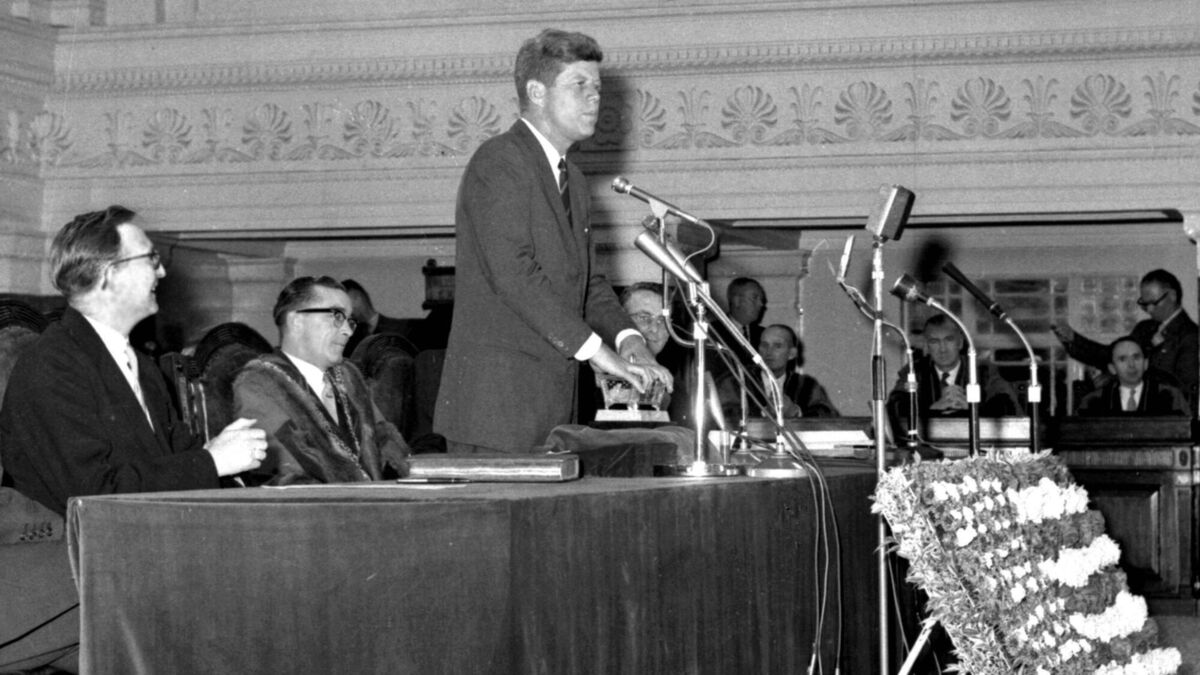
John F. Kennedy spoke a message of peace to the United Nations in September 1961 which was a far cry from current US President Donald Trump's recent appearance at the General Assembly.
In October 1960, an Irishman broke a gavel. Frederick Boland, our man at the United Nations and that year President of the General Assembly, brought it down so hard, trying to quieten Nikita Khrushchev, that the head flew off. Khrushchev had been thumping the desk with his shoe. My father heard it on the kitchen radio in Ballina and told the story as if Boland had done it for the county. A small country in the big chair, keeping order among giants. The gavel broke. The order, more or less, held.
I thought about that gavel all last week, after listening end to end to the speech Donald Trump gave to the General Assembly last Tuesday, and then researching the one John F Kennedy gave in the same hall in September 1961. I'll say it plainly. One of those men came to New York to sell peace. The other came to sell war, and had the nerve to call it peace.
Kennedy was nobody's pushover. The Berlin Wall was six weeks old when he spoke, and he told the hall that America had "both the will and the weapons" to stand by West Berlin. But the threat was the fence, not the field. He knew the word that would be flung at him. His father had been Chamberlain's cheerleader in London, and young Jack had written a whole book on how appeasement had left England asleep. So he went at the charge head-on. "Men may no longer pretend that the quest for disarmament is a sign of weakness."
Then he did something no American president had quite done before. He challenged the Soviet Union, in his words, "not to an arms race, but to a peace race".
It wasn't a slogan; he laid out a plan with six proposals. A test-ban treaty the Americans were "still prepared to sign today", and a stage-by-stage disarmament ending in the abolition of every army on earth except those needed for internal order and a standing UN peace force. He wanted space kept free of weapons and the 1960s declared a decade of development. You can call it naive, and plenty did. What you can't call it is a man looking for a fight. "Every man, woman and child lives under a nuclear sword of Damocles," he said, "hanging by the slenderest of threads." And then the line they carved on things afterwards: "Mankind must put an end to war, or war will put an end to mankind."
He said it shortly after Dag Hammarskjöld's plane came down at Ndola as the Secretary General was flying to broker a ceasefire in Katanga, in a war where Irish soldiers had just surrendered at Jadotville after five days of holding out. Kennedy opened on the body. "Dag Hammarskjold is dead. But the United Nations lives." A man who thought the building mattered.
Last week Trump talked about peace, quite a lot. "While others have spoken of peace, I have made peace." His version is a scoreboard: eight wars settled, and thank-you letters from the leaders of Pakistan, Azerbaijan, Armenia, Cambodia and Rwanda read aloud to the delegates, like a man reciting his own references at the interview. Kennedy's peace was plumbing, pipes and valves and inspection regimes built so no one man need be trusted. Trump's is a trophy cabinet, and there's only one name on the trophies.
Then look at what the rest of the speech was for. Military spending this term will reach $1.5 trillion. All 159 ships of Iran's navy are "lying at the bottom of the sea". Eighteen new munitions plants are going up, and America already has, he told the assembled nations, "more munitions than we could ever possibly even think of using". Kennedy had warned in that same hall that in an arms race a nation's security may shrink even as its arms grow. Trump stood at the same lectern and read out the arms race as if it were a harvest report.
And then Iran. "I have a big decision to make." [A deal], "or do I annihilate the Islamic Republic and do it quickly?" He wondered aloud whether to "drive them into hell". Then, because it occurred to him, he mentioned that Tehran was waiting to see how he did in the midterms. Kennedy used "annihilate" too. His plan would bring "an era in which no state could annihilate or be annihilated by another". Sixty-five years on, the same word has gone from nightmare to menu option.
It didn't stop at Iran. The cartels "should be killed". Cuba "will fall". Mexico "must reclaim control of its soil," or else. On Venezuela, where US forces seized Nicolás Maduro in January and Washington has since signed a 65-billion-barrel oil deal, he said the quiet part out loud: "It was a war, but it's perhaps the biggest deal ever made. To the victor; belong the spoils."
If necessary, he promised the hemisphere, America would use its "unmatched military might". Greenland, handed over to Denmark by treaty, gets two major military bases. Kennedy told the same room that his nation had formerly been a colony and knew what colonialism meant. Trump used the 250th anniversary of American independence as the licence for an empire.
Where Kennedy asked the hall for more power, Trump boasted of taking it away: a 15 per cent cut to the UN budget and more than 4,000 posts gone. That's like telling the family at a wake you've got the undertaker down on price. The International Criminal Court was "an evil group of people". His critics at home were "cowards and traitors". Kennedy saluted "the brave cosmonauts of the Soviet Union" at the height of the Berlin crisis. Trump couldn't find a civil word for his own opposition.
There was one moment of comedy, if you take it bleak. He renamed artificial intelligence "Super Intelligence," because "artificial" sounds fake. "Let's see if I have any power," he said. "Maybe I do, and maybe I don't." I laughed, God forgive me. Then I stopped, because it was the most honest line he gave. That was exactly the question he'd come to put to the world, and he answered it himself for the next half hour.
The line that matters to us is one Kennedy dropped almost in passing. "Until all the powerful are just, the weak will be secure only in the strength of this Assembly." We are the weak. That isn't an insult, it's a population figure. For the best part of 70 years Ireland has sent soldiers under a blue flag, from the Congo to south Lebanon, on the understanding that the Assembly has some strength and a small neutral country can borrow a little of it. Kennedy understood that bargain and said it to the powerful. Last week the most powerful man in the room told the weak the bargain had lapsed.
Boland's gavel broke because a man in the front row was banging his shoe. Nobody needed a shoe last Tuesday as the thumping noise came from the lectern.
Kennedy ended on terror, which he called an old weapon, used throughout history by those who could not prevail by persuasion or example. I've spent the week trying to decide which of the two Trump has given up on. Both, I think. And he'd take that as a compliment.