Mbappé running boots into new territory
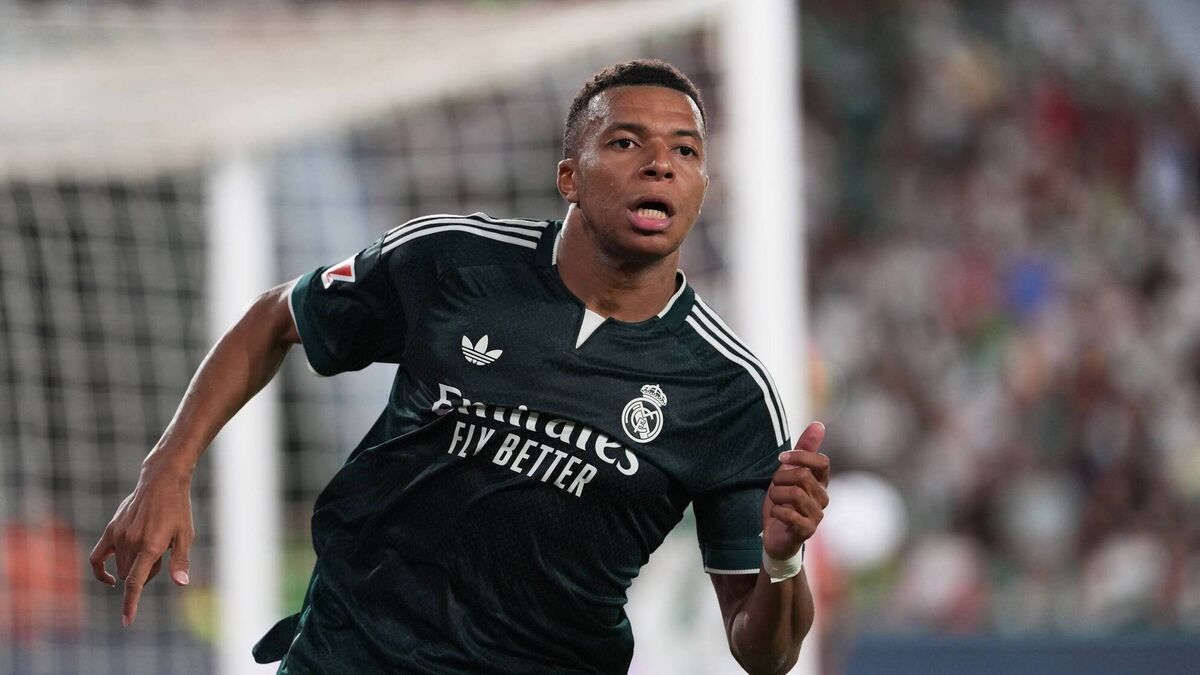
Real Madrid's Kylian Mbappe runs on the pitch during the Spanish La Liga match between Elche and Real Madrid in Elche, Spain. Picture: AP Photo/Alberto Saiz
Have you heard about Kylian Mbappé’s new football boot?
It isn’t sitting beneath bright lights in a high street sports shop. It hasn’t been stacked in boxes, modelled by wingers wearing fancy jewellery or sold to twelve-year-olds convinced that it might finally unlock the stepover.
In fact, it doesn’t even exist yet.
And that is what makes the French footballer’s new deal with Swiss sportswear company On so intriguing.
Better known for running shoes, On signed one of the most famous footballers on the planet in an attempt to break into the lucrative football market. There is no great archive of On goals. No World Cup mythology. No faded photographs of Maradona, Cruyff or Zidane wearing its boots.
Nike, Adidas and Puma have spent decades stitching themselves into football’s visual memory. On, meanwhile, has an idea. And now it has Mbappé.
But the Real Madrid star has not simply moved from one boot company to another. He has joined one before its football identity has been built, and he will have a hand in deciding what that identity becomes.
It is an extraordinary gamble on both sides. On is betting that one footballer can give it credibility in a sport where credibility normally takes generations to acquire. Mbappé is betting that his talent and celebrity are powerful enough to drag a relative outsider into a market already occupied by global empires.
But beneath the novelty of the deal sits an old blueprint. From 1984.
Back then, another extraordinary athlete joined a sportswear company that was trying to conquer a new sport. The athlete brought talent and celebrity and the possibility of creating something a sportswear company has never even pondered.
That athlete was Michael Jordan. And sport has been selling itself differently ever since.
The funny thing about the most famous partnership in the history of sportswear is that Jordan didn’t particularly want it.
In 1984, Jordan was fresh out of North Carolina and about to enter an NBA in which Magic Johnson and Larry Bird were still the established royalty. He loved Adidas. He had worn Converse. Nike was somewhere further down the list. Commercially speaking, Phil Knight’s brand was the lad in the corner still wondering whether he should go over and introduce himself.
Today, the Jumpman is shorthand for an entire sporting culture. You could show it to a child in Chicago, Shanghai or Castlebar and there would be little need for explanation.
Nike offered Jordan $500,000 a year for five years, an extraordinary sum at the time, along with a five percent royalty. It was not merely paying a basketball player to wear a shoe. It was proposing something far more radical: build the shoe around him, build the advertising around him and allow him to share in the value his fame created.
There was plenty of risk buried beneath the bravado so Nike wrote protections into the contract. If Jordan failed to move enough shoes, it could pull the plug. The company was betting an enormous amount of money on a rookie who had yet to play an NBA game and was asking consumers to fall in love not merely with its product but with the young man wearing it.
Then Jordan started playing - and the shoes began to move almost as quickly as he did.
By the end of the first year, Nike generated $126 million from Air Jordan 1. A contract that had looked reckless suddenly looked like clairvoyance.
Before Jordan, athletes sold products. After Jordan, the very biggest athletes could become products, platforms and eventually commercial ecosystems in their own right. A shoe could carry your name. A logo could belong to you. Your earnings could rise with sales. The athlete no longer needed to stand beside the company holding whatever it happened to be selling that season. The company could build an entire business around the athlete.
Jordan did not invent celebrity endorsement. He did something more consequential. He changed the balance of power inside it.
And 42 years later, Mbappé appears to be asking how much further that balance can move.
It is tempting, of course, to call this football’s Air Jordan moment.
But Jordan was still becoming Jordan when Nike placed its bet. He had not yet won an NBA title. He had not built a dynasty. He had not spent a decade turning opponents into supporting actors in his own mythology. Nike bought into the possibility of greatness before the full scale of that greatness had revealed itself.
Mbappé arrives from the opposite direction.
He is already one of the most famous footballers in the world. He has won a World Cup, starred in another final, spent years at the centre of some of the game’s most famous transfer dramas and somehow managed to make even Real Madrid wait for him. His fame is established. His talent is beyond dispute.
What he does not have is Jordan’s dominance. He has never had that sort of hold over football.
And yet that may be exactly what makes this deal more revealing. Because the wager here is not that Mbappé will become Jordan. It is that he may no longer need to.
The modern superstar arrives with a different kind of leverage. Global visibility is instant. Influence no longer waits for six championships and a decade of dominance. The best players now carry their own audiences, their own media ecosystems and, increasingly, their own commercial machinery with them.
That is where the comparison begins to shift.
Mbappé’s role with On is tied not just to a signature product, but to the company as a whole. The distinction is subtle, but important.
Jordan helped show that the superstar could become a business within a company. Mbappé is testing whether the superstar can become something closer to a partner in building the company’s future.
That is a different kind of power. For decades, the endorsement deal was simple enough. The athlete supplied the face, the company supplied the product, and a great deal of money moved politely between the two. Jordan complicated that arrangement by demanding a share of the upside.
Mbappé is complicating it again.
The question is no longer merely how much a player should earn from the thing bearing his name. It is how much of the thing he should help own.
There is no guarantee that On will become a major football brand. There is no guarantee that supporters will suddenly swap decades of Nike, Adidas and Puma loyalty for a company still learning the language of the sport. There is no guarantee that Mbappé’s fame, however immense, can drag an outsider into football’s inner circle.
And certainly there is no guarantee that the result will emulate Nike’s rise.
But if On establishes itself in football through this model, then every elite athlete with enough talent, reach and leverage will notice. The next generation will not simply ask which brand offers the biggest cheque. They will ask for equity, influence and control. They'll want a seat in the boardroom.
Nike changed the relationship between athlete and company by giving Jordan a bigger piece of the pie.
Mbappé is testing what happens when the athlete wants a bigger piece of the future.