Castlebar Workhouse is focus of lecture

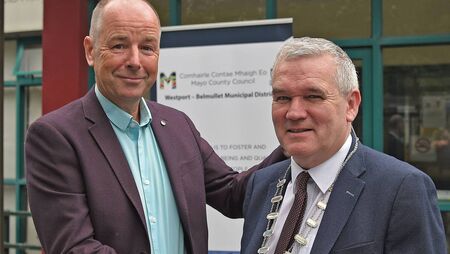
Dr Gerard P. Moran will deliver the lecture.
Mayo Historical and Archaeological Society will host its next talk at ATU Campus in Castlebar on Wednesday, February 18, at 7.30pm.
The talk is entitled 'Conditions in Castlebar Workhouse during the Great Famine' and the speaker is Dr Gerard P. Moran, who is originally from Castlebar.
The Castlebar workhouse was one of five set up in Mayo by the Poor Law of 1838, and took in its first inmates in October 1842. It was the smallest of the union in the county covering 148,000 acres. The building accommodated 700 inmates.
After 1847, the Poor Law provided the only relief available to the destitute and starving and the workhouse was unable to cope with the demand. Additional buildings, auxiliary workhouses, were rented - corn stores, breweries, etc - where conditions were worse than in the main building.
At its height, over 2,500 inmates were in the workhouse, admitting 409 people on September 8, 1848. In 1850, 920,000 were admitted to the workhouses in Ireland, and while many stayed a short period, women and children tended to remain long-term residents.
By September 1848, 46% of the population of Castlebar were receiving relief in the workhouse and through outdoor relief. Conditions in the workhouse were designed to be worse than on the outside to deter people being admitted. Families were segregated on entering the workhouse, strict rules were applied: paupers sent to solitary confinement, the withdrawal of food and sent before the courts when rules were broken.
Unions like Castlebar were constantly in debt and the workhouse struggled to remain open. The guardians constantly looked at ways to reduce expenditure, resulting in the quality and quantity of food being reduced, paupers often receiving one meal a day, which had consequences for the residents’ health, in particular children. Women and children constituted the largest group of residents - children made up to 45% of the overall workhouse population. Children were classified as ‘deserted’ or orphans: parents used the workhouse as a ‘safety net’ while they sought work in Britain and North America. Mortality increased in the late 1840s because of overcrowded conditions and those admitted were badly emaciated. In order to reduce the workhouse population, Castlebar was one of the unions that sent orphan females to Australia and Canada.
Gerard P. Moran, a native of Castlebar, lectured in the History Department at NUI Galway and Maynooth University. He has published extensively on 19th-century Ireland, including (Dublin, Four Courts Press, 2004), and was joint editor of (Dublin, Geography Publication, 2015).