Stunning new book traces 900 years of fascinating history
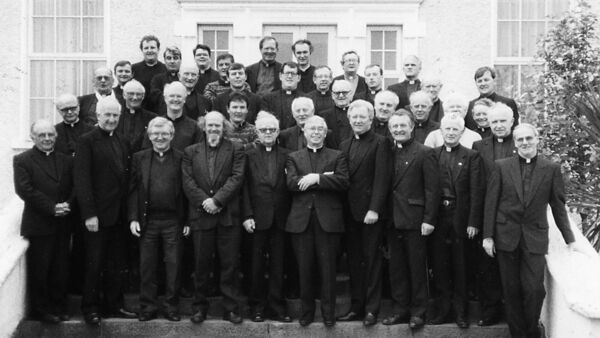
The first meeting of Monsignor Thomas Finnegan after his appointment as Bishop of Killala was at a diocesan conference of Killala priests in Gortnor Abbey Convent in May 1987.
Tracing the history of a diocese over a period of almost 1,000 years is no easy task, but if any man is up to the job, it is Brendan Hoban.
Brendan’s indefatigable research as diocesan historian in Killala over several decades has produced a remarkable body of work and his latest volume, , is the culmination of all those years of tireless efforts. It has been published to coincide with the installation of Archbishop Francis Duffy as Bishop of Killala next Sunday, an event that marks a significant milestone on the road to the historic merger of the Diocese of Killala with the Archdiocese of Tuam.
is one of those wonderful books that is a joy to peruse at leisure. It contains a wealth of information in its 250 pages, not just about the Catholic Diocese of Killala but also the social and political history of an extraordinarily long period in Irish history. To put it in context, the Vikings were in their pomp in Ireland when the first delineation of dioceses came from the Synod of Rathbrazil in the year 1111. We learn that Killala was mapped out to be a much larger area, stretching ‘from Nephin to Ballyshannon and from Blacksod to Ballisodare’, but the synod left it to the clergy in Connacht to map out their own area and Killala ended up as a much smaller diocese.
Obviously, there are scant records or references from those early centuries of the Killala diocese, but there are physical reminders, not least Cross Abbey in Erris, which was established by St Brendan in 1198. It later became an Augustinian monastery through its connection with the abbey in Ballintubber.
The Augustinian influence in the diocese was further enhanced with the building of a friary in Ardnaree around 1400, and the ruins of that monastery on the banks of the River Moy are yet another monument to the rich history Killala Diocese, a history that may now be very distant but remains a part of our lives as long as these ancient buildings endure.
In tracing the history of Killala Diocese in those early centuries, Brendan places it in the context of national and global events, such as the Black Death and Great Schism of the 14th and early 15th centuries, and major developments within the Catholic Church. In the absence of documents, it is the ruins of buildings that illustrate the progress of the diocese, whether it is the priory at Rathfran, which was founded in 1274, or the friaries at Rosserk and Moyne, dating back to the 15th century.
There are some fascinating vignettes contained in , such as a report from the Synod of Tuam in 1632, which agreed 44 statues, mostly concerning priests' behaviour. Among the rules were that priests should not keep hunting dogs, not have long hair or a beard and must avoid debating with Protestants.
Some of the earliest written records from Killala Diocese can be traced to the 18th century, including reports from bishops in 1714 and 1771. A history of the diocese was also written by a man named John Burke in 1686, a volume of which is now in the Killala diocesan archives. Burke’s fascinating life story would make for a book of its own.
The more recent history of Killala Diocese, i.e. the past 250 years, are given extensive treatment in this book, including the 1798 Rebellion and the Famine. Obviously, Killala Diocese was at the heart of Humbert’s invasion, and several priests became involved, including Fr James Conroy and Fr Owen Cowley, whose stories are recalled in fascinating detail.
The construction of St Muredach’s Cathedral in the late 1820s by the renowned Bishop John MacHale, who later became Archbishop of Galway and was one of the most influential figures in Ireland in the 19th century, is extensively covered. It was a remarkably ambitious project for its era – and even by today’s standards, the cathedral is an awe-inspiring edifice, so one can only imagine what the people of Ballina and Ardnaree thought of it two centuries ago.
contains many fascinating short biographies on members of the clergy who served in Killala Diocese at different junctures throughout its 900-plus years. On Page 48, there is a section on Anthony Dominic Fahy, a Dominican friar from Loughrea in Co Galway who was appointed Administrator of Ballina in 1837 but only served for a few months before eventually making his way to Argentina where he became a confidante to Foxford-born Admiral William Browne, founder of the Argentine Navy. Browne and Fr Fahy are buried opposite each other in Recoleta Cemetery in Buenos Aires, a place this writer visited back in 2007 to mark the 150th anniversary of the death of Browne, so it was interesting to discover Fr Fahy’s brief link to Ballina.
The devastation of the Famine, which was particularly acute in Killala Diocese, is captured in stark terms on Page 51 with a set of statistics that make for very sobering reading. In the census of 1841, Killala Diocese had a population of 135,739; ten years later, the population stood at 88,660, a decline of 46,989, which is a truly staggering statistic.
In that same year (1851), the Mercy Sisters arrived in Ballina, and the book traces their involvement in the town and the diocese, as well as the Jesus and Mary order of religious sisters who founded Gortnor Abbey Secondary School in Crossmolina. The important role of these visionary women, who contributed enormously to education and healthcare within the diocese, receives appropriate recognition within this volume.
There is also a very extensive section on the priests and religious of the diocese, with each bishop, priest, religious sister and brother listed across 50-plus pages. It must have been an exhaustive exercise to compile these lists, but the families and descendants of all those who are included will greatly appreciate the efforts that have been taken to include their relatives in this historic publication.
There is a wealth of material in from the past 100 years when records are more widely available, and Brendan Hoban draws extensively on his body of work in recent decades, which has resulted in the publication of several outstanding volumes. Killala Diocese has been very fortunate to have Brendan as its resident historian, not just because of his willingness to devote countless hours to recording the history of the diocese, but also his unique gift at being able to impart his vast knowledge in a manner that is both informative and accessible. Regular readers of this newspaper will know only too well about Brendan’s talent as a writer and it is employed to perfect effect in this book as he takes almost a millennium of history and distils it into a succinct and stylish account that will be of interest to a very wide audience, not just those with an enthusiasm for local history.
Brendan is quick to point out in these pages that he has built on the work of previous diocesan historians – men like Fr Edward MacHale and Bishop Thomas McDonnell – while the book has also been greatly enhanced by a collection of stunning photographs, both historic and contemporary. Special mention must go to photographer Eamonn O’Boyle whose outstanding images perfectly complement Brendan’s elegant prose.
A word of praise too for designer and printer Pádraig Corcoran, from Toneybane, Knockmore, who has delivered a book to the highest possible standards. We hear a lot about artificial intelligence these days, and what it can and cannot do, but a book like is a timely reminder that machine learning is a poor and soulless substitute for the God-given talents of writing, photography and design that are so beautifully displayed in this outstanding production. All those involved should take immense pride at the finished product, which is certainly a fitting tribute to Killala Diocese as it enters a new phase in its long and storied history.
is available from the Parish Office in Ballina at the very reasonable price of €20. In an era of soaring inflation, it would be virtually impossible to find better value for money.