The son of Achill who ruled the world for 11 Years
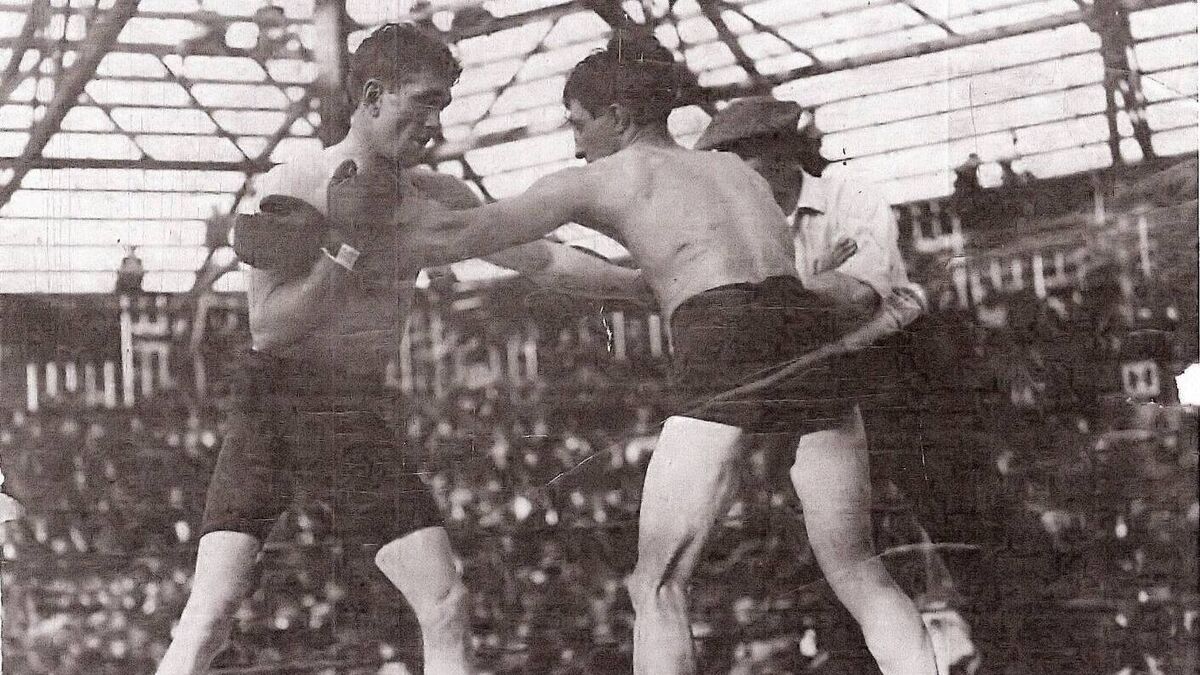
Johnny Kilbane, left, on his way to winning the world featherweight crown for the first time on February 22, 1912 against Abe Attell.
The old champion did not see the end coming. Neither, for that matter, did anyone else inside the Polo Grounds that afternoon.
For five rounds in the summer New York heat, Johnny Kilbane had looked like the Johnny Kilbane everyone had always known – cautious and cagey, faintly elusive, forever half a step beyond danger. Even at 34, with silver creeping through his hair and the strain of training strewn across his face, he still carried the old instincts. As the New York Times wrote in its report: “He had shown many of the traits of the cautious, wary Kilbane of old. He had shown no outward sign that he felt his throne tottering beneath him.” Then, Eugène Criqui walked him backwards.
The Frenchman, whose jaw had been rebuilt after the Battle of Verdun, one of the bloodiest battles during World War I, crashed a right hand into Kilbane’s chest before slamming another into his jaw. The champion fell heavily to the canvas, scrambling desperately to beat the count before time outran him.
And suddenly it was over. Eleven years as featherweight champion gone in one minute and 54 seconds of the sixth round.
The longest featherweight title reign boxing has ever known had ended in New York that night. And it’s a record that still stands today, held by a world champion whose roots stretch all the way back to Achill.
Long before a crowd of 20,000 people watched the sun come down on his remarkable career in Upper Manhattan, the Kilbane lineage was part of the great Mayo exodus across the Atlantic His people came from the Mayo island and emigrated to Cleveland where West of Ireland accents remained even as the landscape turned from currachs and cliffs to chimneys and ironworks. Kilbane was born there in 1889, into a hard Irish-American life shaped by labour, loss and overcrowded streets.
His mother died when he was three. His father lost his sight when the aspiring boxer was six. So, he left school young and went to work on the ore docks, where labourers aged quickly and the Lake Erie wind could cut through a man like a rumour through a rural village.
There was nothing cinematic about The Angle, the west-side Irish district where Kilbane grew up. It was cramped and rough and poor enough to make you understand why boxing gyms flourished beside churches. One promised salvation in the next life. The other offered a puncher’s chance in this one.
And if Cleveland gave Irish emigrants hard lungs and hard hands, it also gave them ambition. Kilbane wasn’t merely another labourer looking to roughhouse for a few dollars. He loved theatre and vaudeville. He played the violin. He could sing a tune and dance. In another life, he might perhaps have ended up entertaining crowds between curtains rather than ropes.
Nevertheless, his route into boxing arrived almost by accident. In 1907, a skinny teenager working the Cleveland ore docks found himself sparring with Jimmy Dunn, a respected fighter who had travelled to Ohio for a training camp. Kilbane had never worn gloves before. He had only street fights and dockyard scraps behind him. But Dunn immediately noticed something unusual beneath the awkwardness – speed, composure and an instinct for distance that could not really be taught.
Cleveland had no shortage of hard men at the time. Boxing gyms were full of them. But Kilbane was different. He preferred movement to mayhem. He boxed with patience and calculation, slipping punches by inches and landing just enough clean shots to convince judges.
There was toughness too, naturally. You didn’t survive the Angle without carrying a little darkness in you. One notorious bout against another local fighter called Tommy Kilbane, who was no relation, drew 408 spectators to a barn, where the doors and windows were nailed shut in case the authorities arrived looking to stop the fight. Both men battered one another for 23 rounds, but the future world champion was too much of a craftsman for his namesake.
By the time Kilbane travelled west to California in 1912 to fight Abe Attell for the featherweight championship of the world, he was already beginning to outgrow Cleveland itself. The little Irish-American had cleaned his way through contenders with his unique style. Kilbane fought economically. He wasn’t interested in theatrical destruction when quiet humiliation would suffice.
Attell, meanwhile, was the old master of the division – clever, cynical and versed in every dark art boxing had yet invented. During the 20-round fight, the champion reportedly used all sorts of cynical tactics with one newspaper account claiming the referee eventually halted proceedings to wipe some mysterious greasy substance from Attell’s body. Kilbane later insisted it was chloroform. Attell claimed it was cocoa butter. Boxing in those days often carried the moral integrity of organised piracy.
None of it mattered. Kilbane outboxed him anyway.
When the train carrying the new champion finally rolled back into Cleveland, delayed by a blizzard crossing the Midwest, the city reacted as though a victorious general had returned from war. 200,000 people lined the streets on St Patrick’s Day to welcome him home. The district where he lived eventually became known simply as Kilbanetown.
But what made Kilbane remarkable was not merely winning the title. It was holding onto it.
Eleven years is a long time to stay champion in any age, never mind an era of 20-round fights, smoky halls and men trying to remove your head for a living. Yet Kilbane kept surviving. He outlasted challengers through timing, balance and knowing precisely when not to panic.
He defended the title through World War I, economic upheaval and the roaring circus of early twentieth century America. All the while, Cleveland watched its Mayo son become something larger than a fighter. He became proof that the Irish, once dismissed as dockworkers and drunkards, could become civic royalty in America, too.
When Kilbane returned to Achill in 1922, locals were said to have expected some enormous heavyweight specimen from America. Instead they found a compact featherweight dressed sharply, carrying himself with the quiet assurance of a man who no longer needed to prove anything to anybody.
At one point during the visit, Kilbane looked across towards Achillbeg and said softly: “That is where I am from.” He then began to cry. That will tell you more about emigration than any census ever could.
America gave Johnny Kilbane fame, money and a world title that lasted longer than any featherweight reign before or since. But somewhere deep down, beneath the parades in Cleveland and the bright lights of New York, he still belonged to a windswept Mayo shoreline.
There is a statue of him now in Derreen on the southern side of Achill. After all the noise and spectacle of the fight game, Johnny Kilbane eventually found his way home.