'The Sam Maguire was put in the boot of the car'
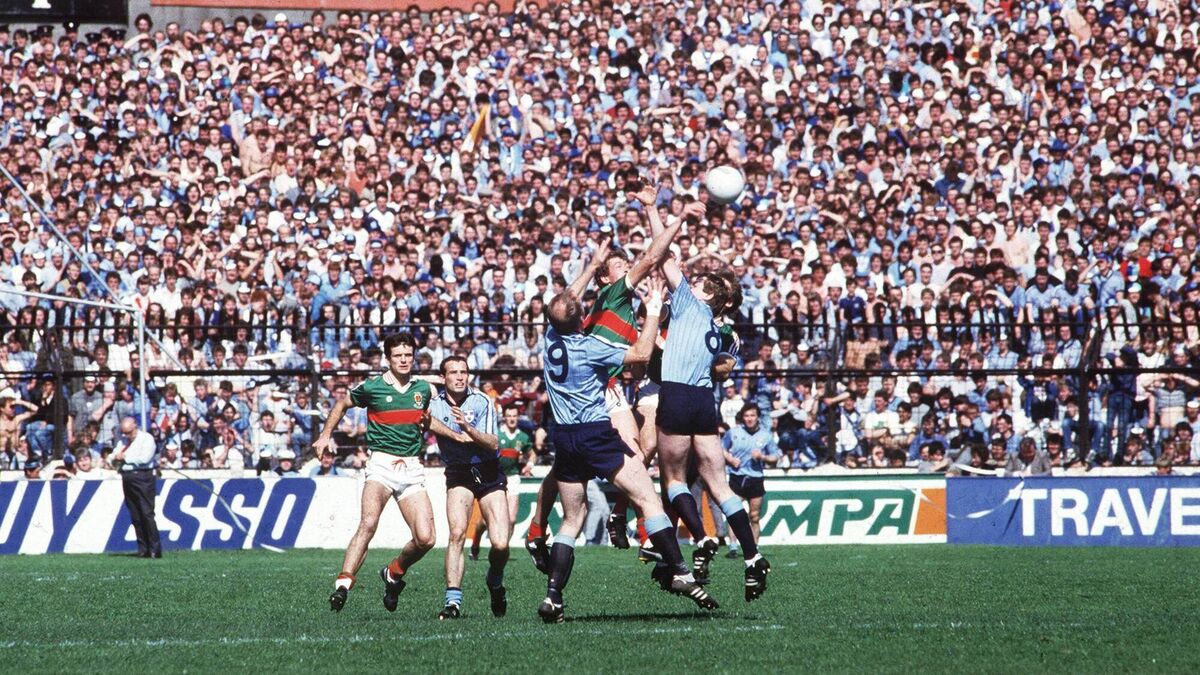
TJ Kilgallon and Willie Joe Padden contest a high ball with Dublin's Brian Mullins and Jim Roynane during the All-Ireland Football semi-final in Croke Park in 1985. Picture: Ray McManus/Sportsfile
Dunnes Stores has a special place in GAA folklore. More precisely its car park in Castlebar has a unique notoriety in the Association. On a damp Saturday morning I visited there in the company of Mayo’s All-Star midfielder TJ Kilgallon. He explained the context to me:
"When I broke into the Mayo team first in 1980 we had no real management, but in 1982 Liam O’Neill took charge of us and brought us up to the mark. Roscommon had given us many a hiding so in ’85 we were determined we would 'dog into them' and match them physically. We beat them convincingly.
"Although we lost in a replay to Dublin in the All-Ireland semi-final, it was a real learning experience and a first for a lot of the players. One of the things I remember is one of our selectors Billy Fitzpatrick who was 41 coming on and scoring a point. Despite his age, he had only played ten or twelve games for Mayo."
The following year Mayo fans and players had great expectations for the Connacht Championship after the apparent breakthrough in 1985.
"Ten days before we faced Roscommon we played Cavan in a challenge and we were brilliant. However, before the Roscommon game Dermot Flanagan got shingles and we ended up playing the game without five key plyers because of injuries. We were missing the spine of our team and were flat on the day and the Rossies beat us.
"I was talking to Martin Carney about this recently and we agreed that if there had been a backdoor that year we would have done really, really well because we had been flying before the Roscommon game and if we got our injured players back we would have mounted a strong challenge for Sam.
"That’s probably the big regret of my career. In ’86 and ’87, a lot of us were at our peak but on neither occasion did we deliver on our potential. We were a very skillful team and in our prime, more so than when we got to the final in ’89 and I see those two years as the time we really missed the boat.
"Emigration was a problem. We lost some good players like Eugene Griffin and an outstanding player in Ger Geraghty. Both our managers back in those years Liam O’Neill and John O’Mahony tried to get [Ger] back and it nearly happened a few times but he never made it."
Things did improve in 1988.
"When John O’Mahony came in to manage us he was a confident man who believed in his own ability. He brought new ways and new ideas. Meath beat us in the All-Ireland semi-final but we ran them close and that gave us hope that better things were coming."
1989 would see Kilgallon in an unfamiliar role:
"The year started badly for me. I severed my medial ligament and there was a possibility that I would never play again. Our physio Martin Carney’s wife [Gena] did a great job with me but when I got back to fitness Willie Joe Padden and Seán Maher were going very well at midfield.
"In my life, I only ever played three games at centre half-back but they were a Connacht final replay; an All-Ireland semi-final and an All-Ireland final.
"The first time was against Roscommon and I went back to my spot to pick up Eamon McManus Jnr. He turned and said to me: 'I think you’re in the wrong place.' I had a bit of a laugh with him about it. It wasn’t that he was playing mind games or anything."
TJ Kilgallon believes the ’89 All-Ireland is yet another case of what might have been for Mayo.
"After Anthony Finnerty got the goal we were in the driving seat because having lost the previous two years they were starting to doubt themselves, but in the last ten minutes we went into disarray and let them off the hook. They finished strongly and got the final three points.
"There were 10,000 people waiting for us when we flew back to Knock. It was awfully moving. There was a real party atmosphere and we went on the beer for three or four days to kill the pain.
"There was none of the back-stabbing you normally have after a defeat. It was almost a mini-celebration and Mayo people were proud of us for getting there and playing well. There was a feeling that we needed to do a tour of the county as a political move as much as anything else.
"I went back to work on the Wednesday though because for me it was over and done with – but not achieved."
Mayo’s next attempt at redemption would come in the All-Ireland semi-final in 1992.
"There was kind of a bad vibe all year and even though we won the Connacht Final there was a sense in the camp that things were not going well. Probably the most memorable incident happened in that game was that Enon Gavin broke the crossbar in Castlebar and the match had to be delayed.
"The management [Brian McDonald was manager] had brought back Padraig Brogan earlier that year - I’m not saying it was a popular move with the players. When we played Donegal in the All-Ireland semi-final it was probably the worst game ever seen in Croke Park. Padraig had played for Donegal the previous year and when the Donegal lads saw him warming up, you could see that it gave them new energy.
"Things got ugly after that. It was more personal than it should have been. It was probably an early example of player power. We said that if there wasn’t a change of management a lot of us would walk away.
"I was asked recently if we really did spend a training session pushing cars. We did! It was here in the Dunnes Stores car-park in Castlebar and the cars were really big. There was not a great humour in the camp and the manager had to walk the plank.
"John O’Mahony had stepped down in 1991 because he was not let choose his own selectors and maybe that’s when we should have acted."
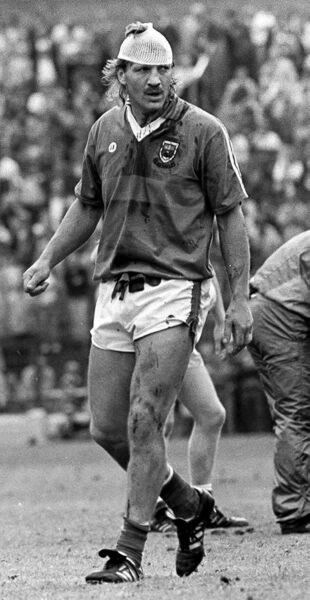
Some players have their careers deefined in moments. Willie Joe Padden is such a player. In the All-Ireland semi-final in 1989 against Tyrone, he was forced to the sideline with a dangerous cut to his head. In one of the most iconic images in the history of the GAA, he later returned to the fray, covered in blood, his head wrapped in a bandage, his shirt splattered in blood:
"Everybody had written us off before the match. I got an injury. I’m not too sure which Tyrone player it was. He was going for a ball and he hit his knee off my head and I got a few stiches in it. You don’t mind getting a few things like that as long as you win the game. It was our first experience of getting to a final after all our endeavours from the previous years. From our point of view and from a spectator’s point of view, it was a great period because we were basking in the build-up to the final, especially being in our first All-Ireland for so long.
"'89 was one of the more open All-Irelands. Unfortunately, Jimmy Burke, our full-forward got injured and he had to go off. That really took the wind out of our sails because he was in there as a target-man and did that job very well. We were forced to re-jig the team.
"Having said that, when we took the lead in the second half we looked as if we were in the driving seat but we got another injury and had to re-jig the team again. I think it was that cost us the game rather than a lack of concentration. We were just as well prepared as Cork so it certainly wasn’t a lack of fitness. We didn’t press home our initiative so we didn’t get the extra couple of points up to have the cushion there for the end of the game. Cork rallied and pipped us in the end."
The promise of reaching the All-Ireland final in 1989 was not built on by Mayo and their All-Star defender Dermot Flanagan looks back on the experience as a lost opportunity: To this day Flanagan finds it difficult to assess the way events unfolded after Mayo’s defeat in the Connacht Final replay to Roscommon in 1991:
"John O’Mahony departed in controversial circumstances. John never spoke in public about all the details and I suppose we should let him bring them to heaven with him. It is probably fair to say that part of the reason was that he was not allowed to choose his own selectors. Looking back, the circumstances of Mayo football were not right then.
"In fairness to Brian, we did win a Connacht Final in 1992 and could have beaten Donegal in the All-Ireland semi-final. We were not in the right frame of mind for an All-Ireland semi-final. There were a lot of problems with organisation. I was a man marker and I was on Tony Boyle for a short time in the game and did well on him but I wasn’t left on him and he played havoc with us.
"Afterwards the controversy broke in the media. The team was going nowhere. There were no winners in that situation. The tumultuous saga reflected very badly on the whole scene in Mayo. The County Board had been deaf to any complaints. John O’Mahony had left under a cloud. These situations don’t come from nowhere. A lot of mistakes were made."
In more recent years, Castlebar is probably best known as the power base of former Taoiseach Enda Kenny. The first Connacht team to win an All-Ireland was Galway in 1934. Two years later, Mayo won their first All-Ireland. The star of the Mayo team was Henry Kenny, father of Enda.
"A mythology developed in the county about the 1936 team, not least because they went fifty-three games without defeat. People thought they could jump over telegraph poles.
"My father went to teacher training college in De La Salle, Waterford. Times were very tough and the food was so scarce there that my father said you needed to have the plates nailed to the tables! After he qualified, he went to teach in Connemara and cycled sixteen miles to train for the club team and sixty miles to Castlebar to play for Mayo.
"One of his teammates was Paddy Moclair, who was the first bank official to play county football and he cycled from Clare. I’ve seen telegrams from the time from the Mayo County Board and they were told: 'Train yourself – you’ve been selected to play.'
"My father was particularly famous for his fielding of the ball.
"He grew up on the same street [in Castlebar] with Patsy Flannelly, another of the stars of the 1936 team. They had no football as kids so they went to the butcher’s shop and got pigs’ bladders from him to use instead of footballs. Dad always said: 'If you could catch those, you could catch anything.'
"The other thing he was noted for was his ability after he caught the ball in the air to turn before his feet touched the ground. When my brothers and I started playing, his advice to us was always: 'Be moving before the ball comes.'
"He found a big change in the way the game was played, especially when they started wearing lighter boots like the soccer players. When he saw a pair of them, he said: 'These boots are like slippers.' He didn’t have much time for the solo runs and that’s why he called it 'the tippy toe'. He said he would 'beat the solo runner with his cap'.
"In 1936, Séamus O’Malley captained the Mayo team to the All-Ireland. He travelled to Dublin by train the evening before the match. On the day of the match, he announced that he could not stay for the celebrations and got a lift back to Mayo after the match. The Sam Maguire Cup was put in the boot of the car. He had to go to his work as a teacher the next morning, so he left for work by bicycle with the Sam Maguire Cup strapped on his back! The times have changed!"
Tom McNicholas was the last survivor of the 1936 Mayo team. At ninety-five years of age, he was still driving his car, and his former career as a teacher was evident in the clarity of his directions to his home. He retained vivid memories of that team and was best equipped to give me an objective assessment of Henry Kenny.
"There wasn’t the same cult of personality back then, but there was no question that the star of our team was Henry. He was wonderful at catching balls in the air. He had great duels with the mighty Kerry midfielder Paddy Kennedy and was probably one of the very few players, if not the only footballer, who could hold his own with Kennedy. This was particularly the case in the All-Ireland semi-final in Roscommon when we beat Kerry 1-5 to 0-6 in 1936, when Kennedy was the new star in the game.
"Henry was known as 'The man with the magic hands'. He had big hands and he could hold the ball in one hand. Now our game has become more like basketball, there is so much handpassing. Back then though, it was a game of catch and kick, and nobody did it better than Henry.
"I don’t think any of our team would believe the way the game has changed, especially the emphasis on stopping teams from playing and above all the number of times people pass the ball backwards. We believed in positive football and playing your own game rather than the opposition’s."
- John Scally’s new book is available in all good bookshops now.