We can’t dance through another minefield in Croke Park
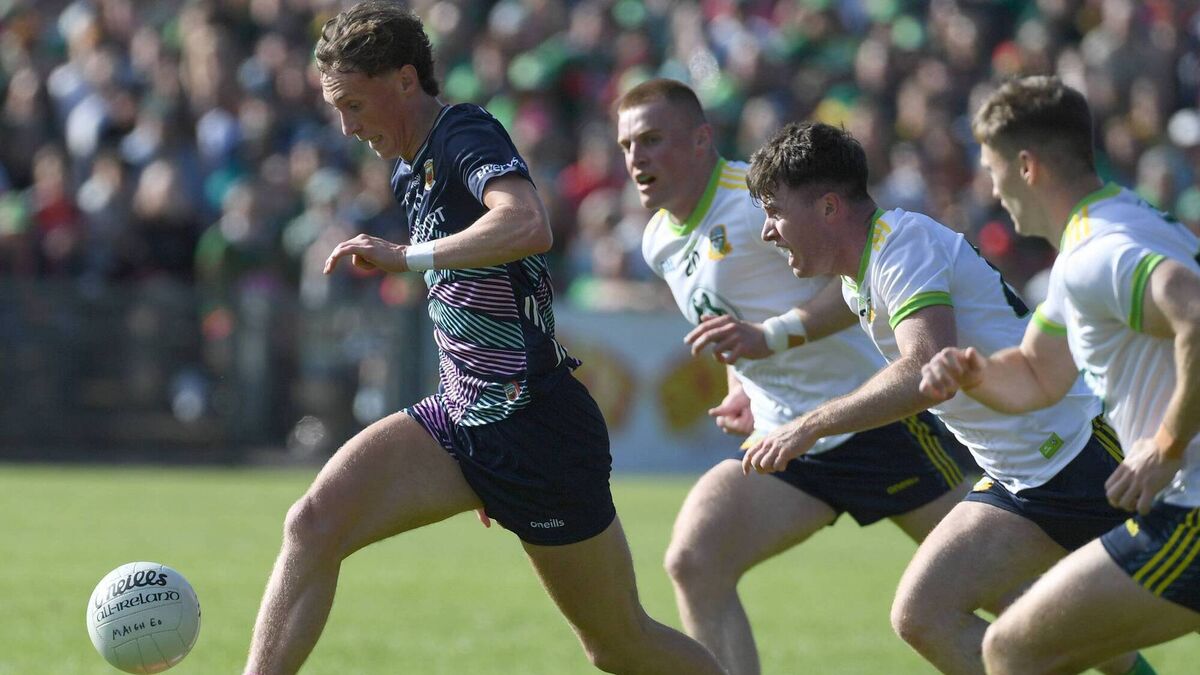
Kobe McDonald, who scored four points on Saturday, is chased by three Meath players during Mayo's three points win at Hastings Insurance MacHale Park, Castlebar, last Saturday. Picture: David Farrell Photography
On 6th August 1945, Tsutomu Yamaguchi was standing on a dockyard in Hiroshima when the sky exploded. The blast threw him to the ground. His eardrums ruptured. His body was burned. Somehow, impossibly, he survived.
Two days later, bandaged and dazed, he returned home to Nagasaki. On the morning of August 9th, while attempting to explain to his supervisor how an entire city had seemingly vanished in a single flash of light, the sky exploded again.
History remembers Yamaguchi as the only man officially recognised as having survived both atomic bombs.
Surviving two atomic bombs made Yamaguchi one of history's great escape artists, but over 80 years later Mayo are testing the upper limits of survivability. Not for the first time this summer, they wandered into catastrophe in Castlebar on Saturday evening and somehow emerged with little more than soot on their faces and another fixture in Croke Park circled on the calendar.
They were seven points behind Meath at half-time and the margin was a charitable reflection of events. Had the visitors been slightly more clinical, or slightly less generous, the game could have been over.
Mayo have developed a curious habit of treating championship football like a man dancing through a minefield. Every step appears hazardous. Every decision feels questionable. And somehow they make it to the other side of the field.
There is a temptation, after a stirring second-half comeback, to celebrate the resilience, the character and the refusal to surrender. And Mayo deserve credit for all three. But survival stories have a habit of obscuring the danger that created them. Because while Mayo eventually found a way out, the more troubling question is why they found themselves trapped in the burning building to begin with.
The afternoon began with a decision that looked curious at the time and even more curious forty minutes later. Having won the toss, Mayo elected to play into a difficult breeze. Perhaps there was logic behind it. Perhaps there wasn't. Either way, they spent much of the opening period looking like a team that had voluntarily chosen to cycle uphill.
The warning signs arrived almost immediately.
Jack O'Connor slipped through and forced Jack Livingstone into an excellent low save to his right. It drew applause from the home crowd. In retrospect, it should have drawn concern. A goalkeeper making a spectacular stop inside the opening exchanges is often mistaken for reassurance. More often than not, it's an alarm bell. And Meath kept ringing it.
Cian McBride was presented with another goal chance and could only palm over the bar. Then came the breakthrough that had felt inevitable. Meath turned Mayo over at one end of the field and swept the length of it with alarming ease. While Mayo defenders spun in circles trying to locate runners, Meath forwards attacked in straight lines. Ciarán Caulfield, a constant source of trouble throughout the first half, applied the finish.
The contrast between the teams was stark. Mayo occasionally found gaps. Meath found avenues. One side looked like it was searching for solutions. The other looked like it already had the answers.
Even when Mayo threatened, Sean Brennan responded with an excellent save to deny Kobe McDonald. And before long the visitors had another goal, Seán Coffey ambling through a defence that was leaking more than a rusty tap. Mayo did eventually string together enough scores before the interval to keep the damage manageable. The scoreboard suggested they remained in touching distance. The performance suggested something else entirely.
By half-time, the surprise wasn't that Mayo were seven points behind. The surprise was that they weren't further behind.
And yet, just when Castlebar was beginning to resemble the scene of a controlled demolition, the script changed.
Meath emerged after the interval and clipped over the opening scores, extending their lead and tightening their grip on the afternoon. But Mayo soon began to stir.
Enda Hession surged forward and forced a save from Brennan. The ground was shifting. Then, a pivotal moment arrived in the form of Ronan Jones' red card following an off-the-ball incident with Jack Coyne. Mayo, who had spent much of the afternoon gasping for breath, inhaled deeply.
And the response was immediate. Jordan Flynn launched over his second two-pointer of the day and the gap was down to two. The noise around MacHale Park rose another octave. The nervous energy that had hung over the home support throughout the first-half was beginning to migrate towards the travelling fans.
As Mayo closed in on Meath, Caulfield again found space and looked poised to land what may have been a significant blow. Livingstone, however, produced another outstanding save. It was his second intervention of the afternoon and perhaps the most important. Within seconds Mayo were charging the other direction. Carney gathered possession and launched over a two-pointer. Five points swung on the pendulum's arc. From there, Meath never truly recovered.
The fluency and certainty that had defined their first-half display gradually evaporated. The comeback was courageous. The football was exhilarating. The response was remarkable.
There is no shame in Meath's defeat. They arrived in Castlebar with a plan, executed it brilliantly for over 35 minutes and exposed weaknesses that will not have escaped the attention of other counties left in the championship. But there was a lesson in their collapse, too.
Good teams can build a lead; better teams know how to protect one.
When momentum began to turn, Meath never quite found the handbrake. The red card undoubtedly altered the contest, but championship football is littered with sides who have weathered worse storms than that. The elite teams possess an instinct for survival. They slow the game. They draw fouls. They keep the ball. They drain the oxygen from the occasion until the crowd grows restless and the opposition's surge loses its pulse.
Meath never managed it. Instead, they found themselves trying to halt an avalanche with a shovel.
The concern for Mayo is not that they lack character – it’s that they keep needing so much of it.
Because Croke Park is where the championship becomes less forgiving. The stakes rise. The opponents improve. The margin for error narrows. That is why the celebration should come with a warning label attached. Mayo's comeback was exhilarating. Their resilience was admirable. Their refusal to surrender deserves every ounce of praise it receives.
The championship road ahead is laden with dangers. And sooner or later, dancing through a minefield stops looking brave and starts looking reckless.