The league can often be a fallacy
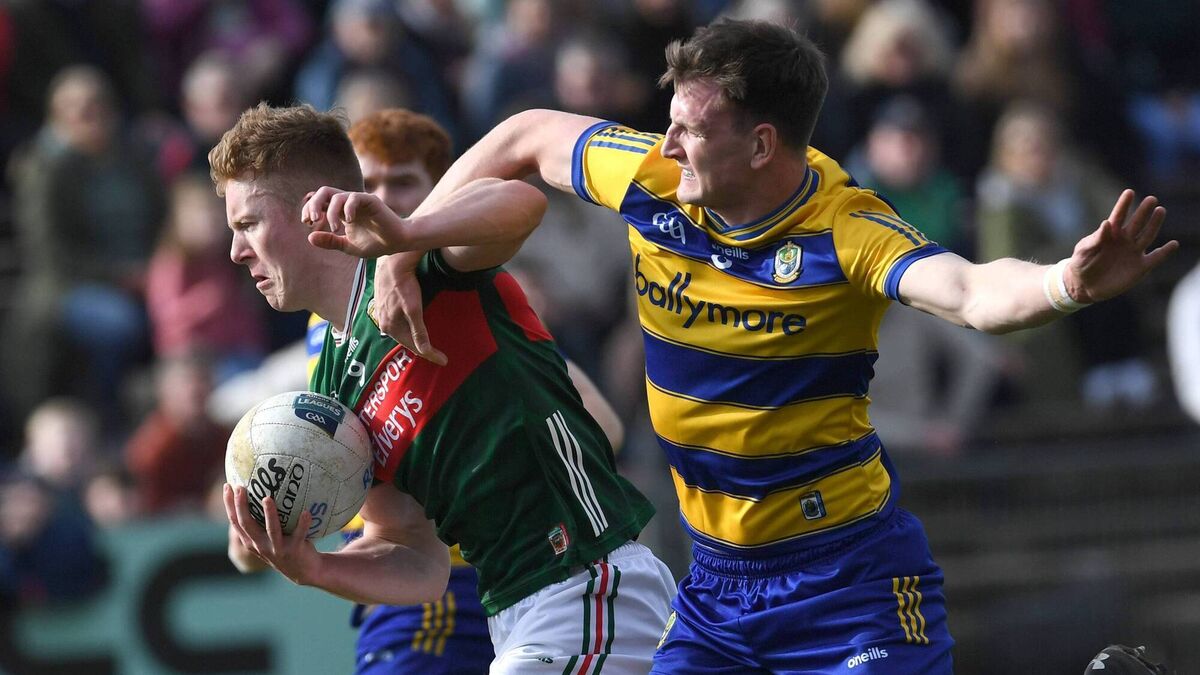
Mayo’s David McBrien is tackled by Roscommon’s Shane Cunnane at MacHale Park last Sunday. Picture: David Farrell Photography
Hands up who had a 37-point swing from Tralee to Castlebar in their wildest imagination this week?
No? Me neither.
After Mayo losing by 16 points to Kerry, the chances of trouncing Roscommon by 21-points would rightly have been seen as farcical.
But that sums up the nature of the league where so much can change from game to game and the topsy-turvy nature of the new rules where negative momentum can be hard to halt.
Are Mayo 21 points better than Roscommon? Absolutely not and they’re probably not 16 points worse than Kerry either.
But when momentum is against you, when you don’t turn up and when you have made considerable changes to your team, bad things can and do happen.
For Mayo in Tralee, read Roscommon in Castlebar.
There are so many moving pieces, particularly in league football, that make the outcome and its overall relevance hard to decipher.
Put it this way, Mayo topped the Division 1 table last year but how relevant was that to the season as a whole? The championship is what the season will be ranked on. The league may foretell what a team is doing well and what their weaknesses are but the weight of various such arguments is hard to establish yet.
But what can we deduce from this year’s league?
We can say Mayo have a more attacking mindset this year and, at times, they have looked formidable on the front foot. Their huge tallies against Roscommon and Monaghan speak to that but against Donegal and Kerry, they did not look near as threatening.
Two-pointers have been a clear target.
Mayo struck 27 across the seven games, 17 from play and ten frees. Impressively, eleven different players have raised orange flags.
It was telling that on Sunday, Mayo only scored one two-pointer with the wind (Cillian O’Connor’s two-pointer into the breeze was some kick). That was a Ryan O’Donoghue free while Paul Towey kicked one effort from play wide in the first-half.
It is no coincidence that Mayo created so many goal chances in the first-half. Roscommon were the major contributory factor to this with a porous defence but targeting two-pointers can reduce the propensity to create goal chances. The latter requires hard running at goal while the former involves more doubling back.
Did Mayo go out with the express intention of hunting goals or did they just play what they saw?
Mayo created an incredible nine goal chances in that first-half. They missed with each of their first four and then Roscommon scored with their first and only goal chance at the time when Ben O’Carroll levelled the game at 1-2 to 0-5.
Mayo’s misses were a source of concern at the time and shouldn’t be dismissed because of the goals that followed. It is common to say that at least they were creating the chances and there was a real intent in this regard but Roscommon left the door open again and again so that point can be overstated.
For context, Roscommon only conceded four goals in their six league games before Sunday and conceded that amount again in one half of football in Castlebar.
So it is a very artificial figure.
Andy Moran mentioned ‘shadow boxing’ ahead of a probable Connacht semi-final in five weeks and while Roscommon manager Mark Dowd was more circumspect, there can be little doubt it played a part in the approach of the visitors.
With safety secured after a very impressive win over Donegal, Dowd could run his panel and very much did. Only two of the defenders who started against Donegal started in Castlebar and Roscommon lost two defenders to injury by half-time.
It will be a very different rearguard in any potential Connacht semi-final.
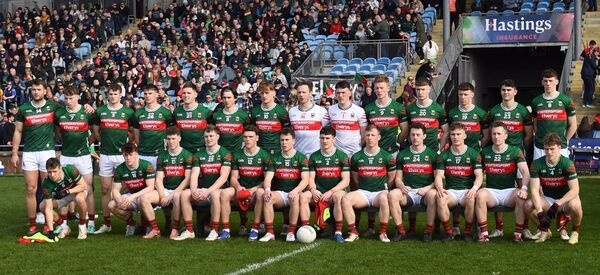
Mayo have scored 12 goals and 142 points in seven league games, averaging over 25 points a game while at the other end, they’ve conceded 11-119, just under 22 points a game.
Mayo games have been among the most open and while some of that is down to a clear change in attacking philosophy, even with that they have been more open defensively than is encouraging.
Even on Sunday, when the game was very much in the mix in the first-half, Mayo were too loose defensively on rare Roscommon attacks, particularly down the right side of Mayo’s defence. Both goals were preventable and there does not appear to be enough aggression or bite in Mayo’s defence, both individually and collectively. It is very much a work in progress.
The nature of the game will have done confidence no harm. Tommy Conroy getting scores and back on the pitch is a big boost. Same with Cillian O’Connor. Aidan O’Shea’s well taken goal will be a boost to him. Cian McHale continues to impress to the extent that there now could be an argument for starting both him and Darragh Beirne in the full-forward line.
Ryan O’Donoghue spent more time in the full-forward on Sunday than any other league game.
But Roscommon checked out of this game at half-time and arguably before then.
Despite playing into the wind, Mayo outscored the visitors 0-15 to 1-6 in the second-half.
We have written in recent weeks about Kerry and Donegal’s high shot conversion rate being as much about Mayo’s passiveness in defence as the accuracy of the opposition. We saw that on Sunday but it was Roscommon’s passiveness that was apparent.
In the second-half, Mayo scored 14 times from 18 shots for a conversion rate of 78 percent, an impressive figure but greatly aided by Roscommon. For context, Mayo had a conversion rate of 58 percent (14 scores from 24 shots) in the first-half.
There is definite progress in Mayo this year. Plenty of players have come forward and made themselves meaningful options. Even on Sunday, there was so much to like about debutant Hugh O’Loughlin at wing-back.
Plenty of positive signs but as should be so apparent by the abject nature of Roscommon’s challenge on Sunday, the full picture of the year has yet to reveal itself.