The greatest ever Connacht final 60 years on
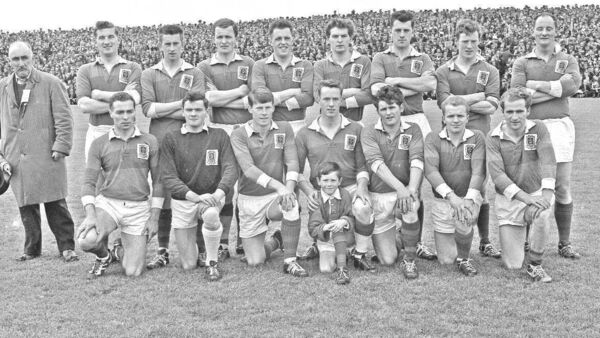
The Mayo senior football team before their epic Connacht Final clash against Galway in McHale Park in July 1966. Back row, from left: Paddy Bluett (legendary Mayo supporter), Vincent Nally, Joe Corcoran, Ray Prendergast, Johnny Carey, John Gibbons, Mick Connaughton, Willie Loftus, Mick Ruane. Front row: Joe Langan, John McGuinness, Seamus O'Connor, John Morley, Pat Kilbane, Vincent Jordan, Michael J. Ruddy. Picture: Courtesy of Liam Lyons Collection
Caesar and Pompey. Mozart and Salieri. Ali and Frazier. One rises, the other responds. Rivalries forged by each side dragging the other to greater heights.
And then you have Mayo and Galway.
In the summer of 1966, Galway arrived in Castlebar for the Connacht final as heavy favourites. As back-to-back All-Ireland champions, chasing a fourth Connacht title in a row, they would’ve been forgiven for carrying the stern authority of a principal marching into a classroom of unruly teenagers. They were the kings of Connacht, after all.
But this fixture has never had much time for certainty. Whatever advantage exists in the build-up has a habit of thinning out once the ball is thrown in, until all that remains is two counties forcing each other to their limits.
And so, for all Galway’s medals and momentum, there lingered the quiet understanding that it might not count for very much once the game began. It never does.
And for much of the first-half, it was Mayo dictating the terms. They played with a sharpness that felt almost overdue – quick to the break, direct in their running and just erratic enough to keep Galway off balance. The champions, so often composed and assured, were made to look uncertain and, at times, ragged. There was nothing cautious about the hosts. Mayo went after the game, forcing it into a tempo Galway never quite settled into. Chances came. Openings appeared.
And yet, for all of that, there was a looseness to their game. Mayo registered nine wides in the opening half, enough to keep Galway within reach, and enough to leave the game unresolved when it might already have been decided.
By the interval, Mayo led by two. It felt like more. It should have been more. And that was the first hint that this was not going to follow the script that was beginning to take shape. Mayo had unsettled Galway, stretched them, even rattled them – but they had not removed them from the game entirely. And against a team like this Galway outfit, that is a dangerous kind of generosity.
And so the game drifted into the second-half still undetermined.
As the half developed, Galway began to rediscover their former selves. They began to move with cool and calculated purpose. Positions changed. Then, they changed again. Men who had started in one line found themselves operating in another, and then somewhere else entirely. Mayo players were all at sea as they were dragged, as Mick O’Connell of this parish noted in his match report, into “a game of draughts”.
Jimmy Duggan was drawn into midfield. Enda Colleran was pulled deeper, where he began to gather balls Mayo had been winning so freely. John Donnellan shifted, too. The shape of Galway’s team became difficult to follow and harder still to contain.
All the while, Mayo continued with the same tempo, the same intent, the same assumption that the plan that had worked so well in the first half would continue to do so.
But the game had already begun to change.
And once the ground titled, Galway moved with the assurance of a team that knew this moment would always come. They attacked in waves after that. Each attack was layered upon the last, with each movement drawing Mayo a little deeper, a little narrower, a little more uncertain. The game, which had felt open and expansive in the first-half, began to tighten around the home side.
Still, Mayo didn’t collapse. That is an important detail. They still fought and chased and resisted what they could. But there was a sense now that they were reacting rather than dictating, answering questions that had only just been asked.
And Galway, scenting the pressure creeping into Mayo mindsets, pressed harder. The deficit began to shrink. Then, it vanished.
With the clock already leaning into the red, Galway found one final moment of inspiration. Duggan, now patrolling the middle third with growing authority, gathered a loose ball and immediately drove it forward with intent. Liam Sammon, who had been kept on a tight leash for much of the afternoon, recognised the opportunity. He collected the pass and, in front of over 30,000 people briefly forgetting to breathe, raised a white flag.
It was his only score of the game. That, perhaps, was the detail that lingered. For all of Mayo’s control, for all of Vincent Nally’s diligence in the full-back line, the decisive moment fell to a man who had barely featured until it mattered most.
There were murmurings afterwards about time, about the additional seconds afforded to the reigning champions. But those details eventually evaporate. What remains is the fact that Galway marched onwards to another All Ireland title two months later.
The game has long been held up as the greatest Connacht final of them all, and not simply for the quality of the football played that afternoon in Castlebar.
In part, it was what it confirmed. Galway, already twice crowned in All Ireland finals, carried themselves through a storm and revealed an ability to bend a game without breaking, to think clearly when so much was threatening to slip. These were not the habits of a good team, but of a great one. Before the end of the summer, they would prove it beyond argument, completing a three-in-a-row that placed them firmly among the game’s aristocracy.
But the day did something else, too. It shifted the sense of what Mayo were becoming.
They had gone more than a decade without a Connacht title. Yet here, for long stretches, they had matched and, at times, unsettled the best team in the country. They may not have won, but they made themselves relevant again.
And the following summer, that suggestion hardened into fact. In Pearse Stadium, Mayo returned and dismantled the reigning champions, ending Galway’s reign with a victory that carried the force of something overdue. They left Salthill with an 11-point win as they returned to an All-Ireland semi-final. What followed was the beginning of a thrilling sequence. A point separated the sides in the 1968 final as the Tribesmen claimed provincial honours. A replay was required in 1969 before Mayo emerged on top.
Mayo and Galway have always had a rivalry. But 1966 gave it its modern shape – the ferocity, the volatility and the enduring sense that when they meet, nothing can be taken for granted.