Remembering Ted Webb – Mayo’s greatest ‘what if’
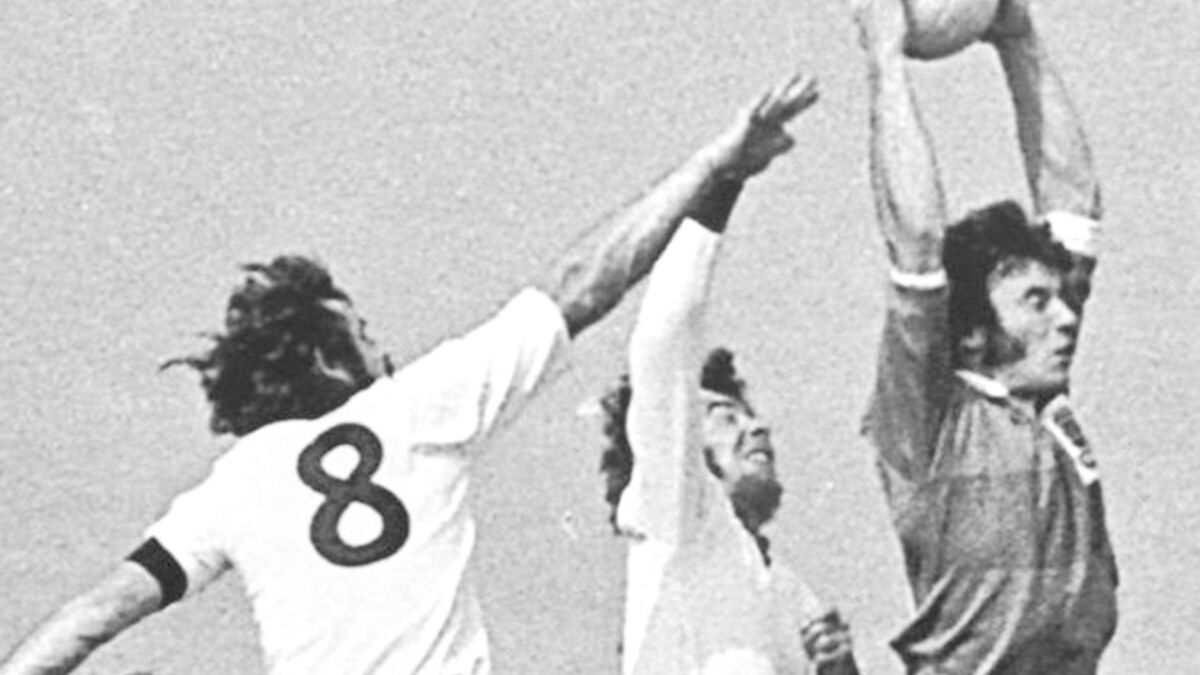
Ted Webb makes a spectacular catch for Mayo against Sligo in the 1975 Connacht SFC. The young Ballyhaunis man's life was tragically cut short in February 1976. Picture: Western People Archives
The ball clung to the sprightly Mayo forward, as balls sometimes do when they sense destiny nearby. And after being handed a half-yard of daylight, Ted Webb was suddenly thundering towards goal, body leaning forward, his mind already made up. From about thirty yards out, he struck the ball clean and hard, allowing it to flash under the crossbar and into the net.
People remember where they were when they saw it. Not because it won Mayo the 1974 All Ireland under-21 title, although it did its part, but because it felt like an introduction. This was not a lucky break or a youthful flourish. This was a statement, a young footballer announcing himself on the biggest underage stage the game could offer, doing so with pace, courage and a complete absence of doubt. Mayo had found somebody special.
Webb didn’t celebrate like a man surprised by what he’d done. He simply jogged back out the field as if to say there would be more of this, that this was merely the opening chapter. In a county always alert to the faintest tremor of promise, it landed like cymbals crashing. The future, briefly, looked sturdy.
That 1974 team was meant to be the start of a new era. And Webb looked like the kind of footballer around whom the following decade might be planned.
The young Ballyhaunis man didn't drift back into anonymity after Croke Park; he leaned into it his newly assumed aura. Connacht finals followed, as did long-range scores that swung over from distances that defied physics and swashbuckling runs that made even great defenders sweat. Subsequent performances suggested this was not a young man feeling his way into senior football but one imposing himself upon it. Teammates trusted him. Opponents marked him with the utmost dedication. Mayo selected him not on promise, but on necessity.
There was nothing theatrical about how Webb went about his football. There was no chest thumping or a sense of a career being curated. His football had a plainspoken authority – strong running, clean hands, decisions made early and carried out without fuss.
And yet for all that momentum, he never tilted away from home. Ballyhaunis kept him. He left briefly for work and returned, choosing routine over romance, repetition over reinvention. Everything about his life suggested continuity - seasons stacking neatly, promise ripening into authority. Nothing in it prepared anyone for how abruptly that sequence would be cut.
It happened on an unremarkable February night in 1976. Webb was travelling home along a road worn smooth by familiarity. At a railway crossing he had passed without thought all his life, a train arrived without warning. The impact was devastating. The car was struck and carried hundreds of yards down the track. Ted Webb was only 21.
News of the tragedy travelled fast. Ballyhaunis heard it first, then the rest of Mayo. And it landed everywhere with that same disbelief and silence. A life that had seemed to be settling into shape, a footballer just beginning to stretch into his promise, was gone in an instant. Not worn down. Simply removed.
Careers usually fade or fracture. They lose form or faith or favour. Ted Webb’s career did none of those things. It was never allowed to disappoint anyone. It ended instead in the cruellest way imaginable.
Following the tragedy, life in Ballyhaunis went on, but something had been removed from the daily rhythm. Mayo felt it, too. There was no black armband long enough to account for the loss, no memorial fixture that could process what had gone. The county never found a successor. Year after year, as new teams formed and old hopes dissolved, his name became a reference point for new generations coming along.
Mayo football has spent the better part of the last seven decades living in the conditional tense. Since 1951, the county’s football story has been written not in certainties but in hypotheticals, each summer leaving behind its own small collection of ghosts.
What if the ball hadn’t bounced so high?
What if the legs hadn’t gone heavy in the last quarter?
What if injuries hadn’t hollowed out the spine?
What if we had avoided that red card?
Every final that was lost, and every semi-final that drifted away, added another line to the ledger. Near misses stacked up. Explanations were offered, rejected and recycled. And the county has learned to carry disappointment with a shrug and a wry smile. Over time, the “what ifs” have become part of the culture rather than a complaint.
The loss of Ted Webb sits in that collection, but it towers over the rest. His death is the one “what if” that never expired, never faded with the next campaign. It has lingered across five decades of Mayo football, outlasting teams, managers and eras.
What if Ted Webb had lived long enough to fulfil his promise?
What if Mayo had been allowed to build around him?
What if he was the antidote to all the county's woes on the very big days?
What his death interrupted was not just a career, but a line of development that, for once, looked uncomplicated. He was the star of a young team in a county finding its shape, and a player growing naturally into responsibility. That kind of clarity is rare in any sport.
In February, it will be fifty years since he died. Mayo’s story since 1951 has been filled with near-misses and narrow defeats, but February 1976 was the moment when the future itself was bent off course.
His short career left only fragments, but they were vivid ones. Mayo football has witnessed drama and brilliance in abundance since, but rarely a sense of calm on the football pitch. Webb offered the prospect of something steadier, something that might have shifted the county away from perpetual brinkmanship. He was the one player who could have changed the direction of travel over time.
And that is why his absence still matters: not for what was remembered, but for what was never allowed to happen.