Mullin is becoming the conversation Down Under
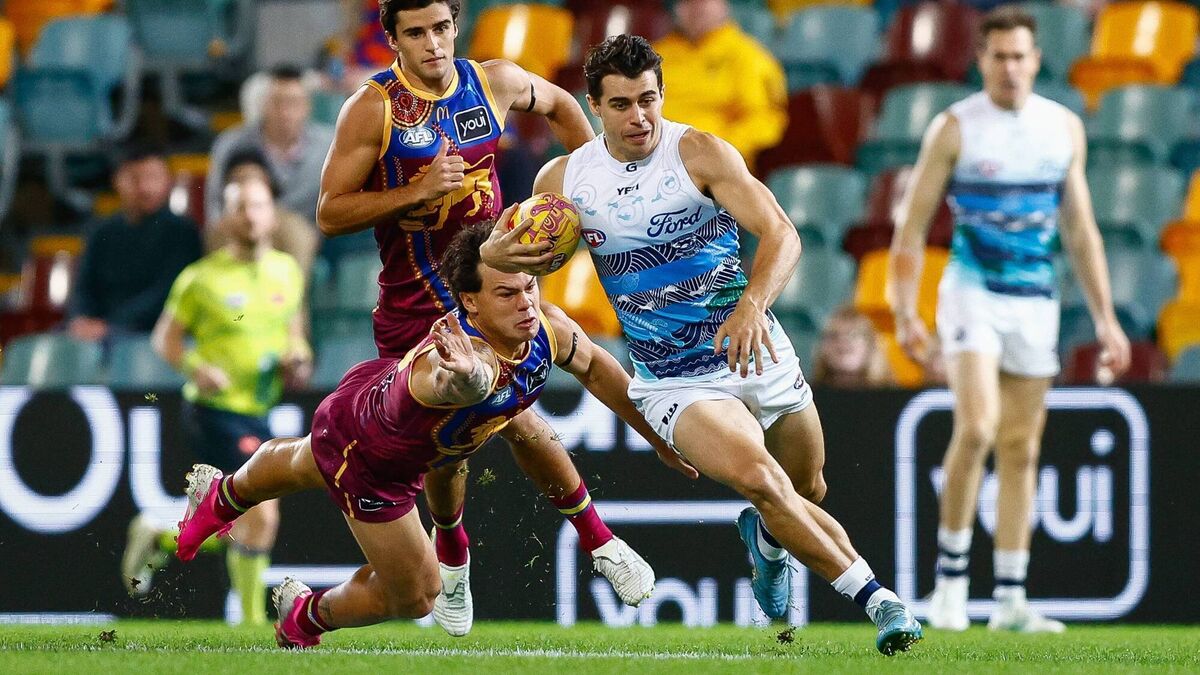
Kilmaine native Oisin Mullin in action for the Geelong Cats during their AFL Round 10 match against the Brisbane Lions last Thursday at the Gabba in Brisbane, Australia. Picture: Russell Freeman/AFL Photos via Getty Images
By the time Chris Scott wandered across the Gabba turf for his pre-match television interview last Thursday night, the question had already spent a week ricocheting around Australian football like a loose ball in a pinball machine.
Who was Oisin Mullin going to?
The Geelong coach had the wry smile of a man trying not to give away the ending to a film everybody had already half-guessed. Around him, the lights glared and the cameras hovered and the broadcasters prodded away at the same mystery that had consumed the build-up to the Grand Final rematch against Brisbane Lions. Lachie Neale? Hugh McCluggage again? Young Will Ashcroft?
There was something faintly surreal about the central tactical discussion before one of the AFL’s marquee fixtures revolving around a young man from Kilmaine. He is no longer discussed as a curio with fast feet and an unfamiliar West of Ireland accent. There is no trace of the exchange student about him anymore. For Mullin has now suddenly become a real presence in the league.
For decades, the tagger has occupied a peculiar corner of Australian football culture – respected in private, unloved in public. They’ve been the sport’s designated irritants, men whose greatest performances were often measured by how well they irritated somebody else. They were not there to paint masterpieces. They were there to smudge them. That was their raison d'être.
But Mullin is beginning to distort the very role itself.
A week after fastening himself to Nick Daicos at the MCG and quelling the Collingwood superstar’s influence, all eyes drifted towards him once again before the opening bounce in the Queensland capital. That is the aura he has begun to cultivate.
Taggers have never belonged to the game's aristocracy. No child grows up dreaming of spending an afternoon attached to somebody else’s hip bone. The role has generally carried all the romance of an insurance seminar at a dilapidated budget hotel. Most taggers disappear quietly into other people’s reputations.
But Mullin is beginning to break away from that path.
There remains something unmistakably Gaelic football in the way he travels across the ground, all long strides and open-field instinct, as though some small piece of Mayo football still clings to him beneath the Geelong navy hoops. And that has led to all eyes gazing in his direction, everybody wanting to know what role he will be handed in every game.
By the opening bounce at the Gabba last week, the answer had arrived. Mullin went to Lachie Neale, the dual Brownlow medallist – Australian football’s equivalent of All Star Player of the Year – and for stretches the assignment on the Brisbane captain was executed perfectly. Neale eventually gathered 28 disposals, because truly elite midfielders always find a way to leave fingerprints on a game. They’re like seagulls around chips; leave them unattended long enough and they’ll eventually raid the bag. But much of the damage Neale caused came once the Cats had already raced clear of last year’s champions.
And that is the subtle distinction Mullin is beginning to master. He is not trying to erase elite players from the game entirely. He knows he can bring other elements into his game that can bring more value to the team. That is what separates modern defensive players from the old caricatures of the role. The elite players in the game are no longer content merely to survive possessions. They want to shape them.
The clearest example of this arrived in the third quarter. Mullin peeled away from his man and took off through the centre of the ground with his legs whirring beneath him like the Road Runner skimming through desert dust, arriving on the end of the move to slam home a goal.
That was the moment the old image of the tagger finally began to blur. This was no longer a player simply extinguishing fires. He is capable of lighting them too.
And this, clearly, is the version of Mullin Geelong always believed to exist beneath the surface.
After the win over Collingwood the week previous, Scott spoke of not wanting Mullin to become merely “dour” or “negative”, before describing the Mayo man as “quite a complete player”. The easiest thing in the world would have been to turn Mullin into a specialist irritant and leave it there. But Geelong appears to have recognised something more valuable early on. They’ve identified the instincts which made Mullin such a force in Gaelic football could not simply be coached out of him.
You can still see the old game in flashes. In the way he attacks open grass. In the timing of his runs. In the almost reckless appetite for transition. A lot of AFL taggers move like men carrying instructions from the bench. The Mayo man still moves like he is waiting to collect a ball off the shoulder and tear up through Kilmaine Community Park with the parish roaring at his back.
And while he has not abandoned the dark arts of tagging, he has refused to let them become his entire personality.
The remarkable thing about Mullin’s rise is not simply that he has become one of the AFL’s premier tagging options; it is that he has become unavoidable. Before Geelong games, television panels and podcasts now spend entire segments wondering who he will be assigned to. Supporters scan team selections looking for possible match-ups. Midfield superstars know there is every chance the evening ahead will unfold with Mullin always in their peripheral vision, closing space and disturbing rhythm.
He has not merely survived in Australia. He has become part of the league’s weekly conversation.
Soon, this will simply become a ritual before Geelong’s biggest games. Chris Scott will step towards the television cameras, pleasantries will be exchanged and then a presenter will inevitably ask the question hanging over the evening ahead.
Who’s Oisin Mullin going to?
A reputation in elite sport rarely arrives with trumpets.
It creeps in through the side door until one day the brightest players in the league start fretting about the prospect of seeing you walk in your direction.
And the Kilmaine man is there now.