Mayo's summer hinges on Moran solving kickout conundrum
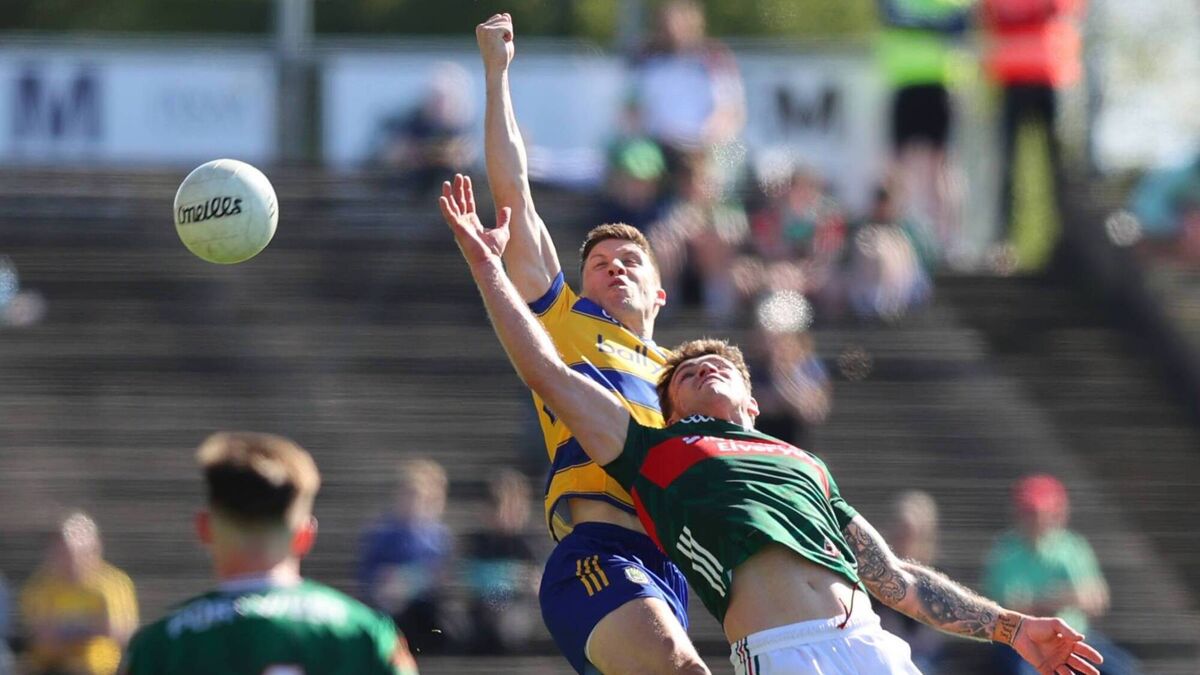
Roscommon's Ronan Daly and Jordan Flynn of Mayo battle for possession in last Sunday's Connacht SFC semi-final at Castlebar. Picture: INPHO/Tom O’Hanlon
When Andy Moran turned to Cillian O’Connor midway through the second-half on Sunday, it felt a reach for the emergency lever. There's nothing wrong with that. Great managers do it all the time. They sense a game tilting, feel momentum beginning to run through their fingers and throw on a player capable of changing the temperature in the grounds with a single touch. It’s football's oldest instinct: when the game begins to wobble, send for the man who has steadied it before.
And in Mayo, no figure carries an evangelical symbolism quite like O’Connor. Even now, in the autumn of his career, there remains a reflexive murmur when his number goes up – the old flicker of belief that perhaps the familiar saviour can bend events to his will one more time.
Only this time it felt too late. And more importantly, it didn't really address the issue at hand. Because Mayo did not need another forward. They needed the ball.
By the time O’Connor entered the fray, Roscommon were already eight points ahead and dominating midfield. Mayo couldn't get near the ball. At stages it felt as though they had not won a kickout since the Cretaceous Period. Roscommon were plucking restarts from the sky like they were low-hanging apples in an orchard, striding through midfield almost unbothered and repeatedly running at a Mayo defence that opened with alarming generosity whenever attacked at pace.
Worse from a Mayo perspective was the manner of it. Roscommon were not tearing the game open in one devastating burst. They were simply tightening their grip on proceedings possession by possession, score by score, until the contest began to feel less like a battle and more like a slow surrender.
Sending on one of the finest forwards the county has ever produced may have altered the personnel. Alas, it didn't remedy the problem.
Roscommon had by then seized ownership of Mayo's supply chains. Kickout after kickout was hoovered into Roscommon hands, and with each one Mayo’s impressive-looking collection of forwards became increasingly decorative. Like chandeliers during a power cut. There is precious little use in stockpiling attacking talent if the ball never reaches them in anything resembling useful conditions.
That is the cruel irony for this Mayo side. For the better part of a decade, their great problem was said to be at one end of the field – a shortage of natural scorers, of killers, of forwards capable of turning pressure into punishment. Now they possess one of their most gifted attacking units in years and find themselves undone by a problem much further back the chain. Mayo built a stable full of racehorses and attached them to a cart.
And that is not the sort of issue cured by a sharper team talk or a week of shooting drills. Poor finishing can fluctuate. Defensive looseness can occasionally be tightened. But when the very first act of possession is compromised, the entire attacking structure begins on unstable ground. Problems at source tend to infect everything downstream.
It changes the psychology of a game, too. Forwards begin to force matters because touches are scarce. Runners overextend trying to manufacture possession elsewhere. Defenders retreat knowing that every lost restart may bring another wave. A malfunction at the restart is not merely tactical inconvenience; it is the slow corrosion of a team’s entire rhythm. And that was very evident in MacHale Park at the weekend.
Mayo have unearthed pace, craft and genuine scoring threat in numbers. Their problem is no longer finding men to finish attacks. It is constructing a team capable of delivering the ball to them often enough for it to matter.
Such an embarrassing loss means the honeymoon period is over for Moran. Fairly or unfairly, that is the nature of the job. Intercounty management offers no long grace period and precious little sentimentality. The early goodwill that greets every new manager never survives long. Novelty buys you a few months. Enthusiasm buys you a little patience. But eventually every manager is judged on the same brutal metric: can he solve the problems in front of him?
On Sunday afternoon, Moran had no answer when Roscommon took command of midfield. He emptied the bench, shuffled the deck and reached for the trusted old reliables. But none of those decisions could address the issue that was deciding the game in plain sight.
That should concern Mayo more than the margin on the scoreboard. A ten-point defeat is ugly enough. A ten-point defeat in which the central flaw remained untouched is uglier still. Perhaps no substitution could have solved the conundrum there and then. But that only underlines how deep-rooted the issue is.
A Connacht title had been widely viewed as the baseline requirement for Mayo this season. But before April is out, that target is already gone.
This was supposed to be the manageable first step of the Moran era and a county in transition. It was a route to silverware that looked navigable and a chance to place an early tangible marker beside the rhetoric of renewal. Instead, Mayo bypassed even that modest checkpoint and will arrive at the All-Ireland series not with momentum, but with question marks.
That does not mean the season is irretrievable. A serious All-Ireland run would change the complexion of the year entirely and send Mayo into winter speaking of promise rather than regret. But salvaging it now will require overcoming a flaw that looks far more ingrained than incidental.
There are four weeks before Mayo re-enter the championship. That's four weeks to find some workaround, some patch, some imperfect solution to a problem that no longer resembles a bad afternoon but a defining weakness.
And if this remains unsolved, Mayo’s championship may end with their best forwards still waiting for service.