Mayo’s poor game management decisive again
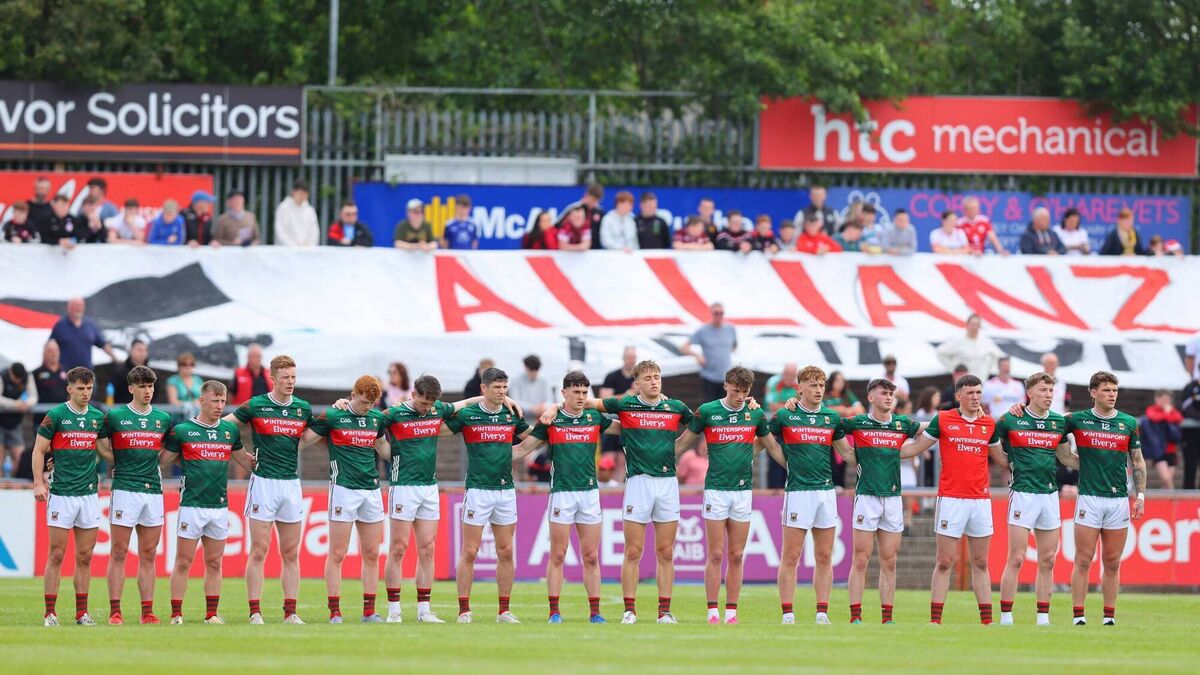
The Mayo team stand for the national anthem with anti-Allianz banner behind them as part of a local protest that included members of Omagh St Enda's GAA Club refusing to erect Allianz hoarding at the ground or sell match programmes. Pictures: INPHO/Tom O’Hanlon
The swift nature of the draw at 8.30am on Monday morning just over 14 hours after the final whistle in Omagh gives Mayo an immediate refocus for next weekend’s clash with Meath in Castlebar.
It is so quick that the potential exists to gloss over the defeat to Tyrone and look forwards rather than backwards. But that would be folly.
Mayo are still only one game away from a quarter-final and will be mightily relieved to have avoided Kerry in the draw. It is likely a 50-50 game and represents a decent opportunity to salvage a good season – for that is what a quarter-final appearance would represent. And given the teams Mayo can get are Galway, Cork and Louth, the potential for going further cannot be discounted.
But Meath will be very happy with the draw too.
They avoided two of the four favourites for the All-Ireland (Donegal and Armagh) and a hostile local derby against Westmeath.
Mayo is arguably who they would have wanted. They were quite comfortable in seeing out a four-point win against Derry in Celtic Park and have a forward unit that Mayo will struggle with.
They will watch the game in Omagh and observe that while Mayo improved in many facets of the game, their game management in the final quarter was really poor and their decision-making in general let them down.
It is not a new phenomenon. I often said during the James Horan era that Mayo were a team who you could never be certain would win with a six-point lead but, by the same token, could never write off when six points down (perhaps a bit too on the nose ahead of a Meath game).
That was under the old rules when six points was a bigger gap than it is now but the principle was the same. Mayo often struggled to control and game manage great positions in games. Who could ever forget going ten points up against Dublin in the 2012 All-Ireland semi-final only for a David Clarke save from Bernard Brogan to stop the comeback.
Nine years later, Mayo were seven down and looking out to the same opposition before a stunning comeback and extra-time victory. Just two of many examples.
If anything, the game management problems have only got worse in recent years.
The amount of games Mayo had within their compass to win but failed to get the job done in the past four years is actually quite staggering. Not everything is just poor game management – you have to credit the opposition too, but there are too many examples for it to be a coincidence.
To Omagh on Sunday, you can add from 2025 the two-point Connacht final loss to Galway when Mayo drew level on 53 minutes with the gale at their back but failed to close it out and then Mayo’s one-point defeat to Donegal despite equalising with mere seconds left only for Donegal to gallop forward for the winner.
In 2024, there was a one-point Connacht final defeat to Galway that Mayo should have won comfortably, although referee David Gough played a significant role. A one-point lead deep in the Dublin game had Mayo topping the group only for Dublin to get the equaliser and send Mayo into the prelims. There, they should have accounted for Derry in normal time but were brought to extra-time and lost on penalties.
In 2023, a four-point loss to Roscommon was followed up by an incredible five-point win in Killarney but a stuttering one-point win over Louth was the preamble to losing to Cork by three and sending Mayo into the prelims. A gutsy one point win over Galway followed but the lack of rest sent Mayo punch drunk into a 12 point defeat by Dublin.
Flip it the other way and what tight games have Mayo won in that time?
Monaghan counts but I don’t think anyone would dare count that as good game management given Mayo were 11 points up on 53 minutes. It would be stretching credibility to include beating Louth by a point in that category too.
You could include Mayo’s two-point win over Roscommon in the 2024 group stages but Mayo led that one by six with two minutes left so it was hairier than it needed to be.
You could make a case that only in Pearse Stadium in the preliminary quarter-final in 2023 where Mayo beat Galway by a point did Mayo see out a really tight, ‘could go either way’ type of closing in the past four seasons. It was frantic but Mayo saw it out. That is one win, four defeats and two negatively decisive draws in such tight games.
Now of course you will notice I haven’t included some really big wins in there like Tyrone in Omagh in 2025 and Kerry in Killarney in 2023.
The distinction there though is that they were results where Mayo actually pulled clear and that is a sign of how good those displays were.
But it also reinforces that Mayo are more likely to win pulling clear than in a single-score game down the stretch.
It is too much of a trend to dismiss, even with a quick turnaround to the Meath game and if we look at Sunday’s game, we see plenty of evidence for why.
When it comes down to it, Mayo’s decision-making and composure has often been an issue, even back a decade ago.
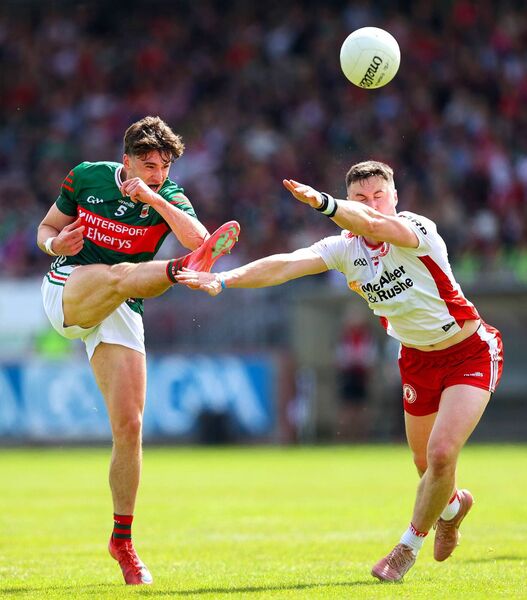
While there may be merits in arguing Darren McCurry’s first point from play was wide and that Aidan O’Shea should have had a free for him and not against for that game-winning two-pointer, the unescapable reality is Mayo made too many poor decisions in clutch moments.
Too often in the first-half, Mayo shots were easily telegraphed and blocked.
It was encapsulated by their last attack of the half. Mayo turned over Tyrone and had possession back with less than 90 seconds to go.
With a one-point lead, with the new rules, there is really only one thing to do in this scenario. Hold possession for long enough that when you shoot, there is not enough time for the opposition to go back up the field.
Ideally, you get the ball to one of your shooters and potentially take a two-point lead into the dressing rooms.
But with 45 seconds remaining, Sam Callinan chose to shoot and was blocked. Tyrone went upfield and very nearly got a goal. They did get a point and it was level at the break.
Mayo should have brought a lead in at the break but they threw it away.
These are scenarios that are coached at club level the length and breadth of the country.
Sam Callinan was the heart of another ‘what if’ late in the second-half.
He broke through on goal and could see the whites of Niall Morgan’s eyes with less than three minutes left. With only one covering defender, he had Tommy Conroy to his left.
After the melee of turnovers in the build-up, you can perhaps understand why he considered a point a good outcome, but while the pass needed to be weighted, it was a gilt-edged goal chance if he squared to Tommy Conroy and that was likely game over.
There was still plenty of time after Niall Morgan’s two-pointer for Mayo to fashion an equaliser.
Again, it is a scenario that must be practised on the training ground and there are players you want to work the ball to in this situation – such players on the field at the time would have included Ryan O’Donoghue, Darragh Beirne, Kobe McDonald and perhaps the likes of Paul Towey, Tommy Conroy and Jack Carney.
You admire anyone who steps up to take on the shot but Aidan O’Shea deciding to shoot from where he did when he did was the wrong play.
There were 35 seconds still left, and it was, at best, a 50-50 shot for him.
Mayo still had time to work a higher percentage shooting opportunity.
In too many games over the years, we have been poor in such moments. Poor decision-making, poor game management, a lack of composure, lacking killer instincts and the bit of savvy the top teams have.
It is easy for those of us who wouldn’t lace the players’ boots to speak, but by the high standards they expect of themselves, they will know it is an issue and has been for some time.
It is an endemic problem in Mayo, and it is a big ask to expect it to change in a week.