GAA volunteerism is under serious strain
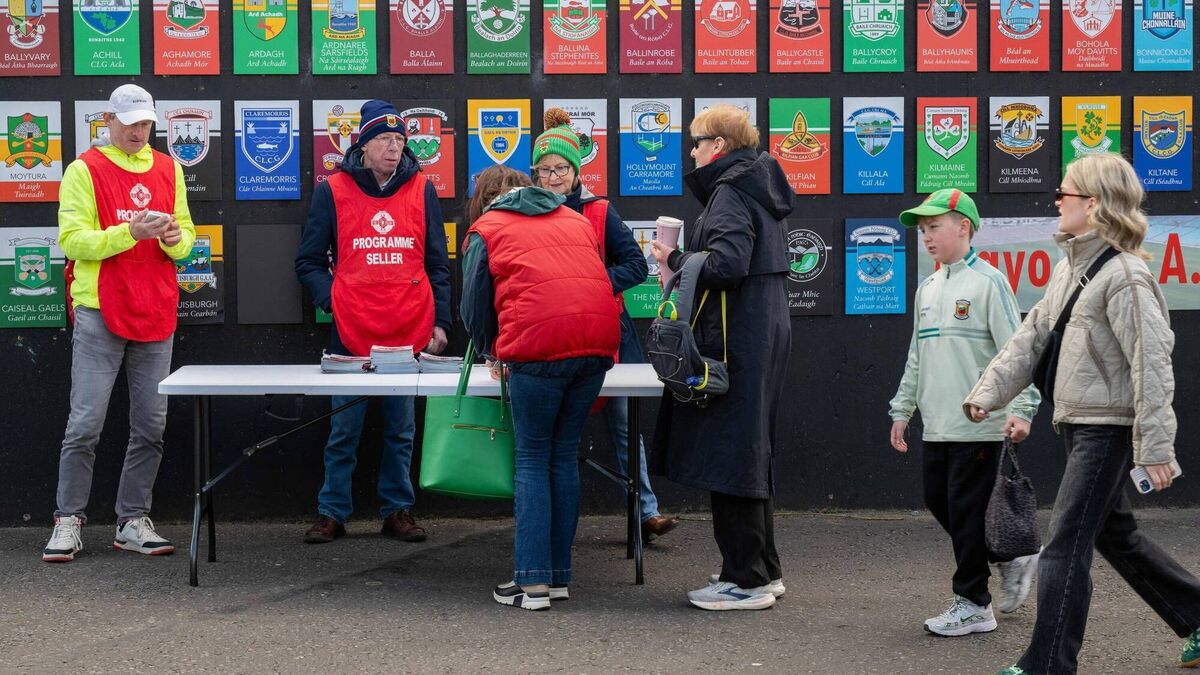
Programme sellers at Hastings Insurance MacHale Park in Castlebar as fans arrive for this years National Football League Division 1 game between Mayo and Roscommon. Picture: INPHO/Andrew Paton
Jack Coyne’s All-Ireland winning speech last month will arguably go down as one of the best we’ve ever heard, for so many reasons, not least that everyone had waited so long to hear a Mayo man deliver those words.
Coyne, as so many captains nowadays rightly decide to do, name checked plenty of people who had an input into Mayo’s day in the sun.
Indeed, one year, traditionalists were up in arms when Declan Hannon appeared to refer to a 53-member backroom team with the Limerick hurlers when he was atop the Hogan Stand steps, though he later clarified it was a mistake on his part.
Nonetheless, those winning captains speeches each year continuously shine a light on the demands on all of those involved to run a high-performance set-up of a sufficient standard to ensure a given team is capable of achieving success. The number of people now involved in running a single inter-county team is into the dozens. It’s a topic that is likely to rear its head even more over the coming months as management teams are ratified and given their starting orders for the new season.
And as Jarlath Burns’ GAA Presidency draws to a close before Wexford’s Derek Kent assumes the mantle next spring, it remains a nettle the GAA has to grasp: where does the future lie when it comes to demands on everyone involved in Gaelic Games?
This column recently discussed the wisdom of Sligo Rovers’ decision to restructure its club model in order to provide for the opportunity for investment in the club from outside sources. This will help generate extra revenue which is badly needed to help the club stay afloat and relevant in the Irish game, which has witnessed major wage inflation in recent years. In professional sport, money talks.
The GAA, of course, does not adopt the professional model, but there are bound to be further challenges on that front in the coming years. It feels as though the association is at something of a crossroads with that ethos, for several reasons.
The association is now in a society that is much changed. Money, for better or for worse, really matters. And, for an organisation that prides itself on the amateurism and volunteerism that has made it what it is over the years, that presents a difficult balancing act.
On the one hand, the GAA will rightly emphasise the great input of volunteers all around the country to clubs and counties, helping the games of football and hurling in particular thrive in every corner and parish around the island. That level of commitment and dedication shown by volunteers – and amateur players – is something everyone involved should be proud of. Because of that, the GAA is able to go to government and seek funding on regular occasions for different projects. The Sports Capital Grants, for example, have been an enormous success for GAA clubs all over the country. Larger scale projects at county level have also received backing from central government.
Then, on the other side of things, the GAA has to look to make the most of its commercial power to generate revenue to help clubs and counties finance their activities. Croke Park has become a major driver of income for the association - Katie Taylor this weekend is another example of that – while the activities around broadcasting and GAA Plus also provide an avenue through which to raise funds.
The GAA will correctly point to the fact that it needs to do all of that and more in order to keep the association going, but how does that finance-driven approach sit with the association when it comes to its amateur ethos and commitment to the grassroots?
In a thought-provoking piece over the weekend in with Kieran Cunningham, former Dublin boss Pat Gilroy aired his thoughts on how important money has become in the GAA.
His assessment was that, “the more money we have, the more we’re going to put more demands on the players, and then it has to become professional. I think these are all unintended consequences.” It's an interesting hypothesis and it's an issue the GAA is going to have to grapple with in an aggressive manner to stop things running too far away from the ethos of the association.
Jarlath Burns has made commendable efforts to emphasise the amateur nature of the association and there's no clamour amongst any cohort of the wider GAA public, it would appear, for the sport to become professional. But the demands will continue to grow on players – and by extension volunteers across the organisation – because it's human nature to try and improve year on year. The idea that the GAA can try and implement a ban on training or limit the number of training sessions in a given week is too difficult to police effectively. Once you've gone to a certain point, there's no going back.
Technology will be employed, psychologists called upon, S&C coaches inundated with requests and nutritionists brought on board. New coaches will be added to management teams and new plans will be drawn up to help create a gameplan good enough to have a better year in 2027 than in 2026. That's how sport works.
That too places an added burden on administrators at county board level to ensure everything runs smoothly behind the scenes and that the required finances are there to sustain the level of preparation requested by management teams and their players. Except here's the problem: all of that takes time and money.
Chasing improvement is absolutely what every county should be trying to do. But is there a point at which the demand on those involved on and off the field reaches a point where it's unsustainable to keep asking them to do it as amateurs or volunteers?
That's something the GAA needs to keep an eye on as we head for another inter-county season in 2027.