GAA can’t afford to let hurling gaps widen
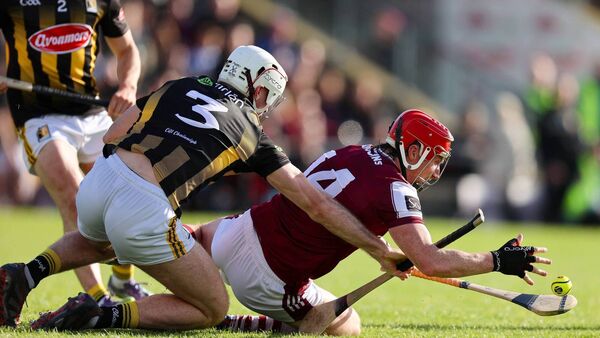
Kilkenny's Mikey Carey tackles Conor Whelan of Galway during the Leinster SHC Round 1 meeting at Pearse Stadium last Saturday. Picture: INPHO/Leah Scholes
Another hefty defeat in Salthill left many wondering when Kilkenny last lost a championship match by as big a margin as last Saturday’s mauling at the hands of a rampant Galway.
It wasn’t quite as significant a defeat as the league hammering at the hands of the Tribesmen earlier this year, when Micheál Donoghue’s side had 18 points left to spare, but last Saturday’s 15-point trimming is the Cats worst championship defeat since 1990, when a young DJ Carey contributed a solitary point in their 4-15 to 1-8 loss to Offaly in the Leinster Championship.
After an underwhelming league campaign when they could easily have been relegated from Division 1A, Kilkenny face a serious examination of their mettle this weekend when they take on Wexford at Nowlan Park in a fixture they have struggled in over recent seasons. Lose there and their championship campaign is more or less over and survival, remarkably, will become their sole goal.
Kilkenny were always going to experience something of a slide off the back of Brian Cody’s departure as manager, which eventually came in late 2022 after narrowly losing that year’s All-Ireland final to Limerick.
Yet, Derek Lyng has done a reasonably good job at managing that transition and they have only narrowly missed out on All-Ireland final appearances in the past two seasons, while they were in the decider in 2023. They’ve also won three Leinster Championships under Lyng’s watch but on the evidence of what we’ve seen so far in 2026, they will struggle to be involved in the All-Ireland conversation this time around.
Such an appraisal of Kilkenny’s woes does something of a disservice to a Galway side that look to be on an upward trajectory under Micheál Donoghue. They say you should never go back, yet the All-Ireland winning boss of 2017 has taken a long-term view here second time around and has formed a young panel that looks capable and hungry, with the experience of Daithi Burke, Padraic Mannion and Cathal Mannion sprinkled in for good measure.
The spark of life when it comes to Galway is very welcome when you take a broader look at the health of hurling across the two provinces because, on the face of it, Munster looks to be in a much, much stronger position at the moment.
We’ve only got a small sample size on which to draw conclusions from this weekend, but the Allianz League too provides something of an insight into where Liam McCarthy might reside over the coming years.
We’re approaching a decade since a team outside of Munster won the All-Ireland, when Galway climbed the steps of the Hogan Stand in 2017.
Much of the debate around hurling nationally is how to spread the game beyond the traditional counties. That's certainly a worthy objective, but it's also important to provide support to those counties that have been at the top table but who may be on the slide. The GAA can't afford for the number of counties competing at the top level to become even smaller, or the gaps to become even bigger within the All-Ireland Championship itself.
Kildare have been held up as the example to many aspiring counties who want to make the breakthrough and their progress has been built upon a couple of key strands, not least an ability to channel population growth by improving underage structures and the club scene locally, where Naas in particular have made some major strides.
The Lilywhites gave Wexford plenty of problems in their clash in Newbridge last Saturday evening but eventually lost by eight points.
Wexford would also fall into the category of a ‘traditional hurling county’ but they too are having serious problems and very nearly dropped into the Joe McDonagh Cup in recent seasons.
Offaly – another of those counties who have prospered in recent memory – experienced that drop and more too, having fallen as far as the Christy Ring inside the last decade. That said, their stock appears to be on the rise again and there was evidence of that in a spirited and determined display against Dublin last Saturday in Tullamore, where they were very unlucky not to win.
In an ideal world, those traditionally stronger hurling counties would continue to hold their position in the top tier, while others like Kildare, Down, Carlow, Laois and Kerry would continue to improve and eventually be capable of standing on their own two feet in expanded provincial championships. However, the opposite seems to be happening.
If anything, we are witnessing the Munster counties dominate to an alarming extent and those participating in the Leinster Championship seem to be falling behind. Seven counties have competed in the All-Ireland hurling final over the last decade. All five of the counties in Munster have reached the last dance in that period, but only Kilkenny and Galway have managed it from outside of the southern province.
Dublin made it to the last four last year, after their outstanding win over Limerick at Croke Park, but then shipped a hefty defeat to Cork which left something of a dampener on an otherwise excellent campaign.
Perhaps a new winner of the Leinster Championship will help stimulate that competition and its participants to achieve something better on the All-Ireland stage. Galway could well take a lot from winning the Bob O'Keeffe Cup this season and the momentum that would bring heading into an All-Ireland semi-final.
Leinster is as competitive as it has ever been, but there is a sense out there that it’s operating at a level below the action in Munster, where all five teams could reasonably make the case that they’re capable of reaching an All-Ireland final.
The opening weekend’s action provided plenty of talking points about the shape of this year’s hurling championship – but those in positions of influence should also keep an eye on the wider trends in order to ensure we continue to have at least two competitive provinces into the future.