Further rule changes cannot be ruled out
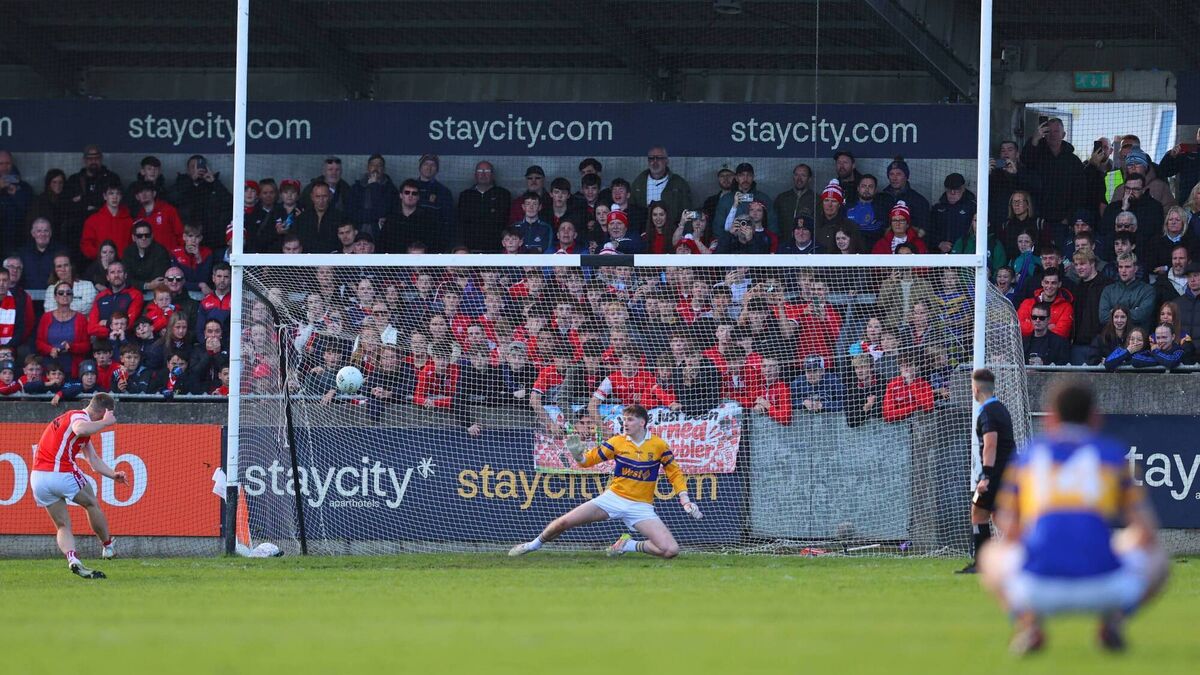
Breaffy native John Vahey is powerless to prevent Con O'Callaghan from scoring a penalty in Cuala's win over Castleknock in last Sunday's Dublin SFC Final at Parnell Park. Vahey was joined on the Castleknock team by fellow Mayo man Shairoze Akram from Ballaghaderreen. Picture: INPHO/Tom O'Hanlon
After a plethora of county finals over the weekend – many of which provided an enormous amount of drama – one should be forgiven for wondering whether any further rule changes are necessary in Gaelic football.
But, whether or not you agree with the idea of having further tweaks to the game, the GAA in the first instance deserve kudos for at least being openminded to the possibility that there may be areas to tidy up off the back of the most significant amount of change the game experienced in 2025. Keeping on top of things and having up to speed data to spot any emerging trends is always a worthwhile exercise.
Indeed, the level of data now involved in the GAA was revealed in all its glory last weekend when the Games Intelligence Unit (GIU) released its analysis report on the 2026 inter-county season. It is an extraordinary piece of work which collates data from all levels of Gaelic football at inter-county level, totalling some 200 matches. If you’re interested in having a look, it is freely available to download from the GAA’s website.
Kevin McStay’s Expert Advisory Group has used extensive data to help inform their decision-making around the proposals to help further enhance the game and, last week, these new tweaks got their first airing in a competitive environment in the opening round of the Higher Education Senior Football Leagues across the country, in matches between the various third level institutions.
I took in one of the fixtures in what turned into a one-sided clash between UCD and Trinity College on Dublin’s Santry Avenue last Thursday evening. All-Ireland winner Sam Callinan was another of those on the sideline as he watched his UCD teammates coast to victory.
UCD won by a cricket score – 9-19 to 1-9 was the final result – so any major analysis of the game and the new rules involved should be taken with a fair level of consciousness that the match itself was never really a serious competitive contest.
Nonetheless, it was easy to glean some observations from the night’s run-out.
Most surprising, to me at least, was that the three consecutive hand-pass rule did not cause anywhere near the level of chaos I had expected it to.
Both teams employed the method of literally counting out loud the number of hand-passes they took in succession to the point that, when the ball arrived to someone after a third successive hand-pass, they were in no doubt that they then needed to kick the ball. On a couple of occasions, a little dinky foot-pass was given over a short distance to overcome the new rule.
But, in several passages of play, UCD in particular were keen to move the ball as quickly as possible by the method of a long kick-pass, which is exactly what the limit on consecutive hand-passes is looking to encourage.
There are two caveats on that rule, however.
The first is that, in such a one-sided contest where one team is quite clearly superior to the other, it's easier to give a long kick-pass forward because you are more likely to have that option against inferior opposition.
Secondly, as pointed out post-match by the Trinity College midfielder Tom McCarroll, the limit on consecutive hand-passes may also force a player into making the wrong decision because they are hamstrung by the rules. In other words, there may be a hand-pass on that could create a goal opportunity, for example, but the player in possession cannot give that pass as the ball has to be kicked.
All of that being said, the limit on consecutive hand-passes did not seem to have any major undue negative influence on the game, and the anecdotal evidence appears to be the same from other fixtures around the country.
Surprisingly, the same could be said of the four-point goal. It appears as though its introduction has been met with approval in most quarters – even in Santry Avenue by Trinity College, with Tom McCarroll reiterating afterwards that he feels it is a good rule that will encourage more goal chances, even if his side conceded nine of them on the same evening.
Johnny Magee, the UCD manager for the night, also felt as though the four-point goal was an idea that had merit.
The Games Intelligence Unit data for 2026, though, showed that both figures for goal opportunities and goals scored increased in 2026, with 2.8 goals scored per game when compared with 2.1 in 2025. The Connacht Championship was the most goal-heavy competition, with an average of 3.7 per match.
What this tells us is that teams are still keen to go for goals – and this is under the award of three points for a major.
On the basis of that evidence, is there really a need for an increase to four points?
The idea does have merit in terms of moving the dial in a game. The value of a goal is now less because of the introduction of the two-point score from outside the big arc. So, perhaps on that basis, teams do deserve a greater reward for going for goal. But, the trends show that teams are already keen to put the ball in the net, and the number of goals per game is increasing without any intervention.
The other rules introduced didn’t have any major bearing on the flow of the contest, with the backcourt rule catching the teams out on a couple of occasions. Otherwise, the game looked pretty similar to the fare we’ve watched over the last two seasons.
The real business begins when the EAG starts its proper analysis once round two of the Higher Education League kicks in this week, but on the basis of the first bits of evidence we have, the appetite could well grow for the new changes to be adopted for the longer term.