A changing Ireland is GAA's greatest task
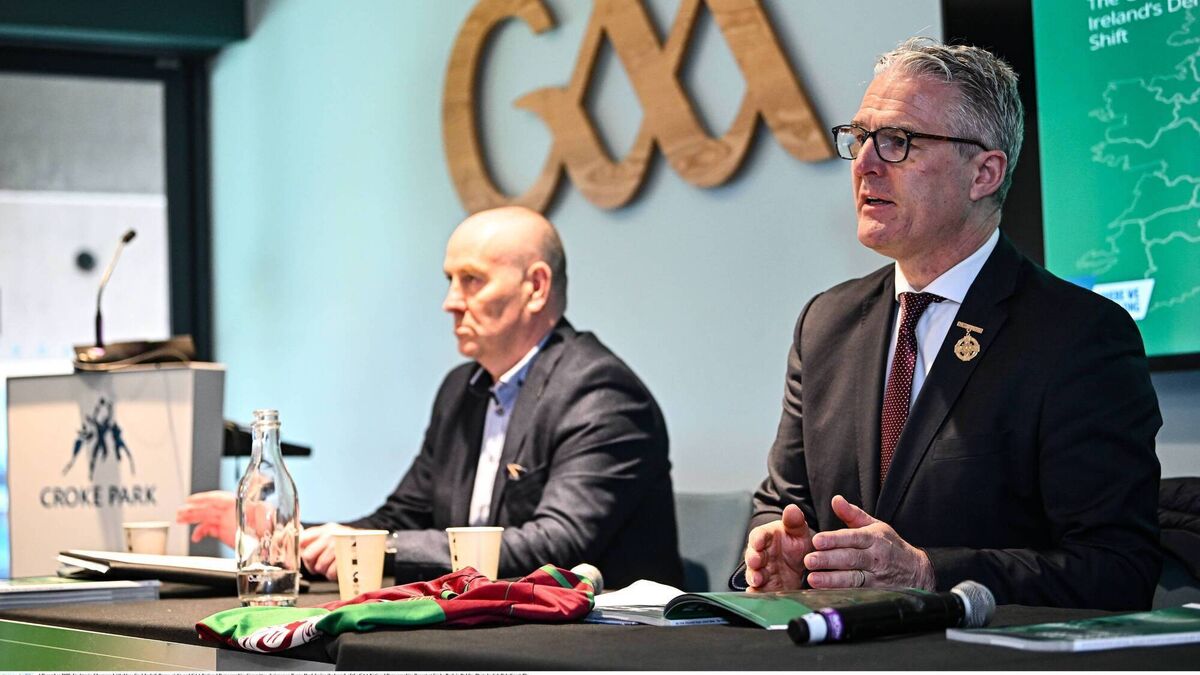
GAA President Jarlath Burns, right, and GAA National Demographics Committee chairperson Benny Hurl during the launch of the GAA National Demographics Report at Croke Park in Dublin. Picture: Seb Daly/Sportsfile
A programme broadcast on RTÉ television last week laid bare the challenges facing commuters around the Dublin area, with the M50 now at capacity according to Transport Infrastructure Ireland.
There is very little the authorities can do to ease congestion given the thousands of motorists that use the road daily. Such is the demand that it is at a standstill for a couple of hours in the morning and the same again in the evening.
The population growth in Dublin and its environs has far outweighed investment in infrastructure over the last decade and, therefore, public services are struggling to cope with demand. There are regular complaints about Dublin Bus services being full to the brim or not enough trains in operation on Iarnrod Eireann routes from other cities to our capital, particularly at rush hour.
In the context of another broadcast on RTÉ this week, the problems in Dublin with the population surge were even more interesting.
Marty Morrissey’s series of reports on the demographics issues facing the GAA was thought-provoking and frightening in equal measure.
In one instance, we got an insight into the challenges facing rural Kerry where numbers are falling at an alarming rate in certain areas where a handful of clubs now have to amalgamate to form a single team at certain age grades.
On the flip side, Dublin and other counties on the eastern seaboard are facing challenges with numbers being too high.
All of that was laid bare in stark terms by the GAA’s own publication late last week, entitled ‘No One Shouted Stop - Until Now’.
The document includes a swathe of insightful data that has been expertly put together by the GAA’s National Demographic Committee, which included Mayo native Katherine Maughan as one of its members. The figures are incredible when spelled out.
Take, for example, the situation with youngsters aged from zero to five across Ireland. 25 percent of those children are concentrated in just 50 - yes, 50 - clubs in the country.
Similarly, one third of the adults in Ireland live in Dublin or within an hour of Dublin in a satellite town. Only 18 percent of GAA clubs are located in this area.
Put simply, the numbers in a modern Ireland don’t add up for the GAA.
The association was founded in 1884 and in the following years, many club units that remain in existence today were formed. They were set-up on the basis of the realities of that time in terms of population and available players, but with many of those clubs now approaching 150 years in existence, it’s obvious that the structure of our club game will be challenged by demographic shifts in that time.
In most instances, the club structure does not require a radical overhaul, but there does need to be action to ensure that, instead of existing club units being forced to change significantly, the GAA instead changes itself to try and accommodate the realities of Irish society in 2025.
The GAA has spelled out some ideas in regard to this, including the holding of competitions with smaller-sided games to ensure clubs are able to play even if they have a smaller pick than others.
A rule to allow 11-aside competitions take place was one of the ideas mooted. This is a welcome proposal.
For all the challenges facing the GAA, the club remains the heartbeat of the association. The split season model has, in this writer’s opinion, helped solidify the club’s place in the GAA calendar and has, in some cases, help breath life back into the club game.
Locally, we saw huge crowds at a number of Mayo club championship matches over the past summer, with packed club grounds for the semi-finals in particular a highlight of the senior campaign. Mayo may be a market leader in this regard but there is evidence elsewhere that clubs have benefitted from having a little more space to breathe.
Beyond the big clubs competing in Senior club championships around the country, it’s the smaller clubs that often illustrate what the GAA is all about.
Mayo is a very good example of several clubs battling against the odds to keep things going, with the Junior ‘A’ and ‘B’ Championships both vibrant competitions.
Ballycroy may not have won the championship this season, but their milestone in reaching the knockout stages for the first time in 38 years means they will approach next season with a renewed vigour.
Aughavas have fallen some way from the heady days of their past when they were winning senior championships in Leitrim, but their run to the Connacht Club Junior final provided huge colour and energy in their local area. Their win over Galway’s Carna Caiseal in the semi-finals was arguably the standout result in any of the three male championships held in Connacht over recent weeks.
Clubs like Ballycroy and Aughavas know all about falling population and the impact of urbanisation in our society as young people from those areas, and many others, flock to our cities to take jobs and begin their adult life. Yet they've battled on and have enjoyed productive seasons in 2025.
Like a talented bunch of underage footballers coming through and helping sustain a club for a while, population changes can too be volatile, in both directions. The GAA needs to ensure that clubs survive the current challenges so that, when things may tilt in the other direction and rural Ireland becomes a little bit better served with infrastructure and employment, that clubs are still there to cater for those returning to their home areas.
Amalgamations do work in some instances, but there are also instances where amalgamations that took place 50-odd years ago have now led to clubs having too big a pick due to demographic changes. Clubs being too big is also a challenge - albeit a lesser one - that the GAA will have to grapple with in the not-too distant future.
As an association, the GAA needs to do all it can to support clubs, not simply tell them to club together and form a team amongst two or three clubs. Amalgamation should always be the last resort because the club is everything to a local community. And once it's gone, it most likely won't come back.
That's why 11-aside competitions, for all their perceived flaws, are a good idea.
Every last thing must be done to ensure our clubs survive in a changing Ireland.