Prague pain carries a hint of optimism
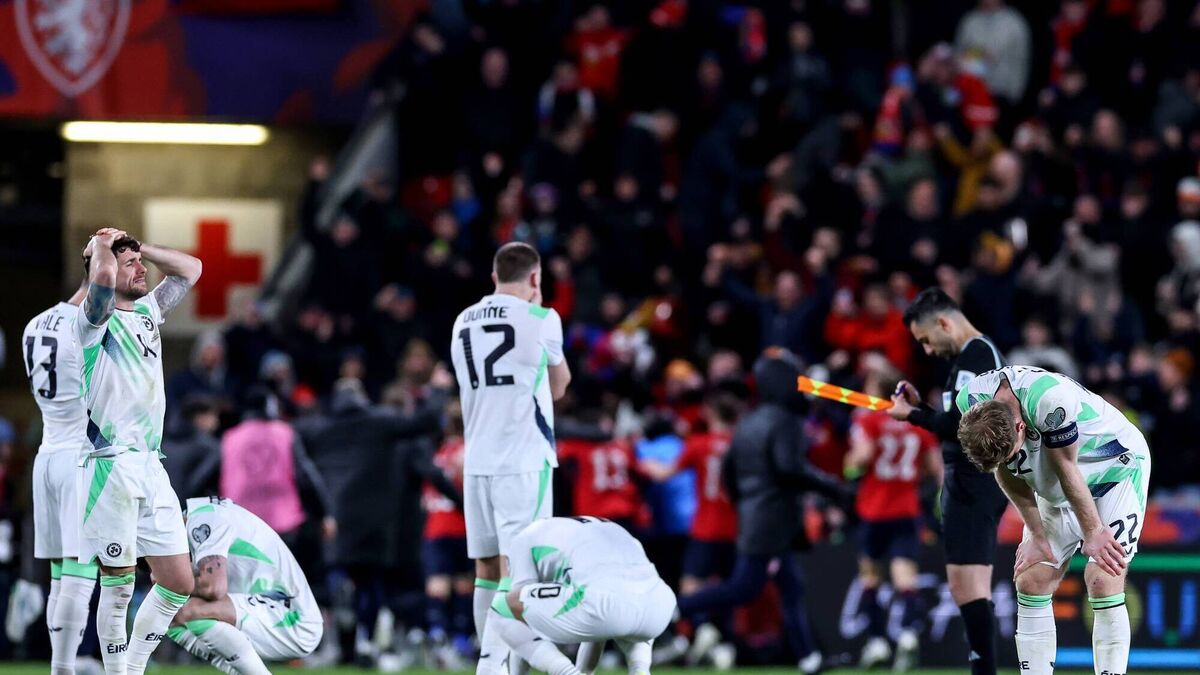
Republic of Ireland react as they lose the penalty shoot-out to Czechia in the FIFA World Cup Play-off Semi-Final in Prague. Picture: INPHO/Ben Brady
- Seamus Heaney
Anguish settles quickly after a penalty shootout defeat.
And Prague was no different. Irish shirts stood still while red ones scattered in celebration. A few players bent over in a bid to hide the raw emotion on their faces; others stared straight ahead, as if the night might rewind itself out of pity. It didn’t. These nights never do.
At home, it travelled slower. It seeped into pubs where conversations stalled mid-sentence, into living rooms where nobody quite trusted themselves to speak. There was no great outburst, no roaring at the sky - just that familiar, hollow feeling settling in the chest.
The Republic of Ireland were out. There would be no World Cup adventure. No sunburn. No street parties. No harmless mischief.
And this one will linger.
It will follow people into June and July, into the long evenings and late kick-offs, into the hum of a World Cup that the Republic of Ireland were supposed to be part of. Because as the tournament unfolds - in colour and noise and chaos - there will be a quiet question drifting through it all.
What if?
What if that two-goal lead had been enough?
What if one moment had been managed, one ball cleared, one nerve held?
What if the Republic of Ireland had made it?
And then the mind begins to wander.
Irish fans filtering into Mexico City, jerseys draped from balconies, songs spilling out onto unfamiliar streets, strangers becoming friends over pints and broken Spanish. And Mexico City, vast and unruly and alive, would have embraced it. The colours. The noise. The shenanigans. You imagine the Irish fans flooding into the Estadio Azteca, one of the great cathedrals of the game.
And you imagine the country growing into the tournament, finding their rhythm in the thin air, a favourable draw opening doors that once seemed bolted shut. And then a knock-out tie with the old enemy beckons. As England comes to town, Mexico City is beginning to feel like home. The songs are louder. The belief is firmer.
Another victory over the English is folded into Irish folklore.
From there, the road bends to Florida for a dream tie with Brazil in the sweltering Miami heat.
It could have been.
But this feels different.
For years, these exercises in imagination have felt like indulgence - little daydreams to pass the time between campaigns that never quite took off. You could sketch the route, name the cities, picture the songs - but somewhere deep down, you knew it wasn’t real.
This time, it is - or at least, it was close enough to touch.
The Irish side didn’t arrive in Prague clinging to hope. They arrived with expectation - not the loud, chest-thumping kind that collapses under its own weight, but the quieter sort. That hasn’t always been the case. Hope, around here, has often been a short-term loan rather than a long-term investment.
For too long, Irish football has lived off memory. The same old nights have been replayed ad nauseam. What followed was a slow drift - campaigns that promised little and delivered less, performances built on resistance rather than ambition.
The latest campaign brought the country to unfamiliar territory.
Not because they were flawless. They weren’t. Not because they controlled every phase of the game. They didn’t. But because, for long stretches, they looked like a team that understood what it was trying to be.
They pressed with intent. They carried a threat. They played forward without fear. And when the moment came, they took it.
And when it slipped, as it did, it didn’t feel like the old collapse. This wasn’t a side overwhelmed by the occasion or outclassed by the opposition. This was something subtler. This was simply a team that hasn’t yet learned how to control a game once it tilts against them, a team still figuring out how to close the door.
There’s a difference. The old Republic of Ireland lost because they weren’t good enough. This Republic of Ireland lost because they’re not finished yet.
And that distinction, small as it might seem in the aftermath of another elimination, is where the optimism lives.
But optimism also tends to arrive with a caveat tucked under its arm, a quiet reminder of all the times movement has been mistaken for progress. Encouraging defeats have been dressed up as turning points before, after all. Narrow exits have been repackaged as beginnings. The language is familiar.
The best teams don’t just build leads - they suffocate games. They recognise the moment when chaos needs to be quietened, when energy must give way to control. The Republic of Ireland, for now, is still caught between those states. Irish players are capable of surging forward, of overwhelming spells, but they’re not yet able to dictate the terms once the tide begins to turn.
Moreover, this campaign was not built on steady ground. It was pieced together in bursts - a result here, a performance there, momentum gathered late rather than sustained throughout. The surge came, but it arrived at the end rather than the beginning.
That, more than anything, is the next step.
The Republic of Ireland needs to put together a campaign that holds its shape from start to finish, one where progress isn’t something you chase late on, but something you establish early and carry with you.
Consistency is the barrier now.
The old Republic of Ireland rarely got this far into games. The current version of the team gets there - it just has to learn what comes next.
And that’s why the optimism, cautious as it may be, feels earned rather than imagined.
The next campaign is already waiting. The Nations League will come and go, offering another set of tests, another chance to learn how to manage moments rather than merely survive them. And beyond that, the road to Euro 2028 will be a campaign that will demand that glimpses are converted into habit.
They didn’t make it to the summer.
But for the first time in a long time, it feels like they might yet earn one sooner rather than later.