World Cup won't touch our GAA championships
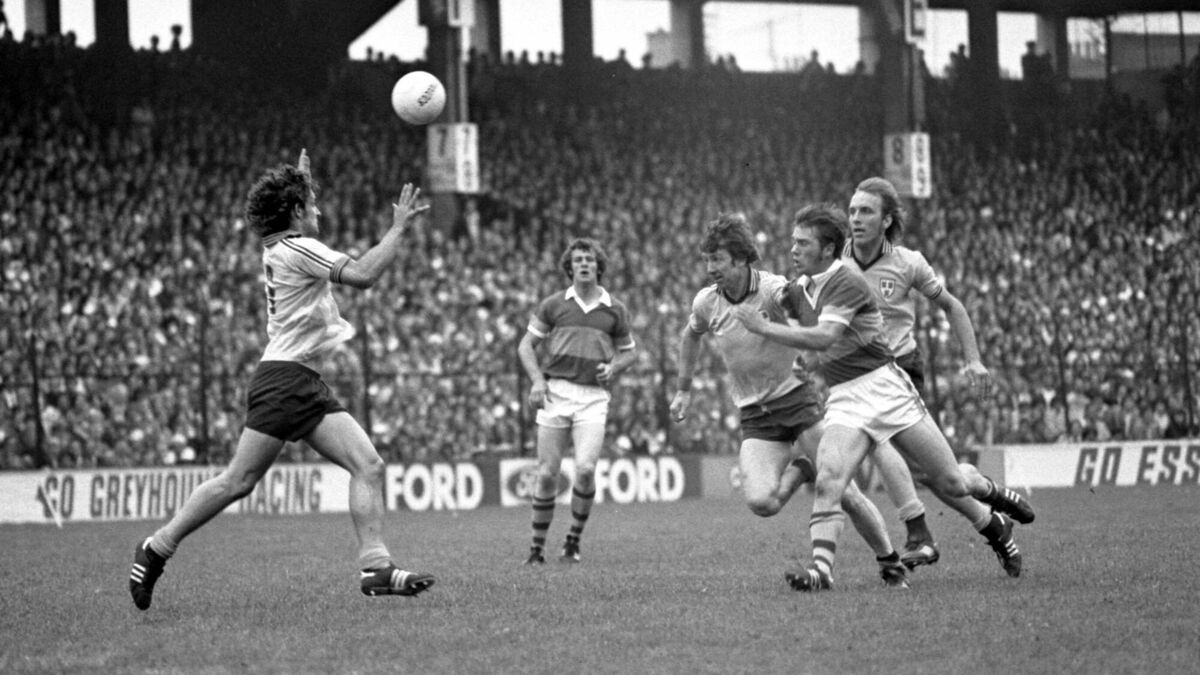
Dublin's Kevin Moran about to block a fisted pass from Kerry's Páidí Ó Sé O'Shea during the All-Ireland Final in 1977.
When I think of the phrase 'footballing heroes' I think of the head-bandaged warrier with a never-say-die attitude. I think of the likes of Kevin Moran and Willie Joe Padden; men who had raw talent, a desire to compete and no gaping flesh wound would keep them from their task - a bit like the Ox Mountain men I played with and against in my younger days.
Over the next few weeks, we will see the superstars of world football grace our screens as part of the 2026 World Cup extravaganza. We will witness indisputable footballing talent but it will be contaminated with copious amounts of bad manners, infantile behaviour and blatant cheating.
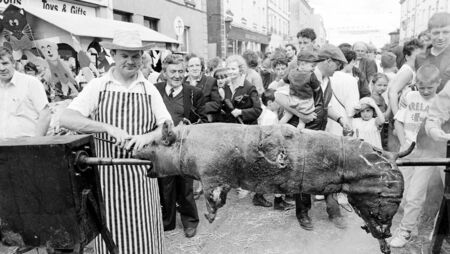
The history of soccer spans over 2,000 years. It seems it was always the nature of men to hone their athletic prowess by kicking a round object around the yard; everything from an enemy’s head to a pig’s bladder. Soccer has evolved from such rituals in ancient China, was formalised in England in the late 19th century, and has culminating in what we have today - the world's most popular sport.
In October 1863, representatives from various English clubs and schools met in London to establish a universal set of rules. This particular meeting officially separated soccer from rugby and formed the Football Association (FA). In 1904, the Fédération Internationale de Football Association (FIFA) was founded in Paris to manage international competition. Founding members included France, Belgium, Denmark, the Netherlands, Spain, Sweden, and Switzerland but, remarkably enough, did not include England. Later, in 1930, the first World Cup was hosted and won by Uruguay.
And so, we arrive at what has become known as 'The Beautiful Game'. While the exact origin of this term is often questioned, the phrase was immortalised by Brazilian football legend Pelé. He famously used the phrase to describe the graceful, joyful, and creative aspects of the game. In Brazil, the philosophy goes beyond simply winning; it values how the game is played. It represents artistry and flair, creativity and joy. There, it is not just a game; it is a way of life, meant to entertain and bring happiness to both players and fans alike.
The story of the foundation of the Gaelic Athletic Association (GAA) is now legend. We are all aware that fateful day in November 1884, and the historic meeting in Hayes's Hotel in Thurles and the organisation that was created to preserve and promote our indigenous sports of hurling, Gaelic football, and handball. Its formation was as political as it was sporting and its tribal and parochial nature proved unique. The GAA and its games forged an identity for a people who didn’t have one at that time and it is an identity that has remained with us to this very day.
None of this is to say that the GAA and its games are perfect; there have been many bumps in the road. We have had the slow formation, the long fall-outs, the politics, the substandard facilities and the poor treatment of players. We have had financial scandals, any amount of personality conflicts and rule changes to beat the band.
With regard to rules, it seemed as soon as one county team mastered one set, it signalled an outcry from the remaining 31 to level the playing field. I refer to the great hand-passing Kerry teams of the late 1970s and the blanket-defence Donegal tactics spawned in 2012. Mick O’Dwyer and Jim McGuinness may have been shrewd tacticians but they were not for the purists. Some would even say they stole Gaelic football for a while. They found a way to play the game, albeit within the rules, that gave their teams an advantage over others. The trouble was; in order to regain the advantage, all the other counties had to adapt to and begin to play these ‘new’ games. The problems caused by the blanket-defence method of playing Gaelic football almost killed the game.
In recent years, the GAA introduced sweeping changes to Gaelic football spearheaded by their Football Review Committee, chaired by Jim Gavin. The aim of these changes was to increase the flow of the game, promote kick-passing and high fielding, reduce cynical fouling, and restrict overly defensive play. The efforts of this committee have transformed Gaelic football. It is, once more, a game that displays all that was good about our great game, where talent and skill and endeavour are rewarded. Even a lower division club match is now enjoyable to watch and all intercounty games are highly entertaining.
We will see two contrasting games on our screens this summer. One, played by highly paid professionals that will be hallmarked by abuse of match officials and attempts to cheat. The other will be played by amateurs, showing respect for referees and where there is no room for cheating - there simply isn’t time in such a fast-moving game. The glamour of the upcoming World Cup will attract the attention of millions of people and will generate billions in revenue. And all this for a game that provides two or three scores over a period of 90 minutes. These days, a good Gaelic football match throws ups a well-worked score every two minutes.
As the All-Ireland football series enters its final phase, Irish audiences will be treated to nail-biting entertainment every weekend through this June and July. Each 70-minute game will be packed with scores and all manner of footballing skill will be on display. Goalkeepers pin-point kickouts, towering two-pointers kicked from sixty yards and majestic high fielding will be the order of the day. There will be no whining over refereeing decisions, no hocus-pocus celebrations and no rolling around on the ground feigning injury. The clock will be stopped when play is stopped and the hooter will sound when the seventy minutes are up.
Close your eyes. Imagine a game where men play for club or county instead of for cash. Imagine a game where cheating has no currency. Imagine a game where referees are shown respect. Imagine a game where officials (a whole team of them) are not required to make a vital decision that takes forever in the middle of an important game. Imagine a game that is meant to entertain and bring happiness to both players and fans alike. Now, open your eyes. What comes to mind - soccer or Gaelic football?
Don’t get we wrong, I like soccer, I like the beautiful game, Pelé’s , but I don’t like the antics and the corruption that goes with it. But this new brand of Gaelic football? Well, it is something else. It has never been so advanced, never demanded or displayed so much skill, never been so disciplined, never seen such talented players, never been more enjoyable. The game that the founders of the GAA envisaged has finally arrived. It is a game that is a worthy tribute of our ancient heroes; warriors, hunters and athletes who prided themselves on discipline and guile in equal measure.
Picture the scene; two armchairs and two television screens in different rooms. It is a Sunday afternoon in late June 2026. There is a clash; on one telly there is a World Cup match and on the other, a match in the final stages of the All-Ireland football series. I don’t know about you but I know the game I’ll be watching. Oh, and I’d suggest an urgent meeting between FIFA and the GAA.