The story of Ireland and Empire isn't simple
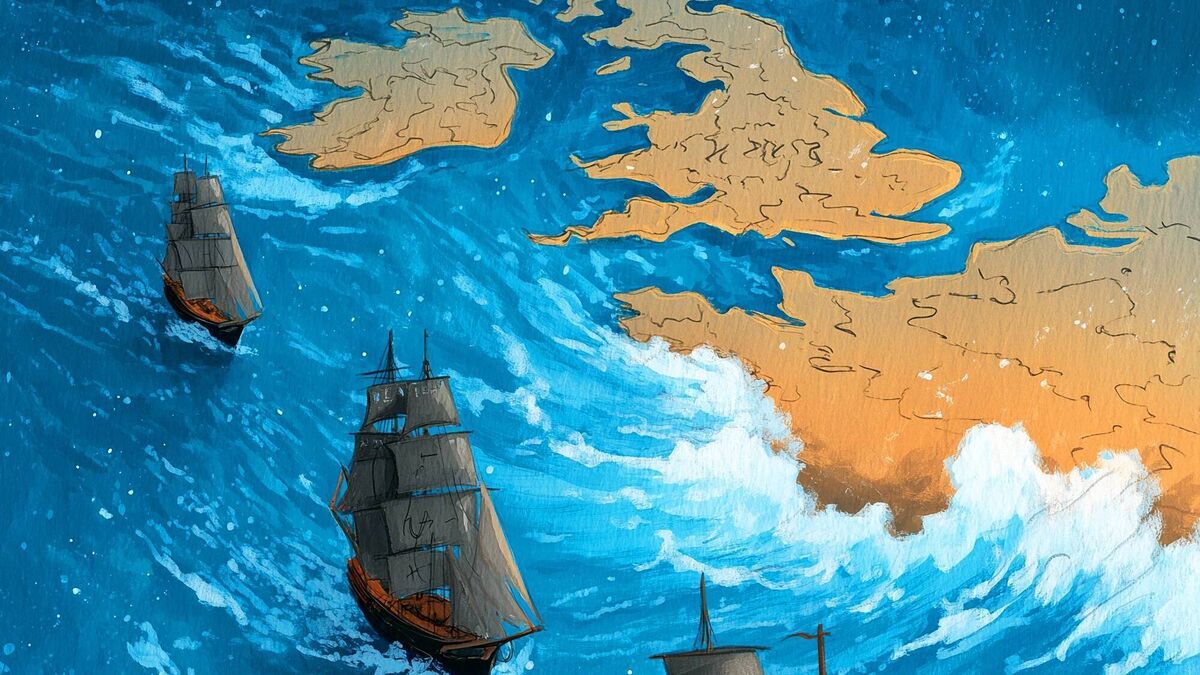
Author Jane Ohlmeyer argues that Ireland simultaneously was England's first colony and eventually a willing participant in the business of empire-building. Illustration: Conor McGuire
A sedate and satisfied historian might suggest that there's something almost reckless about writing a history book that urges us to look at our ugliest family photographs. But Jane Ohlmeyer's unsettling book is precisely that sort of album, the kind you find secreted in the attic and wish you hadn't uncovered. Wanton dismissal isn't an option as this historical retake comes with copious footnotes and a pressing invitation to sit down and really examine what we're seeing.
The central proposition is simple enough to make your Republican credentials wince. According to Ohlmeyer's scrupulously researched theory, Ireland wasn't just colonised, it colonised. We were both the laboratory rat and the laboratory assistant, the conquered and the conqueror's accomplice. It's the sort of historical truth that lands like a slap, which is presumably why Ohlmeyer felt compelled to write it now, in our current moment of post-Brexit glee and demands for reckoning.
The book emerged from the 2021 James Ford Lectures at Oxford, which explains both its considerable scholarly heft and its occasional tendency toward a lecturing style. Ohlmeyer uses Brian Friel's as a framing device throughout, which works beautifully in places and grates like a pebble in your shoe in others. One suspects it was magnificent in the lecture hall, where each week offered a fresh start, and Friel's Hugh O'Neill could stride onto the stage anew. In book form, the repeated invocations begin to feel like being introduced to the same person at a party over and over again.
But personal reservations about structure aside, what Ohlmeyer has assembled here is nothing short of a generational reckoning. She's arguing that between roughly 1550 and 1770 – the span of what historians call the First English Empire – Ireland was simultaneously England's first colony, its imperial testing ground, and a reluctant but eventually willing participant in the whole grubby business of empire-building. We were the prototype, the dress rehearsal, and then we joined the tour.
The familiar tale of Ireland's elite Anglicisation reads like a slow-motion cultural surrender. Through intermarriage, English law, new markets, and the seductive pull of commerce, Irish society began to hybridise. Patents were issued for 560 markets and 680 fairs between 1600 and 1640 alone. Irish aristocrats like Antrim and Thomond were inviting planters in to boost their rental income, the early modern equivalent of turning your ancestral home into a boutique hotel. Wardships and English education transformed Catholic noble families into Protestant ones, who then made strategic marriages with newly arrived English families desperate for the legitimacy that old Irish names could provide.
The bardic poets mocked this cultural degeneracy with savage satire, but satire never stopped anyone from making money or climbing the social ladder. What's striking in Ohlmeyer's account is how human nature simply got on with things – the way it always does – with people adapting, compromising and occasionally thriving in circumstances that were supposed to have destroyed them entirely.
Then came the really interesting bit: the Irish went abroad. The Caribbean chapters read like a shameful list of complicity. Irish indentured servants and Cromwellian prisoners ended up in the Leeward Islands – Nevis, Antigua, St Kitts, Montserrat – working alongside and sometimes owning enslaved Africans. There were Irish governors, Irish planters, Irish merchants and Irish Catholic clergy. The ‘Black Irish’ of Montserrat stand as a monument to exactly how tangled and compromised this history became.
Ohlmeyer excavates some properly astonishing connections. Maurice Thomson, an investor in confiscated Irish land, helped create a stranglehold on colonial trade in the 1650s – Spanish silver, African slaves, Barbadian sugar, Indian textiles. The web spread further: Arthur Annesley, Earl of Anglesey, increased his Irish holdings from about 15,000 to 144,000 acres and invested across the Atlantic world. His associate Francis Aungier was connected to Gerald Aungier, who became the first governor of Bombay in 1669. Stolen Irish land, it turns out, helped leverage England’s first phase of world empire.
The laboratory thesis is compelling. Sir John Davies and Sir William Petty pioneered land law and mapping techniques in seventeenth-century Ireland that were then exported wholesale. Gerald Aungier's activities in Bombay – fortification, land titles, Anglicisation, mapping, settlement – followed what was by then a familiar Irish template. We were the beta test for the British Empire.
And the profits flowed back. Ohlmeyer traces 68 landed estates bought and developed across Ireland, thanks to East India Company money. The Irish, along with the English and Scottish, owned the majority of Jamaica's 600 sugar plantations and the estimated 200 slaves of African origin on each one.
The Brownes of Westport House, notable for their spirit of philanthropy during the famine, made their fortune from Jamaican sugar plantations but through the subsequent efforts of the second Marquess of Sligo, Howe Peter Brown in 1834, they were instrumental in the abolition of slavery on the island. Sugar refineries and tobacco businesses sprouted up to meet the demand for colonial produce. While the poor survived on American-derived potatoes, Munster was transforming itself into a provisioning hub, supplying butter and salt beef to Caribbean plantations and British fleets.
Then there's Hans Sloane, born in County Down, who married a Jamaican plantation heiress and documented in revolting detail the punishments inflicted on enslaved people, even as he invested in the Royal African Company and the South Sea Company. His money and collections founded what became the British Museum. The man is now remembered – correctly – for more than his role in popularising chocolate.
What Ohlmeyer has produced is a devastatingly detailed account of how thoroughly compromised we were. The Irish weren't simply passive victims – we were active, often enthusiastic participants. We learned from our masters, and then we taught their lessons elsewhere. This is a deeply uncomfortable history.
The book's contemporary resonance is impossible to ignore. Ohlmeyer published an article during the Black Lives Matter protests, pointing out that modern Ireland hadn't come to terms with its imperial past, citing Trinity College Dublin's little-known historical ownership of slaves. The ensuing backlash was predictable and fierce as national narratives don't enjoy being complicated, particularly when that complication involves acknowledging that the colonised also colonised.
Where the book occasionally frustrates is in its reluctance to push certain questions harder. We get the violence catalogued – the massacres, the expropriations, the coercion – but less examination of the underlying mechanisms. How exactly did the English harness Irish military prowess to their purposes, and what about the ever-present anxiety that the Irish might learn too much from their imperial masters? Francis Bacon worried that “Ireland civil become more dangerous to us than Ireland savage” – a telling and prescient phrase that deserved deeper excavation.
The counterfactual is tantalising in its possibilities: what if Hugh O'Neill or Owen Roe O'Neill had succeeded – would Ireland have become independent with a few small colonies of its own, or would we have been absorbed into the Spanish Empire instead? Either route might have left Global Ireland a considerably smaller entity than it is today. The irony is almost too perfect.
50 years ago, J.G.A. Pocock called for a “New British History” that would treat the conflict and creation of societies across what he termed the “Atlantic archipelago”. Ohlmeyer has answered that call with a vengeance, placing Ireland in ever-expanding contexts: archipelagic, European, global. It's an impressive feat of synthesis that draws on an enormous range of sources.
The result is a book that demands we grow up about our history. The story of Ireland and Empire isn't simple – it’s not a tale of pure victimhood or pure villainy. It's messier, more human, and ultimately more true. We were conquered, and we conquered. We suffered, and we inflicted suffering. We resisted, and we collaborated. Sometimes all at once.
suggests that understanding this complexity isn't optional anymore – not with Brexit, not with culture wars, not with mass immigration and difficult conversations about race and legacy happening everywhere. The book is Ohlmeyer's contribution to what might be called the Empire's afterlife, the long work of reckoning with what was done and what was made.
It's not always comfortable reading but the best history rarely is, and what Ohlmeyer has written for us is a mirror – and what we see reflected there is neither heroic nor monstrous but unmistakably, uncomfortably human. The question now is what we do with that knowledge. Because, as Friel's Archbishop Lombard understood, it really is time for another history. The only question is whether we're brave enough to look at it properly.