Ontario gave some harsh truths to Trump
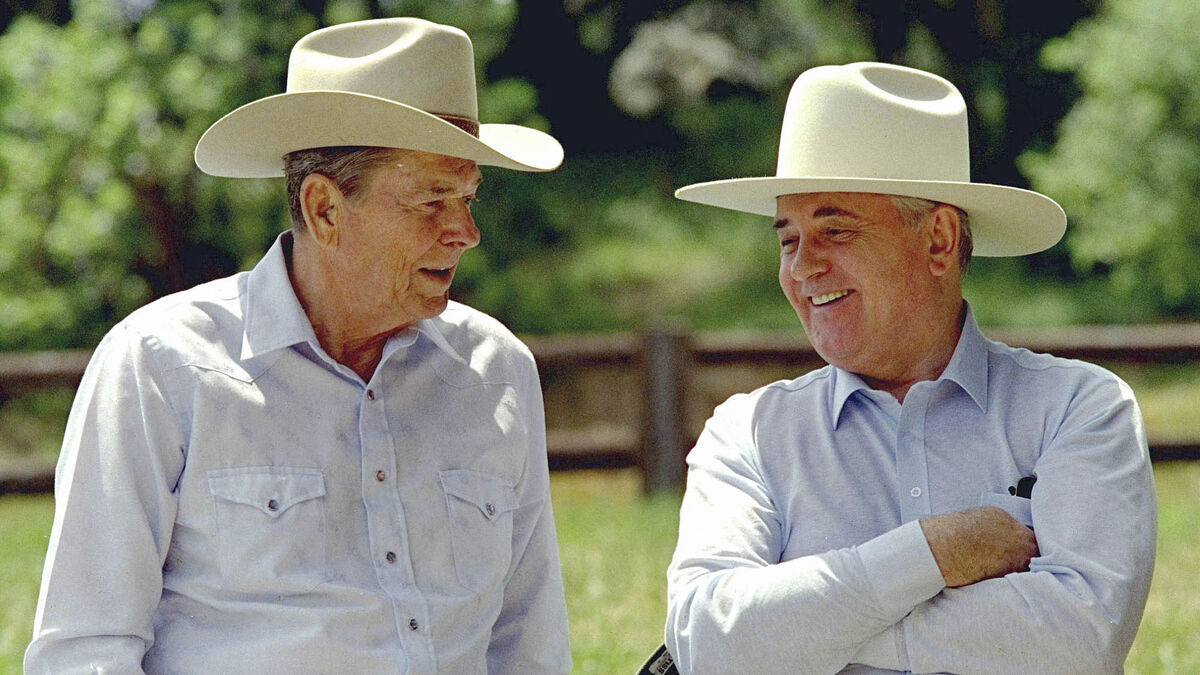
Former US President Ronald Reagan, left, and former Soviet President Mikhail Gorbachev don cowboy hats while enjoying a moment at Reagan's Rancho del Cielo north of Santa Barbara, California, on May 2, 1992. Picture: AP Photo/Bob Galbraith, File
Forty-five years ago this week Ronald Reagan was elected President of the United States. His legacy and record remain much discussed and contentious today, and his impact on contemporary American politics was highlighted again very recently.
An advertisement paid for by Canada's province of Ontario included some lines from a speech Reagan gave in 1987 about foreign trade, and which talked about his views on tariffs.
The ad was designed to try and show that Donald Trump was doing the opposite of what Ronald Reagan would have done on tariffs and trade. There was, as you would expect, a big row about it, with a furious denial that Reagan had meant what the ad implied. Trump threated Canada with higher tariffs as a result.
President Trump threatening higher tariffs on someone is hardly news, but the circumstances here are interesting. Evidently even Donald Trump does not like it if someone suggests he is on the opposite side to Ronald Reagan.
The US President, fair to say, is no respecter of tradition. He has certainly never held back from criticising former Presidents, even Republican ones, or worried in the least if people claimed that what he was doing was at odds with what either of the Bush Presidents would have done.
So why is it different in this case? Why was Reagan such a significant President and why does his record still hold such a powerful grip on American politics today? And is Donald Trump justified in linking himself to Reagan and his legacy?
There are some similarities between them. Reagan was a political convert. He started off as a Democrat and then changed party to Republican. Some say that was because his views changed, whereas he would always say it was because the Democrats changed their views.
Anti-communism, more than any other thing, formed him. While an actor, he believed that many in Hollywood were communist sympathisers and he forged his reputation in opposing them. That made him a highly divisive figure – some loved him for it, many hated him.
He came to stand for a strong national defence and for uncompromising opposition to the Soviet Union, to communist China, and for a full throated support of the Vietnam War. He associated himself with many people who took very hard right views on those issues.
Domestically, he came to the political view that government was the problem and not the solution. He therefore argued that the federal government in particular should be massively reduced in size. He wanted to see decision making and power returned to as local a level as possible. He wanted the state out of people’s lives, and especially out of their pockets. This was a point of view that always had supporters in the United States of course, but in the 1960s – when Reagan first entered the elected political arena – the opposite view was in fashion. He enjoyed fighting against the fashion.
He wanted to see judges appointed who would not make liberal rulings based on what they interpreted the constitution to mean. He wanted judges and laws to strictly follow the text of the constitution as it was written. This conservative approach was a guiding political light, and at the heart of much of the political support he received – quite like Trump. Interestingly, while Reagan was a political conservative, he was in many ways personally liberal.
The culture wars of the 1960s shaped him. He was known as an actor, but he came to real national prominence as Governor of California where he fought hard against the radical students of that day. He did not use soft words and he was not afraid to deploy hard tactics.
He became closely associated with the hard right of the Republican Party when he made a famous speech in support of that party’s candidate in the 1964 Presidential election, Barry Goldwater. Goldwater was very far to the right, and his large defeat ended his national political ambitions, but turbo charged those of his great tribune, Reagan.
He came close to being his party’s candidate in 1976, but got lucky in losing that time, because it was the failure of the domestic policy agenda of President Jimmy Carter that allowed Reagan to beat Carter decisively in November 1980.
His presidency shaped the 1980s. He changed the political weather. He did many great things and many things that strongly divided opinion. He appointed conservative judges. He cut taxes to stimulate the economy and strongly supported free trade around the world. He said he wanted to cut spending, but achieved very little. Cutting taxes and not reducing spending meant the accumulation of great debt.
Reagan was very strong on national defence and got involved in some very questionable foreign affairs adventures, particularly in Central and Latin America. But for all his anti-communism, he made genuine efforts to make a deal with the Soviets, despite having called the Soviet Union an ‘evil empire’. He was very committed to NATO and to Europe’s defence, even though many in Europe opposed him politically.
He was a sunny guy, who presented an optimistic take on the world. He was sentimental, even maudlin, but could be very tough. He had Irish connections, and they were sometimes helpful, but he was no Joe Biden when it came to Irish interests. Margaret Thatcher was his great ideological and political ally, but he could from time to time be called upon to try and rein in her most unwise positions on Northern Ireland.
Reagan’s presidency has done very much to determine the shape of the current day Republican Party, perhaps as much for the veneration of Reagan as his actuality. He has become a saint in that party, whom people invoke to win support and curry favour.
Even Donald Trump feels the need to do this. The objective reality though is complicated. On appointing conservative judges, they are hand in glove. On fighting back hard against culture warriors, they are at one. On having a strong national defence and a large military, they are entirely in the same place. On tax and spending, there are definitely similarities, though you are never quite sure what might happen next with the current President.
But on trade, on foreign policy and on observing constitutional norms, it is very hard to see continuity between the two. That ad from Canada got under Donald Trump’s skin for a reason. In the big picture, Reagan supported free trade. Trump doesn’t. It is also very hard to imagine a President Reagan acting on the foreign policy stage as President Trump does. And on observing constitutional norms, in respecting the decorum of the office, and having a sunny personality while doing it, you’d have to say that a lot has changed since that week in November back in 1980.