It takes all sorts of people to do the most good
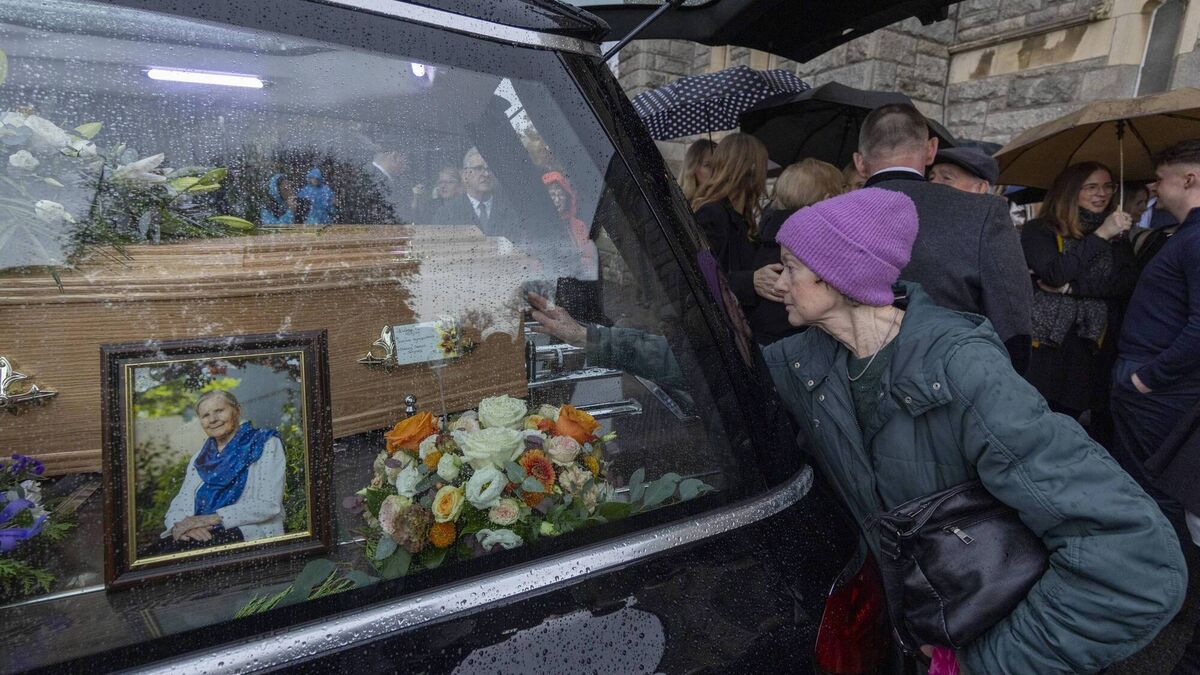
A mourner reaches out to the coffin of Sr Stanislaus Kennedy after her funeral Mass at The Church of the Sacred Heart, Donnybrook last month. Picture: Tom Honan
There has always been a pious image among very religious people that certain types of people are really cut out to be priests or nuns. For the latter, the image is of demure maidens fingering their beads as they tot up a recitation of multiple rosaries.
Those who are wiser perhaps realise that the image – biddable, unaffected, pious – is very often far from the truth. Take Sr Stanislaus Kennedy, who died recently at 86 years of age after leaving her mark not just on religious life but on Ireland.
Born Treasa Kennedy in Lispole on the Dingle peninsula in Kerry, at 18 years of age she decided to enter the Sisters of Charity. A certain local incredulity greeted that decision as, in the words of the obituary: “The girl who loved dancing, the lively flirtatious one among her friends who stayed late at dances, had an ear for music and an eye for a good-looking young man, was the last in her garrulous circle who was thought likely to become a nun.”
That unlikely template is, of course, more likely than not to characterise most young women who ‘enter the convent’. And Sr Stan herself, as she became more widely known, made no effort to deny what she herself described as her ‘rather wild’ youth and that on her first night in the convent, when she heard the music from a local carnival in the distance her instinct was to conclude: ‘That’s where I should be.’ Sr Stan, like so many others, find themselves in a convent or a seminary, not because the decision fitted with their instinct, but because of a curious fascination with what we call ‘a call’ that urges a decision that, of its very nature is tentative rather than compelling, unsure rather than instant and life-changing – unlike that of St Paul on the road to Damascus.
That said, in later life nuns and priests can tend to forget the ambivalent and uncertain nature of trying out a vocation and through formation or an unholy piety come to delight in regaling anyone who listens to them that from the day they stepped into a seminary or a convent or they were as happy as Larry or Loreto.
I suspect that behind such a fervent declaration is a mixture of motives: encouraging vocations; fear of being thought less than what they are expected to be; worry about giving bad example or worse still scandal; and denying any possibility that they might have got the biggest decision of their lives exactly wrong.
The truth is more complex but more credible. I suspect that religious life has more than a fair mixture of doubt and denial, regret and contentment that in less pious though more holy moments pickle every life.
It augured well for Treasa Kennedy that she heard the music from the carnival and wondered whether she should be there rather than in the convent. A priest said to me recently that he found assisting at weddings increasingly more difficult as the tangible happiness of the couple getting married seemed to exacerbate his own experience of a similar loss.
But back to Sr Stan. After entering religious life, she soon discovered – despite the pull of the carnival – that it was where God intended her to be. An early blessing was her meeting with Bishop Peter Birch of Ossory (Kilkenny) with whom she shared a compassion for those in need and a conviction that what we now casually describe as ‘social services’ needed to be put in place – urgently. The providential alliance between the outgoing Sister and the reserved bishop ploughed a new and creative furrow in Kilkenny and was soon being widely replicated.
As often happens in religious life, Stan, the victim of her own success, soon found herself transferred to Dublin where the challenges of poverty were more obvious. Famously she founded a housing trust, , advocating for change and experiencing at first-hand what life was like for young women living on the streets of Dublin. She harangued politicians, demanding action of those in positions of responsibility in church and in state – Charlie Haughey once described her as ‘the most intransigent woman I ever met’, which according to the Sunday Times obituary, ‘she took as a great compliment’.
Stan was a credible voice in the market-place because she had no ulterior motive apart from serving those in need and she could be as critical of her own church as of other established institutions. The Catholic Church, she said once, was too comfortable, pointing out that its wealth and trappings often sat disagreeably alongside the gospel message Jesus had proclaimed. This drew a rebuke from the Vatican.
She established the , fighting for the rights of migrants and underlining the moral imperative of welcoming them into Ireland. And in more recent times, indicative of her creativity in finding spaces for those in need, she established , a centre for prayer and meditation in Dublin’s north inner city, arguing for the need for silence and reflection in a world of clamorous voices forever seeking our attention.
In later life, she produced a series of prayer books, reflections on life, indicative of a deeply embedded spirituality, as simple as it was profound. In recent times, her prayer (she confided) consisted of sitting in silence and saying over and over again, the name of Jesus. At her funeral Mass, the celebrant used the word ‘mystic’ to describe her – adding quickly that he could already hear her laughing at the compliment.
It all seems a far cry from the 18-year-old who, on her first night with the Sisters of Charity, felt she could hear the carnival in her native Lispole and wondered whether she was in the right place. I suspect that for Stan the carnival and the gospel are not as incompatible as the pious sometimes think. Especially for mystics.