Irish unity is about more than a border poll
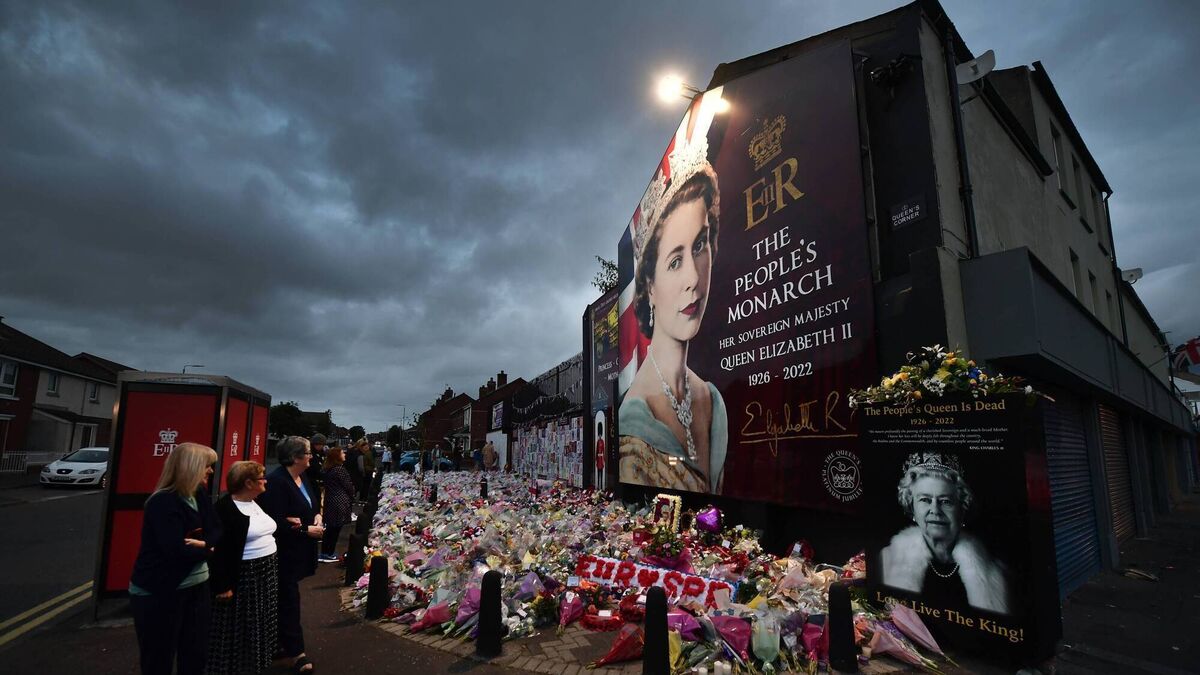
People gather on the Shankill Road in Belfast in front of a mural dedicated to Queen Elizabeth II following her death in September 2022. Picture: Charles McQuillan/Getty Images
It is interesting how things change. Twenty-five years ago, the priority on the island of Ireland was to stabilise relations across three dimensions: between the people in Northern Ireland, between the north and south of the island, and east-west, between Britain and Ireland. That was the aspiration we talked about all the time. The Good Friday Agreement was designed to secure it.
Now the priority seems to be to secure a United Ireland. That’s a laudable goal and was explicitly described as such in the Good Friday Agreement. It is a noble cause; it was and remains a legitimate aspiration for anyone to want to unite Ireland. Very recent times have seen a rejuvenation and deepening of that spirit. It comes about some would say as a reflection of the anti-colonial spirit of the times, while others might see it as reflecting the general rise of nationalism across the world these days. Whichever it is, it is interesting that a United Ireland is talked about these days less as an aspiration and more as an inevitability.
That is a significant development and worth trying to understand a bit better. In the Good Friday Agreement, we all agreed to the principle of consent, and by that we meant that a majority in both parts of Ireland had to agree to a United Ireland for it to happen. The Agreement stated clearly that if such consent was given, a United Ireland would happen.
That created space for the democratic pursuit of the objective – while at the same time ending any justification for physical force to achieve it. It was John Hume’s great achievement.
That’s the political and democratic aspiration, but how likely is it over the short to medium term? Maybe I don’t read enough news from Northern Ireland, but where is the indication that such a majority there is anywhere near to being on the horizon? There is a lot of talk about people being ‘open to the conversation’, but it seems difficult to conclude, based on what we know today, that a border poll anytime in the next decade would produce a majority in favour of a United Ireland.
Over the longer term, what is the thinking that explains how that will change? Catholics now outnumber Protestants in the north that is true, but not all Catholics will vote for a United Ireland. If that is news to you, you have never been in Northern Ireland. And a lot of people in the middle – the ‘Northern Irish’ as they call themselves, many of whom flat refuse to be described as green or orange – are clear about one thing in particular: they see a border poll as the route to sectarian division and instability.
Maybe the coming times will bring some significant change in opinion or circumstances in the north. The irony is - as the leader of the Ulster Unionists, Mike Nesbitt, pointed out - that the bigger threat to the United Kingdom comes from English rather than Irish nationalism. Given that, it does make sense to make some plans in the event that a referendum on a United Ireland did happen and especially so if it was carried.
The debate we are currently having about it suggests that many assume we would need a few changes but nothing major.
They might point to Germany for evidence. When Germany unified back in 1990, West Germany simply absorbed East Germany. So people might say, well, unification worked there without needing to make big changes. Is that a lesson for Ireland? One big difference: everyone in West and East Germany were Germans.
On this island, there are about one million people living in Northern Ireland who are British. Some of them also think they are Irish, but they all think they are British. You may not like that, you may disagree with them in their assessment, and that’s totally fine: but British they are.
And if we have a United Ireland, we will have two options: we can stick our metaphorical boot on their head and tell them to shut up, or we can make major changes to our state to accommodate their identity and traditions.
With that number of people, a United Ireland worthy of the name would have to be very different. What would our new flag be? What would our new anthem be? We would surely remain a republic but it would have to be a republic within the British Commonwealth. De Valera for one would be pleased. Poppies are being worn all over the north at official ceremonies this week - would that form part of the official life of this new United Ireland?
Are we up for all that? Really? Would Protestants who live in the South, having heard what was said by some about Heather Humphreys and her husband, agree that we are? I wonder what Protestants - those who paid attention - in the north took from what they heard over the last few weeks.
The desire to achieve the unity of this island must proceed not out of a desire to get a 50% + 1 win in a referendum sometime. It must come from the acceptance that there are different traditions to being Irish on this island. That you don’t need to speak Irish to be Irish. That you can be a member of the Orange Order and be Irish. That you can be British and Irish. If that cannot be, and if our new state could not reflect that, what kind of unity are we talking about?
And if we really want to win a referendum on Irish unity, how do we think we can secure votes from at least some people from the non-nationalist tradition if we don’t take that approach? And, if we ever did win a unity referendum, how could we secure the consent of Unionists who voted against it to the new arrangement? Wouldn’t that matter? Wouldn’t we want to be inclusive of the culture of our fellow Irish people and secure their consent to their membership of this new state? And we wouldn’t do that by telling them not to worry because orange is already in our flag – you don’t need to know many unionists to know that wouldn’t cut it.
Partition was a terrible thing. But if it hadn’t happened, there would have been a civil war and bloodbath on this island, as the one million Unionists in the north would have fought with the nationalists to avoid being taken out of the United Kingdom against their will. Two nationalisms – one green, one orange – tearing each other apart. That would have made what we experienced from 1916-'23 seem minor by comparison.
The people who paid the price for that partition were northern nationalists, who were left in what became an orange statelet, with very little respect for their rights or their identity. The triumphalism and the discriminations were wholesale. The Good Friday Agreement was designed to end that orange dominance through ensuring there was what was called parity of esteem for all traditions: it has gone a long way to achieving that.
But if we now think that unity means winning a border poll and then just sticking a Tricolour on top of Stormont, we have forgotten what the Good Friday Agreement was all about. If we are to unify the people of this island in any meaningful way, parity of esteem must cut both ways.