Ireland owes Irish-America more than we admit
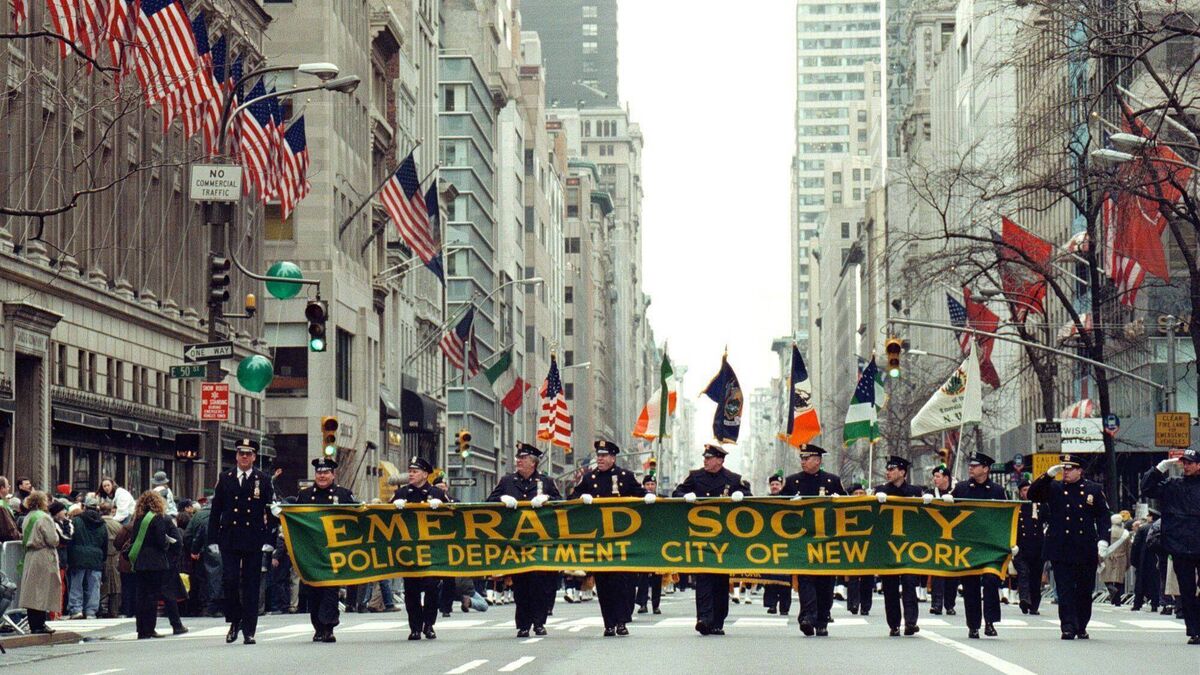
The New York Police Department's Emerald Society marching up 5th Avenue during the 2000 St Patrick's Day parade in New York City. Picture: Getty Images
Thanksgiving isn’t an Irish holiday.
Our forefathers didn’t sail across an ocean as dance-hating, religious zealots in weird hats. Our pilgrims didn’t strike an uneasy alliance with the native Americans of what would become Massachusetts and fight to the death with local turkeys (soon to be the other-way-around). And we don’t need another special day to argue with our families around a dinner table. Christmas is quite enough.
And yet, this year, I’ve been thinking about what Thanksgiving means. Not for America, but for Ireland. And specifically: that we owe America and especially Irish-Americans far more than we ever acknowledge. Because let’s be honest, Ireland has a habit of laughing at Irish-Americans.
We’ve all seen the caricature – the loud Yank stepping off the plane in Shannon with a green jumper and greener cap, a folder-sized report of his Ancestry.com DNA results and a 1/16th conviction he’s a Noone of Boghadoon.
Brendan Grace captured it perfectly with the local man selling “authentic” skulls at the airport to the same Irish-American tourist:
“Here’s the skull of St Brigid. Here’s the skull of Michael Collins. Here’s the skull of Éamon de Valera. Here’s the skull of St Patrick…”
“But sir… I bought the skull of St Patrick from you twenty years ago!”
“Aye, ya might have – but was the skull of St Patrick .”
As with all good jokes, there’s a core truth. We treat Irish-Americans as naïve, sentimental, gullible. But here’s the thing: it’s not fair. And worse, it’s ungrateful and forgets a basic truth – the people who left Ireland were the brave ones.
This bizarre modern argument – that “the Irish can’t be racist because we emigrated everywhere” – completely misses the point that the people who stayed on the island didn’t emigrate. Many couldn’t. Many were too poor, too tied to family, or too frightened. Many enjoyed the status-quo. The Irish who crossed the Atlantic weren’t the soft ones – they were the ambitious, the desperate, the hopeful, the angry, the visionary.
And America was the place that took them in.
When Ireland couldn’t support all its people, without America, where exactly would they have gone? Britain? Canada? Australia? Many went there, yes – but nowhere matched the vast, messy, contradictory, imperfect American promise: you can start anew here. You can dream of being more here.
Many died on the journey. Many more suffered unimaginable hardship on arrival. But they got there. And America gave them – or at least their children – a chance.
It was not charity.
America didn’t embrace the Irish as saints or victims. They were expected to work, bleed, fight, join armies, dig canals, build railroads and erect the skylines of New York, Boston, Chicago.
But what matters is this: they were allowed to try. That single opportunity changed the destiny of Ireland more than any event after the Great Famine. Because once they arrived, the Irish didn’t forget home.
We forget this in Ireland. We forget it far too easily.
The Irish-Americans who trace their ancestry today – often loudly, sometimes awkwardly, occasionally with a green shamrock tattoo they absolutely should not have gotten – are not clinging to some cringe fantasy. They are carrying the emotional memory of people who left everything behind.
They carry the longing, the grief, the homesickness, the hope. They carry the hunger – literal and spiritual – that drove their great-grandparents onto those boats. And when they come to Ireland, they come to pay respects.
Not to be fleeced.
Not to be mocked.
Not to be treated as walking ATMs.
But to touch the ground their ancestors walked on – the ground many of them never saw again – and embrace the people whom their ancestors left behind. We should be honoured by that. Instead, too often, we roll our eyes.
I’ve met many Irish-Americans since moving here – in LA, in New York. Not one has ever been anything other than proud, warm, emotional, delighted to talk about their Irishness. There is an honest affection in them about Ireland that we, who actually live on the island, often lack. They are not to be mocked for loving Ireland. We deserve to be mocked for taking them for granted.
And worse, ‘official’ Ireland – in tourism offices, government departments, and glossy diaspora conferences – treats them primarily as a cash cow. Not a people. Not a nation. But a market opportunity.
As frustrated councillor Gerry Coyle once declared in an online Mayo County Council policy committee meeting I attended during Covid: “We don’t respect Irish-Americans enough. We just raid their pockets as soon as they get on the plane to get here.” He was and is, I believe, absolutely right.
There is another truth we ignore. Without Irish-Americans, Ireland might not even be free.
Who funded the Fenians?
Who bankrolled the Irish Volunteers, Sinn Féin and later the IRA?
Who bought the bonds de Valera sold in America to fund the Irish Republic?
Who kept rural Ireland alive through remittances sent home in the post?
Who paid the rent on family farms when Ireland was broke?
Irish-America did.
Long before tech companies or European subsidies or Celtic Tigers, the money that kept Ireland alive came in envelopes from Boston, Chicago, New York and Philadelphia. Money earned in sweat, danger, prejudice and back-breaking labour.
The Irish state would not exist in the form it does today without the Irish diaspora – especially the diaspora in America.
So what am I thankful for this Thanksgiving?
• For America, imperfect and often maddening, but the country that took us in.
• The escape it gave our ancestors from tyranny, hunger, poverty, and despair.
• The opportunities it offered generations who would have had none at home.
• The remittances that kept Ireland clothed, roofed, educated and alive.
• The Irish-Americans who carry our story with pride, emotion, and loyalty.
• The political support that helped secure Irish independence.
• The fact that millions still feel a deep, almost sacred connection to our small island.
We don’t need to get sentimental or performative about it. But we do need to stop sneering. Because the Irish nation is not confined to 26 counties, or even 32. It lives all over the world – and nowhere more vibrantly than in America.
This Thanksgiving, instead of rolling our eyes at Irish-America, maybe we should say something simple: Thank you.
For remembering us.
For loving us.
For carrying Ireland into the proud, prosperous country it has become today, during the long years when Ireland could barely carry itself.
That’s truly worth giving thanks to.