GAA clubs bear brunt of rural depopulation
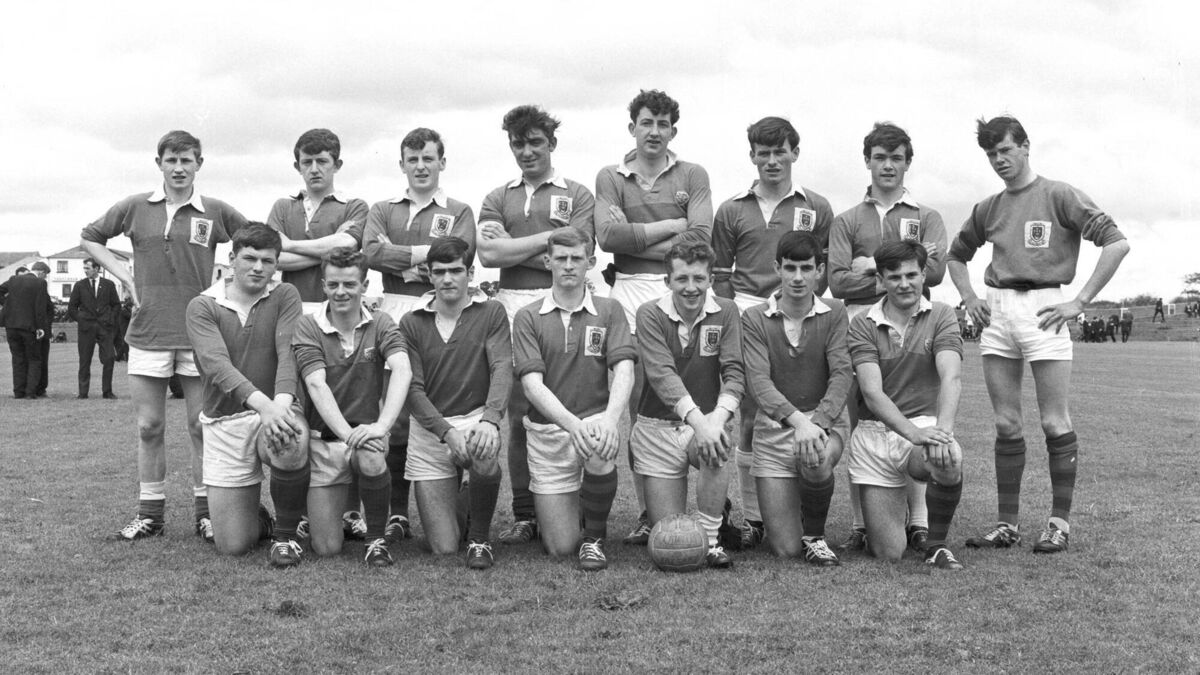
The All-Ireland winning Mayo minor football team of 1966. Back row, from left: Tom Fitzgerald, Pat Glavey, Seamus Smyth, Tom Cafferkey, Tim Snee, Seamus Hughes, Bernie Meenaghan and Eugene Rooney. Front, from left: Gay Nevin, Joe Timoney, Aidan Kelly, Benny McHale, Seamus O'Dowd, Anthony Joyce and Sean Kilbride.
Sixty years ago this year, Mayo football legend Paddy Moclair was worried about the future for Mayo football.
Mayo had just won the All-Ireland minor title, 30 years after Moclair had been one of the stars of Mayo’s first senior title.
As the 1966 All-Ireland minor champions were feted in Ballina on the Tuesday night after their success, Moclair was wondering aloud how many of them would be able to remain in Mayo and continue representing the green and red in the years ahead.
Migration and emigration were ever-present problems then as they remain today.
The Mayo GAA legend wanted to act and told the of his ‘Moclair Plan’ for people to come together to provide job opportunities for Mayo’s young players.
“I have been told that many of the minor team will have to emigrate and then they will be lost to football and to Ireland,” Moclair said. “Surely there are enough people in Mayo with the interests of their county at heart to ensure that the boys who have given another glowing chapter to Mayo’s football story will be allowed to spend their lives in gainful employment in the county they served so well."
He proposed forming a committee with the primary objective to provide employment for members of the minor team.
Such work would likely have been informal so it is not immediately clear if the Moclair Plan was successful or not. What we do know is seven of the starting team played senior for Mayo but only two played past 1971 (when the players were 23) and no player played past 1973 so there was certainly no fruitful return from that group.
An editorial in the was critical of the plan, stating in December 1966 that ‘employment should be given on merit, not sentiment’. While you cannot dispute this argument on one level, it misses the spirit of what Moclair was trying to do. His warning was not just about football. It was about the sustainability of rural Ireland itself.
So many of Mayo’s brightest and best were flooding towards the ferry and Moclair was railing against the trends of emigration that were impacting Mayo’s football prospects - it was up to more influential men than him to solve the wider issue.
It is no coincidence that, almost 60 years on, the current Mayo senior manager Andy Moran, upon his appointment last August, made a big play on the need to get Mayo players working and living in the county, rather than having to commute, as so many selflessly have, cross-country from Dublin, often twice weekly.
From a footballing perspective, it shows their commitment to their game and the grá of playing for their county. On a wider socio-economic point of view, it underlines a trend that has been plaguing our county for generations.
National policy that pulls people toward urban centres has created problems on both sides - soaring housing costs in cities and the weakening viability of rural communities. That’s before you look at the east-west dysfunction with the State either actively promoting the hegemony of Dublin in terms of investment, jobs, infrastructure and housing or showing scant regard to the imbalance this creates in other parts of the country.
We’ve written on this topic regularly as it relates to Mayo. Every part of the county is impacted but the scale of it is much greater on the periphery, particularly in the west and north of the county where depopulation has been at its greatest.
But we are far from the only part of the country impacted by this. The western seaboard from Donegal, through Sligo, Mayo, Galway, Clare, Kerry and Cork are all feeling the brunt of this and it was instructive to hear about the issues in the Iveragh peninsula in Co Kerry on the Mick Clifford Podcast with the .
Joseph McCrohan, the chairman of the South Kerry GAA Board and a man who is a rural development officer with the South Kerry Partnership, is one of the best people I’ve heard speak on the subject.
Iveragh, which encompasses much of the Ring of Kerry cycle route, is a vast peninsula and home to GAA legends like Mick O’Dwyer, Mick O’Connell (on nearby Valentia Island), Jack O’Shea and Maurice Fitzgerald. Current Kerry manager Jack O’Connor is from there, from the same club, Dromid Pearses, as Declan O’Sullivan.
But, in a story very familiar to parts of Mayo, schools on the peninsula have seen their populations plummet, down 41% from 1993 to 2022 and Joseph McCrohan said that they are facing into the reality of having just two underage amalgamated sides encompassing the ten clubs on the peninsula and the prospect of players travelling 60 miles for training.
At adult level, clubs are coping reasonably well but often because players living and working in Killarney, Cork, Limerick and even Dublin will still return to play for their home club. Training sessions often take place as a halfway house to accommodate this and keep the clubs viable. Not unlike clubs in Mayo and county players, like Andy Moran has hinted at.
But, ultimately, without a seismic change in regional development and spatial strategy, the real hit will come in half a generation’s time when those players’ children are playing in those urban centres and there will be so little coming through in their home clubs.
A decline in employment from agriculture has contributed significantly to it, greater rates of education and the lack of opportunities for many of these qualifications in rural Ireland, housing shortages in rural areas and struggles to get planning have all fed into it.
McCrohan observed that, but for Ukrainian immigrants, there would be a much greater shortage of a workforce in parts of South Kerry, particularly in tourism. It’s alarming we’re at that point where the critical mass for viability of a community is so under threat.
McCrohan put it in a unique way when talking about the housing crisis.
“The west of Ireland is the cause of the housing crisis – we’ve pushed people into the cities,” he observed.
Pulled rather than pushed might be a more accurate but was this by design, or simply the result of poor spatial planning?
Some of the issues around rural and social enterprise McCrohan explored we will return to. There are certainly things that local communities can do to help themselves.
Because 60 years on from Paddy Moclair bemoaning emigration in Mayo, we’re still having the same debates and discussions and not near enough has changed.
In 1966 Paddy Moclair feared Mayo would lose its footballers and that Mayo’s future as a whole was in peril. In large parts of the county, that fear feels closer than ever.