Open University transformation ‘to Northern Ireland’s third university’ hailed
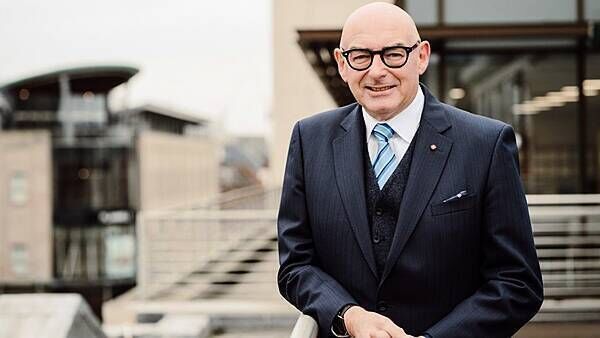
By Rebecca Black, Press Association
The director of the Open University is stepping aside after seeing a transformation from “best-kept secret” to “acknowledged third university” in Northern Ireland.
John D’Arcy said he wanted to focus on connecting with the local community when he took on the job in 2015.
During his tenure, student numbers multiplied, ranging from professionals, pensioners, young people and prisoners, resident across the island of Ireland.
From 4,225 registered students in Northern Ireland the 2019/20 academic year, the Open University saw their numbers go to 7,430 in 2022/23.

Mr D’Arcy joined The Open University in 2010 from a background in education, including as chief executive of Colleges Northern Ireland.
He described an initial “steep learning curve” in terms of the scale of the institution.
“Although we’re the smallest university in Northern Ireland, we’re probably the biggest university in Europe,” he said.
“So we’ve about 175,000 students in England, Scotland, Wales, Northern Ireland, Ireland, and also continental Europe, with lots of partnerships in different parts of the world, such as the the Arab Open University.
“Many people may think The Open University is social sciences, creative writing, but we have got a nursing programme.
“Many in the health services, such as health care assistants, do a four year programme with us and become registered nurses.
“We do a lot of hard sciences, like physics, chemistry, engineering, and probably our big growth area of the last number of years has been IT.
“Cyber security would be huge for us, and we just launched the UK’s first part time computing with artificial intelligence degree.
“You don’t have to do a full degree, if you’re in a job and you just need this extra bit of learning, then you can do just a module.”
Mr D’Arcy said The Open University has become more externally focused.
This includes working with Queen’s University, Ulster University and the further education colleges, accrediting the latter’s foundation degrees, as well as a partnership with Libraries NI and the Irish Congress of Trade Unions.
It also shifted from become funded from London, to receiving funding from Stormont in 2013.
“We’re very small, just over £7million, but then we don’t have same quantum of students, and all the buildings and stuff like that,” he said.
“We’re very a cost effective type of learning, and people can drop in and out of it, which suits lifestyles now.”
From the earliest days in 1969, Open University delivered courses via videos through the post, and BBC television and radio. Now it’s largely online.
“It’s an interesting space we’re all in as educators, with so much content out in the world that is free,” he said.
“The challenge for people is to make sure whatever content they’re getting is credible. It’s a bit like the fake news debate.
“So that’s why we’re keen on things like OpenLearn, which can give people that free learning, but they know it’s been quality assured, it’s been written by academics, it’s legit, and that’s the big thing as well for us.”
Mr D’Arcy said they’re now starting to see more younger students, but there is more work to do to raise awareness for that age group.
“We’ve a bit of a job of work to do with schools to make them aware of what our offer is, but it’s interesting that it sort of started it up organically,” he said.
“Our fees are pretty reasonable, and there is a lot of funding from the department (for the economy), you can get a fee grant, and there’s also access to a part time student loan. So there are ways that you can make make it affordable.”
Mr D’Arcy also spoke about how much he enjoys their graduation ceremonies, and hearing about the personal experiences.
“When they walk across the stage, I always say, ‘congratulations, we’re very proud of you’, I remember one man saying, ‘very good for somebody didn’t get their 11 plus and has no GCSEs’,” he said.
“You’d love to stop them and put that out to the audience so they can understand what people have come through.
“He said it took him eight years.
“A lot of people come back to learn, it’s not necessarily to get a job, it’s that pursuit of knowledge, mental well being as well.”
He said he was sorry to be leaving, but felt it was the right time both personally and professionally.
“The thing I felt when I first came in was we probably were Northern Ireland’s best kept secret – reasonable student numbers, but we weren’t at the table with the other two universities and the colleges,” he said.
“A lot of my time was spent working with business organisations, and Stormont to make sure that we are fitting into the needs of the programme for government and the Minister for the Economy’s priorities.
“My thing was, if you want to be called one of three universities in Northern Ireland, you’ve got to be playing your part.
“So it was finding in ways in which we could add value to what the universities and colleges do, and I think we’ve sort of found that place.
“The minister talks about the three universities, it’s common parlance, and certainly, if we’re doing anything with other parts of government, The Open University, will be at the table where we weren’t before.”