Sod is turned on historic Mayo project
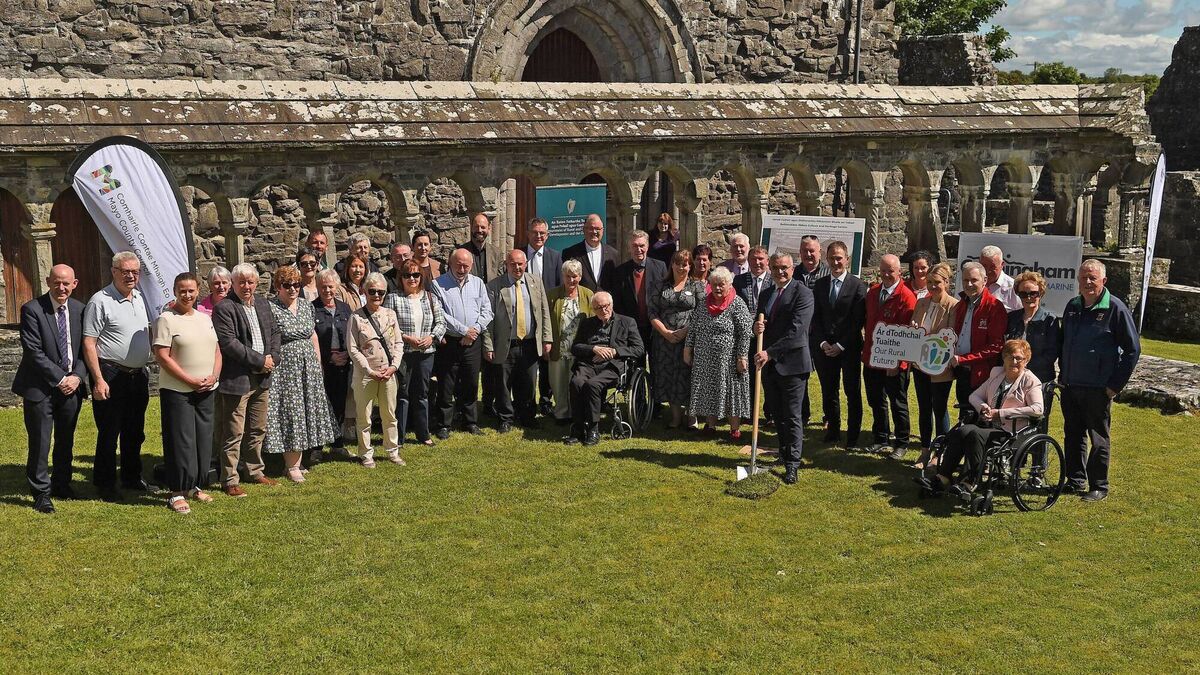
Pictured at the official sod-turning for the Ballintubber Abbey Culture and Heritage Centre were Minister for Rural and Community Development and the Gaeltacht Dara Calleary with Minister of State for Employment, Small Businesses and Retail and Circular Economy Alan Dillon, Cathaoirleach of Mayo County Council Cllr Sean Carey, local councillors and representatives of Mayo County Council, as well as members of the Ballintubber Trust, including Fr Frank Fahey. Picture: Conor McKeown
Minister for Rural and Community Development and the Gaeltacht Dara Calleary TD turned the sod on the new €7.4 million Ballintubber Abbey Culture and Heritage Visitor Centre last Friday.
The project received a grant of €6.4 million from the Rural Regeneration and Development Fund (RRDF), as well as €350,000 from the Department of Housing, Local Government and Heritage, Heritage along with matching funding of €712,139 from Mayo County Council and Ballintubber Abbey Trust.
The new Ballintubber Abbey Culture and Heritage Visitor Centre consists of the construction of gallery and exhibition spaces on the ground and first floors where visitors will engage with the multi-layered story of Ballintubber and its treasures viscerally. It will also include exploration spaces on ground and first floors, where visitors will embark on journeys into the past. Also included in the design is a reflective space on the second floor.
Works will also see the re-roofing of the Cloister remains along with works to the Cloister, a new access stair, lift, reception and toilet facilities.
The East Wing was traditionally the part of the abbey where guests were greeted on arrival and entertained.
The new wing will provide exhibition spaces at three levels, the upper two accessed from a new lift and stairs, with a separate entrance to the ground floor space from an original doorway at the southern end of the cloister.
The historic masonry will be left unaltered, all original openings will be re-used and expressed, new windows and doors carefully placed within the opening without interfering with the remaining archaeological features. Internally, the upstanding walls will be retained as found, so that the original forms and uses can be interpreted by the visitor.
A new timber portal frame, whose arched design reflects the shape of the groins in the abbey church, is inserted into the shell of the ruined east wing and supports two intermediate floors, as well as the new pitched slate roof.
The new solid masonry external walls faced with finely cut local limestone will be built directly on top of the existing walls of the ruin, their thickness arising from aesthetic as well as technical requirements.
Speaking after the sod-turning, Minister Calleary said: “This project will see the restoration and regeneration of Ballintubber Abbey an architecturally significant complex that has played a significant role in the local community over the centuries, to create a new state-of-the-art three-storey Culture and Heritage Visitor Centre.
“The Ballintubber Abbey Culture and Heritage Visitor Centre project is a perfect example of what the RRDF is all about, supporting the vision of the community to create opportunities for economic and social vitality within rural Ireland."
Cathaoirleach of Mayo County Council Cllr Sean Carey, added: “This is a place where history lives on every day not just in books alone, but in stone, in tradition, and in the lived experience of the people who have gathered here generation after generation to pray, reflect and remember.
“The development of the Ballintubber Abbey Culture and Heritage Visitor Centre honours that legacy. It represents a step into the future, but one that recognises the importance of preserving our heritage and ensuring it is alive and well for future generations.”
Chief Executive of Mayo County Council Kevin Kelly stated: “This is a project that represents a significant investment in Mayo’s cultural infrastructure and tourism offering.
“It is a carefully planned and technically complex development that brings together a number of strands that needed to be threaded together including conservation, forward thinking design, thoughtfulness for the past and a modern visitor experience in a highly sensitive heritage setting.”