Pyrite group welcomes revised standard for defective concrete blocks
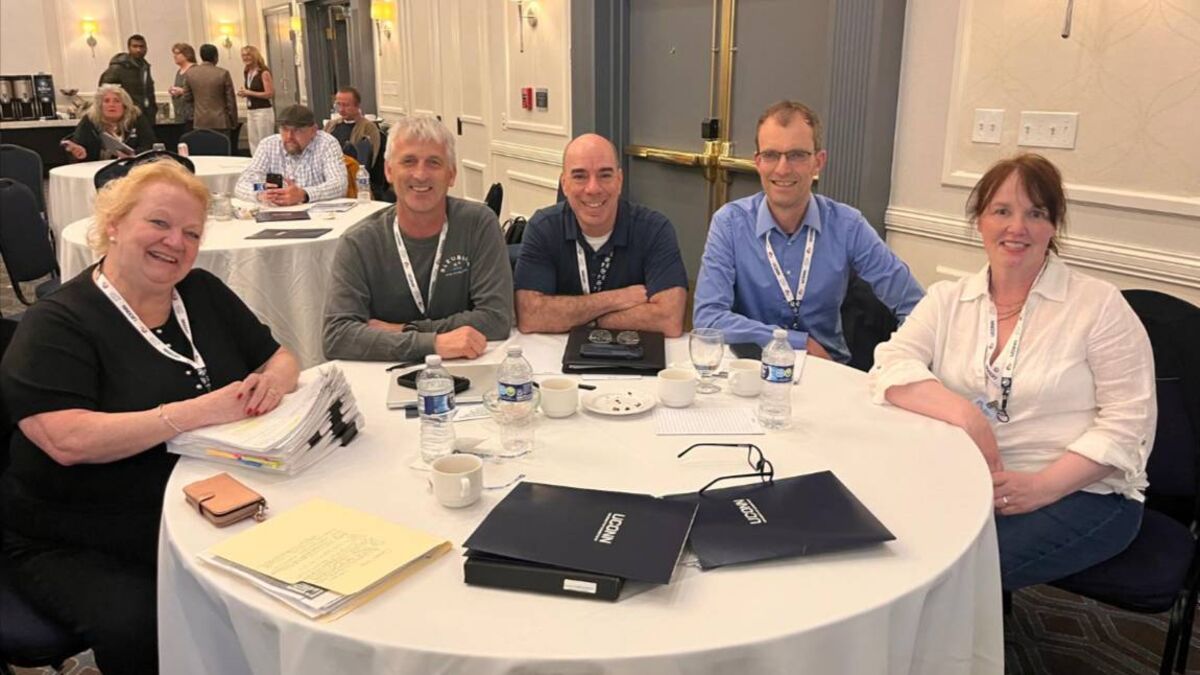
Pictured at the 2026 International Conference on Iron-Sulfide Reactions in Concrete were, from left: Debbie MacCoy, 'Connecticut Concrete Queen' and advocate for Ireland; Professor Paul Dunlop, Ulster University; Nick Scaglione, CRT, Ohio, USA; Dr Andreas Leemaan, Scientist, EMPA Switzerland; Margaret Walsh, Mayo Pyrite Action Group. Margaret Walsh addressed the conference, which was attended by the world's leading experts in sulfide-bearing aggregates, such as pyrrhotite and pyrite, in concrete foundations.
The standard used by engineers to assess buildings affected by defective concrete has been revised with local pyrite activists in Mayo hoping the long-awaited changes can facilitate remediation for a wider range of buildings, including social housing.
The National Standards Authority of Ireland (NSAI) has published a revised version of the I.S. 465 standard used to assess, test and categorise homes built with defective concrete blocks.
The publication of the revised I.S. 465/2026 does not change existing schemes such as the Defective Concrete Block (DCB) scheme, however, it triggers a review of the scheme which must begin within three months.
Among the changes welcomed by the Mayo Pyrite Action Group is the consistent use of the term ‘building’ as opposed to ‘dwelling’. Margaret Walsh from the group told the they hope this will allow the existing Defective Concrete Block (DCB) scheme to be expanded to a wider range of buildings.
“The document now consistently uses the term 'building' rather than 'dwelling', assuming this could make it applicable to a wider range of structures,” she said. “Mayo Pyrite Action Group are curious now if this means there is a route to remediation for garages/outbuildings, public buildings and social housing.
“We now ask our government representatives if the legislation underpinning the current scheme has to be revisited to amend the DCB scheme in this regard.”
Ms Walsh also called for Government action around a new requirement to take samples from foundation concrete and no longer just from wall blocks.
“This is very welcome; however, the current DCB grant scheme does not fund foundation replacement.
“We do not know the implications of finding defective concrete in foundations for timelines and moving on with remediation, given it is not addressed in the current legislation and there is no provision for funding in the current DCB grant scheme for foundations. We need the government to act on this now.”
A Building Condition Assessment (BCA) investigation is still required to be carried out by a chartered engineer on a home suspected to be impacted and begins with a structural assessment. Under the current DCB scheme, the BCA damage threshold requires the presence of pattern cracking; however, the revised standard has removed reference to the damage threshold.
It also now allows for historical evidence such as previous photographs, repair records and documented cracking history to be used as evidence when assessing buildings, and if the engineer believes there is a structural stability concern, urgent safety recommendations may be required.
Laboratory testing of samples will now be carried out in stages with a screening stage performed first with more advanced testing only undertaken where necessary. Ms Walsh said the group hopes this will have an impact on improving timelines and getting homes rebuilt faster.
The building assessment and lab results are combined to determine what is recommended, and the assessment now relies on a combination of engineering inspection, petrography, sulphur testing, and risk classification, rather than any one test result.
Ms Walsh said while mica remains relevant to the issues affecting homeowners, it has been acknowledged in the revised standard that it is not the primary cause of cracked homes in County Donegal. The standard now specifically addresses pyrrhotite, pyrite, other iron sulfides, mica, and internal sulphate attack (ISA). She said that under the revised standard, the only option for homes with damage due to framboidal pyrite, pyrrhotite, or ISA is full demolition and rebuild, with partial fixes no longer an acceptable option going forward.
She said the Mayo Pyrite Action Group welcomes the revised standard and is awaiting to see how it is implemented.
“It is long overdue, and we thank all of the experts, national and international, who have contributed to a better science based standard. In particular we commend Professor Paul Dunlop of Ulster University.”
However, the members of the group remain concerned about the market surveillance of concrete.
“We are currently collaborating with experts in the field to test today’s concrete blocks. As returning customers, who have to navigate this complete nightmare, we have a right to know the concrete we are buying today, is fit for purpose,” said Ms Walsh.