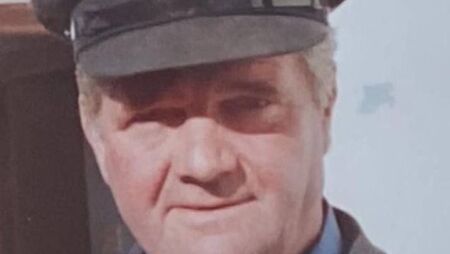
Frank played crucial role in Knock Airport story
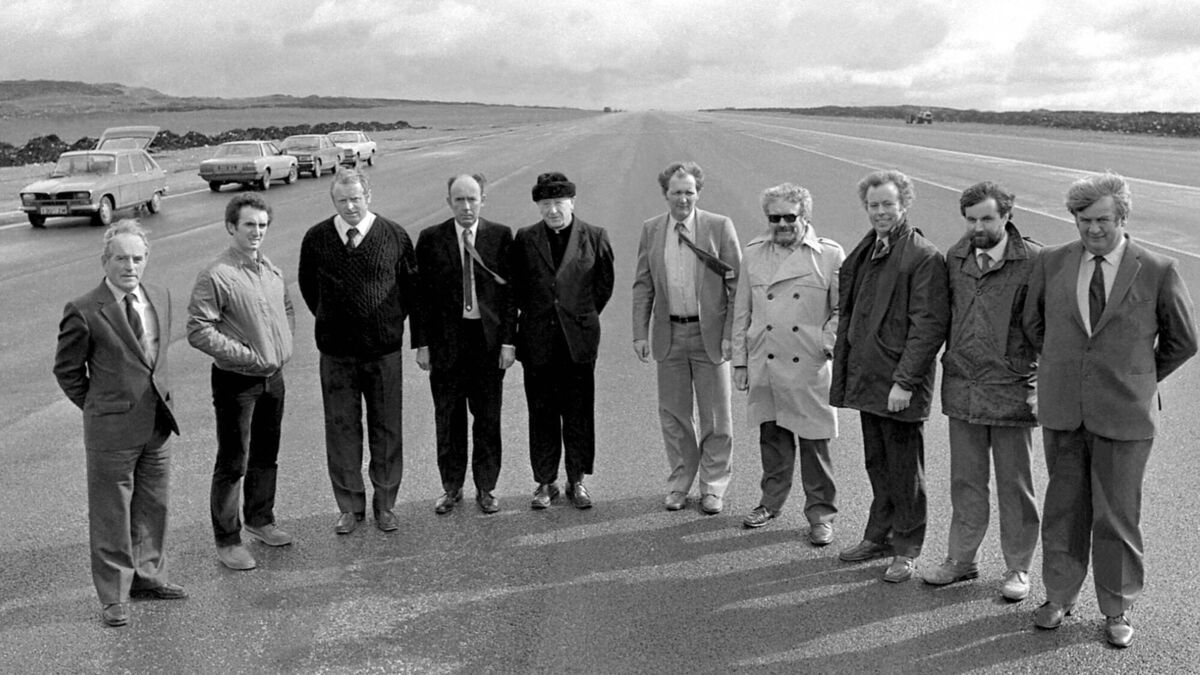
Pictured on the runway of Knock Airport for a public open day in September 1983 after the first section of the runway was laid were, from left: Jim Ryan, airport director; Pat English, site engineer; Mick Ruddy, general foreman; Paddy McDonnell, site agent; Monsignor James Horan, Frank Harrington, Seán Balfe, consultant engineer; Chris Lysaght, An Foras Forbartha (National Institute for Physical Planning and Construction Research), Paul Crowe, site engineer; PJ Durkan, foreman. Missing from photo, John Corcoran, surfacing foreman. Picture: Henry Wills/Western People Archives
Monsignor James Horan had the vision for Knock Airport. But he needed someone to build it.
He already knew the right man.
He had employed Frank Harrington’s services for work at Knock Shrine and was very happy with the quality of work.
But it wasn’t just a high standard of workmanship he needed. He needed someone who would quietly get on with the job, even if it may have been grander than anything officially sanctioned.
The job required someone who would trust that he would get paid even if the money was not immediately available.
Because from 1981 to its first flight in 1985 and official opening in 1986, there were plenty of crossroads where doubt could be entertained. Plenty of questions from officialdom that may have required careful answers. And plenty of time where you had to draw into your own reserves to pay your staff for a job that was shrouded in uncertainty.
Above all, the Monsignor required someone who could get the project far enough down the road that it would be too late to call halt by the time any Government reservations took hold.
In Frank Harrington, the Monsignor found the perfect man.
As you meet Frank at the Harrington Group offices in Kilkelly, you can immediately see why this relationship worked so well.
Frank is a very humble man. He speaks quietly, measures his words, and never says more than he needs to.
He is the epitome of calm, the steady hand on the tiller. That was exactly what was needed in 1981 when work started on what appeared to many at the time as a fanciful notion of an airport outside Harrington’s native Kilkelly.
Their relationship began in 1973 when Monsignor Horan contracted Frank Harrington Ltd to carry out work for the building of the Basilica. They provided all the fill for the building itself and built a new road in from the Ballyhaunis Road as well as paving and tarring the walkways through the grounds.
Harringtons were there for two years and Frank got an insight into the type of taskmaster the Monsignor was.
“There was no doubt but he was the main boss. He would come out every day after morning Mass to see how the work was going.
“He would trust you mostly but he was well able to tell you too if he thought something wasn’t right. He was very well clued in - he missed nothing,” recalls Frank.
With that job finished, he continued to work on smaller jobs the Monsignor needed. Still, to this day, the Harrington Group do a lot of work at the Shrine.
But there were bigger plans afoot.
Frank recalls the Monsignor talking about an airport throughout the 1970s but the arrival of Taoiseach Charlie Haughey in Knock in 1980 for the funerals of John Morley and Henry Byrne, two gardaí killed by bank robbers in the line of duty, saw a critical meeting in the Monsignor’s house afterwards.
“He got a hold of him (Haughey) and got the first nod for a small airport,” said Frank.
Given the inch, Monsignor Horan took the chance to go for the proverbial mile.
His plans were always much greater than a ‘small airport’ but, as single-minded as he was, he needed good men around him.
He had Tom Neary, chief steward of the Knock Shrine Society, as his right-hand man. He got Jim Ryan, who had experience at Castlebar Airport, to assess a suitable site and then procure land for the current site and, crucially, he contacted Frank Harrington.
His father, also Frank, had donated 35 acres of his own bog on the current site and soon the Harrington machines would be responsible for a huge job of work.
He recalls the first day on site instantly - February 6, 1981. He would not be paid for six months - until August. He won’t divulge how much he was on the hook for at various parts of the airport development but it is understood to be a considerable six-figure sum at one point.
He did so because he had faith in Monsignor Horan and in the idea.
“I believed in it. We’d great trust in the Monsignor. He was always true to everything he did - he was the sort of man who wasn’t happy until everyone got paid. We knew if we got the job up and running, it would work no problem. We had to make sure it would get up and running or else it would never happen,” said Frank.
It was June before they actually won the Government tender for the job, so they were acting in pure good faith until then.
“We had no money at first. It was a wing and a prayer at the start,” he said.
It was far from a great site and required a lot of work. There was boggy ground, peat covering with a mixture of good land.
They won two contracts – one was the civil engineering contract and the surfacing of the runway. They would also be involved in the construction of the terminal.
The first job was to build a road connecting the old Kilkelly to Charlestown road with the (at the time) new N17. Then there was a 70-foot difference from one end of the site to the next that had to be rectified. On one day alone, they moved 12,000 tonne of ground. It remains a record volume in one day in the history of the Harrington Group.
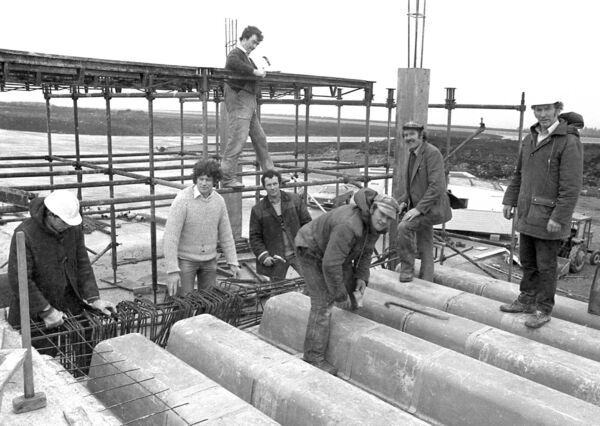
One of the aspects of Harrington’s work that pleased Monsignor Horan most was the employment of local men, including many who were able to return from England to work on the job.
The general foreman was a man called Mick Ruddy from Foxford who called to Harrington’s and met Frank’s father.
“I came home that evening and he said, ‘I’ve a good man for you’,” Frank recalls.
Frank Senior wasn’t wrong.
“Mick was excellent, a smashing man,” said Frank.
Ruddy went over to England to bring home a gang of men from the area to work on the job too. Families who were expecting to call England their home were able to move back to Ireland because of the work on the airport.
He mentions many other people who did amazing work for him but is wary of naming some and not others.
“A lot of excellent people worked with me on the site. They were all willing - everyone wanted to see the airport happening,” he said.
There was a real cloak-and-dagger nature to the work. Often, local government officials and representatives from the Department of Transport would come down to see what work was going on and it was readily apparent that it was bigger than what was agreed.
For Frank Harrington, he had to act the role of someone who knew less than he actually did. He knew exactly what he was doing, and, just as importantly, what not to say.
That the project might be bigger than what might have been officially sanctioned was on a need-to-know basis. The mantra Frank applied was simple: “Keep quiet but keep going.”
The Monsignor was of a similar mind. He had ‘a lot of headaches to deal with’ but there was ‘no stopping him’.
“We both felt it would be a great thing when it was done,” Frank recalls.
There is little doubt that many officials who visited the site were broadly sympathetic towards it too and were easily dissuaded from looking too far under the bonnet. But there was trenchant opposition in some political quarters.
At one point, Barry Desmond, the Labour minister who was the airport’s fiercest critic, wanted to pay off Frank Harrington and anyone who had worked on the project and simply shut it down. Frank did not entertain such an offer.
“He said the airport was daft. It wasn’t daft at all. Look at it now,” he said.
He recalls Monsignor Horan being critical of many politicians’ and bureaucrats’ attitudes towards the region.
“He used always say they’d put a fence around it and turn it into a bird sanctuary if they were let,” he said.
But, with the airport becoming a big political football and now far more in official hands than at the beginning, work often ground to a halt as funding commitments changed from minister to minister, government to government during the turbulent political era.
The Fine Gael/Labour Government refused to support a longer runway and it was left at approximately 1,800 metres. It was a decent size but Monsignor Horan always felt it needed to be 2.4km to make the airport more viable and able to attract bigger aircraft.
“Any other man would have left it at that but the Monsignor was determined,” said Frank.
While the runway was sitting idle, incomplete as far as the Monsignor was concerned, work stopped.
One day Frank Harrington was having his dinner when the Monsignor rang in a panic.
“What are you at?” he asked Frank.
“I’m having my dinner.”
“Well never mind your dinner, get out here as fast as you can and get your lorries and machines, I’ve cameras coming!” instructed the Monsignor.
Morley Safer from the renowned programme in the United States was on his way to interview the Monsignor about an airport led by a priest which had captured the imagination of people on either side of the Atlantic.
The footage about an airport being built would not look good with no work actually going on in the background. So, for once in his life, Frank Harrington had to pretend he was working, moving stone from one place to another and back again.
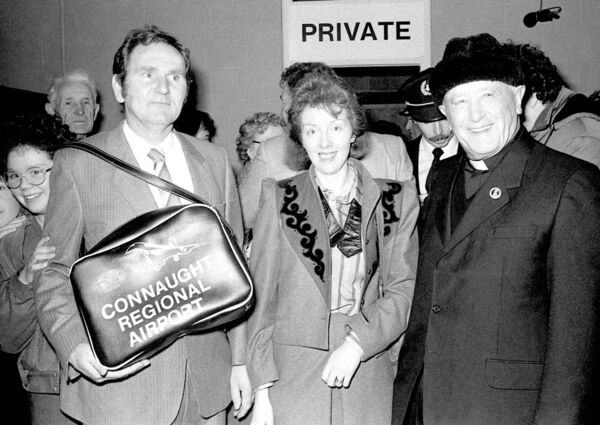
Frank has a whole host of fond memories. He drove Monsignor Horan and Cardinal Tomás Ó Fíadh down the runway. Archbishop of Tuam, Joseph Cunnane, a Knock native, would arrive most Thursdays to monitor progress.
Seán Quinn came down from Fermanagh and told Frank he was ‘mad’ to be working on it and that the project was ‘daft’. Frank gave him short shrift.
He remembers ‘excellent people’ on the various boards of Knock Airport and has particular praise for Cathal Duffy, the Castlebar businessman who was a long-serving chairman.
“He gave so much of his time to that and for no pay. He didn’t get the recognition he deserved. He was a great man. When the chips were down, he was the man to sort it out,” he said.
He is generous in his praise for Monsignor Dominick Greally who took over from Monsignor Horan in 1986.
Frank and his wife Patricia were on the first flight from Knock to Rome in 1985.
“It was great to see the flights take-off. There was great excitement,” he said.
He is a regular user of the airport to this day, flying to places like Lanzarote and Tenerife for holidays.
He loves to see neighbours heading off in the morning to work at the airport and it gives him great satisfaction to see how many people work there now. His humility is very apparent but there is an unmistakable quiet pride in his central role in making Knock Airport a reality.
Hand-in-hand with the success of Knock Airport across the last 40 years has been the continued growth of the Harrington Group all through the decades. The steady hand at the tiller that was so invaluable at Knock Airport has been instrumental in his business’s success.
Frank started working for his father, Frank Senior, in 1960, and while his sons Francis and Brian are now in charge, Frank is still there on a daily basis, arriving at 7am most mornings.
They are one of the largest indigenous employers in the west of Ireland and their success is one Monsignor Horan, who yearned to see more local employment, would doubtlessly love to witness.
As Frank brings you around their Kilkelly site in his jeep, his pride in the business is apparent. He is 82 now but retirement is not something he is too worried about.
“It keeps you going, I like to be at something,” he says of his involvement. He farms as well.
His wife, Patricia, works here still and was a central player during the Knock Airport job.
“She kept the show on the road and had plenty of headaches to deal with,” said Frank of the uncertainty when they were waiting for payment.
He was a hugely popular winner of the Mayo Person of the Year in 2008 with the one of the largest attendances ever at that year’s awards, a demonstration of the esteem he is held in.
Between staff and people they contract, there are in the region of 400 people employed by the Harrington Group. It is an important responsibility, says Frank.
“There are a lot of people to be paid every Thursday. They are all good people - good staff are the key to any good company,” he said.
And good leadership too. Monsignor Horan picked the right man.
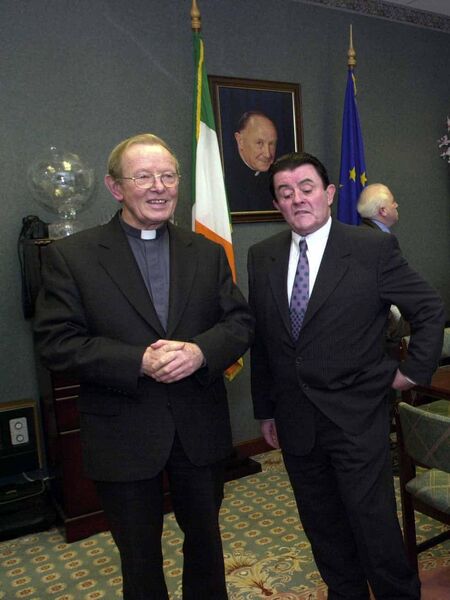
Frank Harrington was en route to Dublin for work on August 1, 1986 when, having pulled in for dinner, he heard the waitress saying at different tables about the ‘poor Monsignor’. He asked what had happened and was told Monsignor Horan had died in Lourdes.
“It was a big shock. The poor fella,” he said.
One dream of the Monsignor’s which has not come to pass as yet is employment in a designated zone at the airport. There are plans for the Strategic Development Zone progressing but, said Frank Harrington, certainly not close to the pace the Monsignor would have wished for.
“I’d like to see more factories up there. Look at Shannon and what that has done for that region. It would want to stir,” he said.
Overall, he recalls a transformative priest who led it all.
“He deserves all the praise in the world - he was a mighty man. He was not for himself - he was for all of Mayo.
“He was a sound man. If he lived for ten more years, there would have been an awful lot more around Knock. There was awful pressure on him. People didn’t realise that,” he said.
To this day, the Harrington Group do a lot of work at the airport. But isn’t loyalty a two-way street? There are not many who would take the chance and risk so much money like Frank Harrington did in the 1980s.
Monsignor Horan had the vision. Frank Harrington made it a reality.