Focus remains on Lough Carra rehab
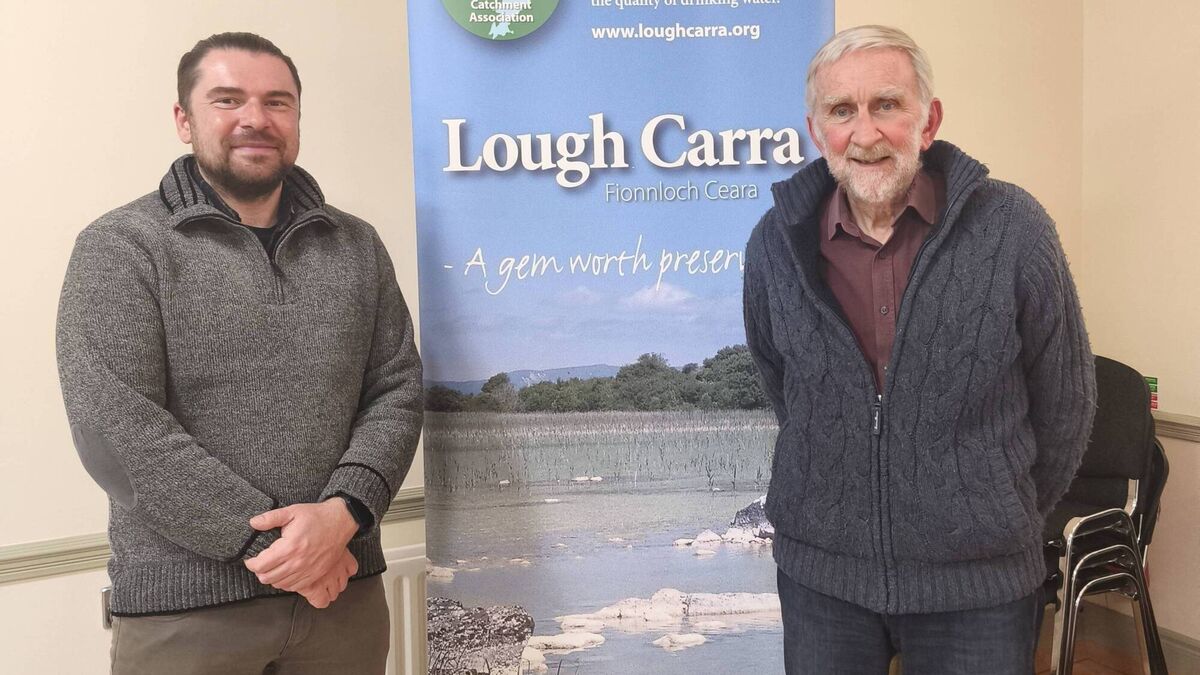
Ecologist Jarek Majkusiak and Chris Huxley, director of Lough Carra Catchment Association.
The AGM and November meeting of Lough Carra Catchment Association brought together local residents, environmental specialists and project partners to reflect on another year of conservation work at one of Mayo’s most treasured lakes.
Held in Belcarra, the meeting featured a range of speakers, including ecologist and podcast producer Jarek Majkusiak, LCCA Director Chris Huxley, and Ann Marie Meaney, Acting Project Manager and Surface Water Officer with the Lough Carra LIFE Project.
Jarek Majkusiak discussed the LCCA growing podcast series, which has become an important tool for bringing the story of Lough Carra to a wider audience. Since its launch, the series has released 15 episodes, blending scientific insights, local knowledge, and personal stories.
Jarek shared analytics showing strong and increasing listener engagement, noting that episodes featuring members of the local community have been particularly popular. “Getting these conversations out into the world is vital,” he said. “The more people who hear about Lough Carra, the more awareness and support we build for its protection.”
Ann Marie Meaney updated attendees on conservation work across the catchment, including the demonstration wetland at Moorehall, where reed and willow beds are well established. Renovated toilets at the site will help reduce nutrient input into the lake at this site. Upcoming workshops and booklets will explain the wetland’s design and practical applications. Other initiatives include protection of lesser horseshoe bats, native tree planting, and invasive species management. Additional actions in 2025 under the farm scheme include the protection of karst features across the catchment, continued farmer workshops, and the development of a grassland identification guide specific to Lough Carra. Ongoing surface and groundwater monitoring is supporting these efforts, providing essential data to guide management and conservation decisions.
Chris Huxley, founding member of the LCCA, reflected on 25 years of conservation at Lough Carra. He praised the dedication of local volunteers and scientists in protecting the lake, building on decades of earlier research by botanist Robert Lloyd Praeger and ornithologist Robert Rutledge, whose studies established baseline data on bird populations and lakeshore vegetation that continue to inform conservation work today.
A critical point raised during his talk was habitat loss and decline in species at the lake. He said there was a fundamental change in land use across the catchment, with the conversion of semi-natural habitats into improved grassland to intensify agriculture, leading to declines in orchid and bird populations. There has also been a consistent and worrying decline in trout populations in the past twenty years.
In the early 2000s, Trinity College Dublin researchers, led by Dr Ken Irvine, carried out extensive studies on nutrient levels, while subsequent ground breaking research revealed significant changes in the lakes marl and aquatic vegetation, attributable to nutrient enrichment. These findings underpin monitoring approaches now used by the Lough Carra LIFE Project to assess lake health and guide restoration measures.
The growing concern over Lough Carra’s ecological decline, including its role as a source of local drinking water, ultimately led to the formation of the Lough Carra Catchment Association in 2018. Despite facing many obstacles, the LCCA has brought together residents, scientists, and volunteers to protect and restore the lake, safeguard its habitats, and raise awareness of its ecological value.