Council land purchase is revealed after 56 years
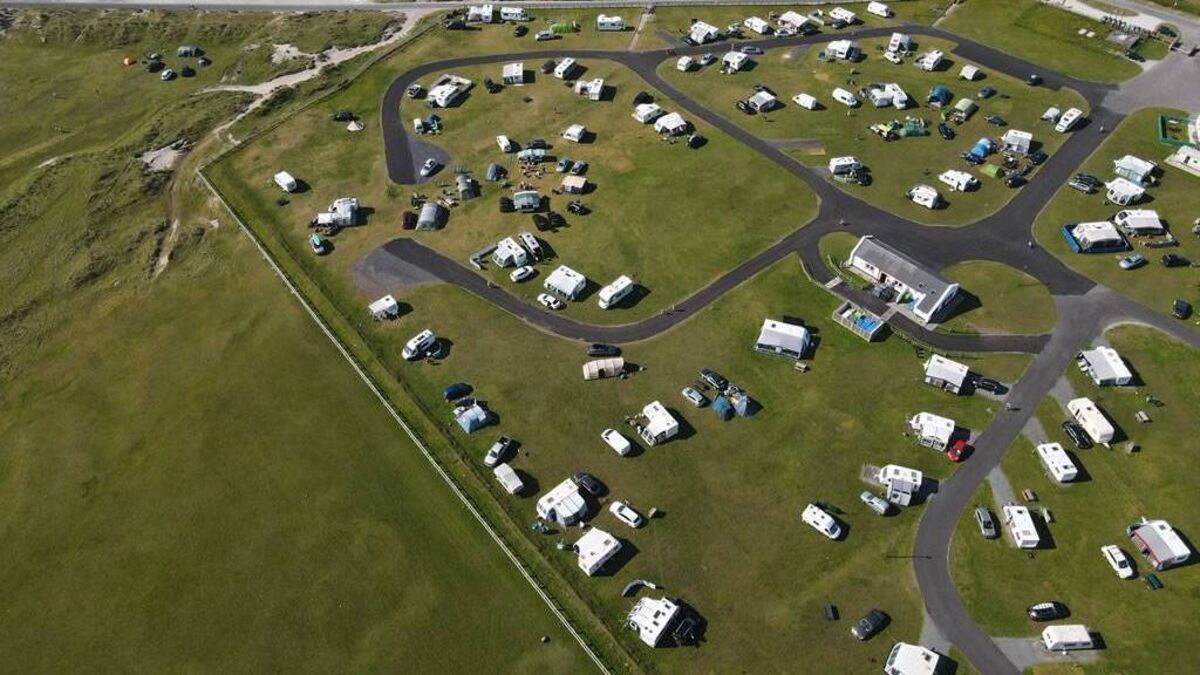
The commonage on Achill Island includes a caravan and camping park.
Mayo County Council has confirmed it is the owner of 440 acres of commonage on Achill Island.
Up to now, the lands were believed to be owned by local shareholders, many of whom have been receiving agricultural payments.
The extraordinary revelation was made at the monthly meeting of Westport-Belmullet Municipal District with Achill-based councillor Paul McNamara stating that the matter had come to light following a scrutiny of documents in the Department of Agriculture. Cllr McNamara said he had uncovered documentation showing that the council had compulsorily purchased Keel Sandybanks some 56 years ago. It means the local authority is the owner of a property portfolio that includes a campsite, a golf course, football pitch, tennis court and 400 acres of grazing land.
“You are almost as good as Donald Trump, you have a good golf course in a very scenic area”, Cllr McNamara told the head of the municipal district Seamus O’Mongáin.
Mr O'Mongáin confirmed he had been made aware of the situation last February and said the council is preparing to publish a vesting order to ratify the change of ownership and formalise the final stage in the compulsory purchase order (CPO) process, more than fifty years later.
Reading from a prepared script, Cllr McNamara said the CPO was documented for the land, but the records did not match with Land Registry records, with the shareholders believed to be the owners of the land. He also said there was no proof of any compensation paid to the shareholders.
Cllr McNamara said he had now “let the genie out of the bottle” and was dismayed that it was falling on his shoulders to have to tell the many families involved that officially they did not own the land. He demanded that council management provide clarification and address misinformation in relation to who is responsible for managing the lands by providing full transparency on the entire process and also clarity on the legal basis of the council’s claimed ownership of the land.
“This raises the possibility of a grave historical injustice, not just to shareholders but the generations who came after them. This is above all about justice. The shareholders and their descendants deserve answers and the people of Achill deserve the truth.”
Cllr McNamara was supported by fellow councillors who agreed they had not been aware of the council’s ownership of the land in question, beyond its ownership of Keel caravan and camping site, for which it had received €800,000 in lease payments over the past 20 years.
Mr O’Mongáin said the matter would have to go through the council’s legal office, and he could not answer all the questions raised.
“Mr Lavelle was the representative of the shareholders, that’s what is in the documents; it all went through the normal CPO process up to and including that there was a public hearing, and only one objector at that meeting to it.”
He added that as the matter is historical, the records are quite voluminous.
Cllr McNamara demanded a full report on the matter from the council for the next meeting of municipal district later this month.
Municipal district cathaoirleach Cllr Brendan Mulroy said the situation was “not great and someone has to be accountable".
Cllr Peter Flynn said he could not understand how the council could compulsorily acquire 400 acres of land “given the controversy there is over a few hundred metres”, adding: “It’s hard to see how that could have happened back in 1970 and nobody had a problem with it.”
He suggested a report be prepared in advance of the next meeting of the forum as “it is important we are all informed as there will be calls from all around and this will have implications for a lot of people".
Mr O’Mongáin said: “A vesting order is a particular final element of a CPO process and once a CPO is confirmed that means the land is purchased. Vesting is essentially registering it. So, the CPO was confirmed following the review of the objection.”
Cllr Chris Maxwell said the potential consequences of such an historical CPO could have serious implications for the farming community, insisting it be protected.
“We have to realise the consequences for farming families out of this. Who is going to protect them? They did all of this in good faith. What if the Department isn’t happy with their farming payment situation? That would need to be sorted for these people. It wants to be a priority that farming families are looked after.”
- Published as part of the Local Democracy Reporting Scheme.