Barefoot walker would 'do it all again'
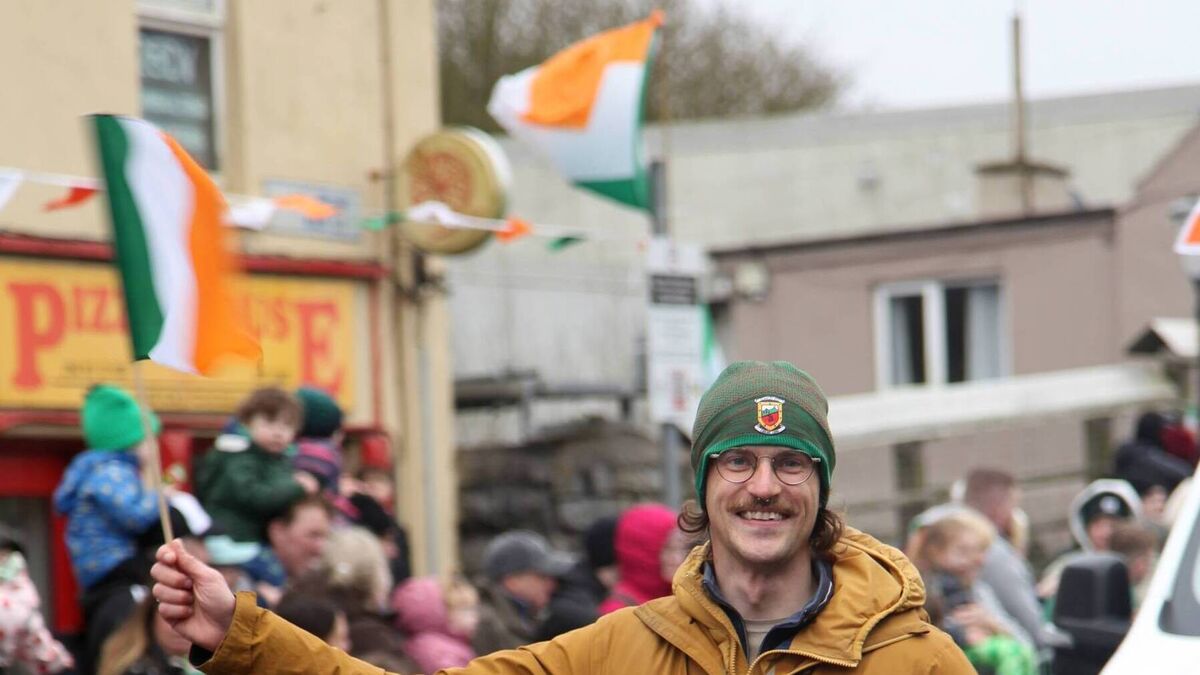
Eamonn Keaveney pictured in the St Patrick's Day Parade in his native Claremorris. Picture: Trish Forde
When Eamonn Keaveney stepped out in Istanbul on March 4 last year, he did so without shoes, without guarantees, and without any certainty about what lay ahead beyond the next stretch of road.
Three hundred and sixty-nine days later, the 33-year-old from Claremorris walked back into his hometown having covered 6,805.83 kilometres entirely barefoot. His journey, which took him across ten countries and through extremes of heat, cold and isolation, is expected to enter the Guinness Book of World Records as the longest barefoot walk ever completed.
He describes the idea as a natural progression rather than a leap into the unknown.
“I did that walk 10 years ago around Ireland, and that was the Guinness World Record at the time,” he told the . “Ever since then, I wanted to do another big walk. When you’ve walked around the country, the next logical thing, I suppose, is to walk across the continent.”
That earlier walk - 2,000 kilometres around Ireland in 2016 - laid the foundation. This latest challenge, from Istanbul to the western edge of Ireland, was on an entirely different scale.
Eamonn’s route took him through Turkey, Bulgaria, Romania, Hungary, Austria, Germany, France, England, Wales and finally Ireland. His target was the headland of An Dún Mór in west Kerry, the most westerly point in Europe. Along the way he averaged around 24 kilometres a day, though some days were shorter, others longer. On the final day, as he returned to Claremorris, he covered just over 14 kilometres, greeted by a large crowd of family, friends and neighbours.
“It was class,” he says of the homecoming. “There were a load of people gathered and it was just absolutely lovely to see friends and family and the community out to welcome me home.”
The journey was not just about distance. Eamonn undertook the walk to raise funds for Jigsaw and Friends of the Earth, ultimately bringing in more than €20,000 - double his original target.
“I was kind of hoping for €10,000, to be honest,” he says. “So to go over €20,000, I’m absolutely delighted with that.”
The walk was self-funded. He took a career break from his role with the Data Protection Commission, where he had been based in Dublin, and relied largely on personal savings to sustain the year-long effort.
“There was a fair amount of personal sacrifice,” he says. “The vast, vast majority of it was just out of my savings. My savings took a real hammering over the last year.”
In the early stages, Keaveney travelled with his girlfriend Ellie.
“She came with me for the first kind of half of the trip,” he explains. “After that, it was mainly on my own.”
There were occasional companions for short stretches, but most days were spent alone, moving steadily across unfamiliar terrain. However, Eamonn says loneliness was rarely an issue.
“I’m fairly happy in my own company,” he says. “And we all have a mobile phone in our pocket now. I was able to message family and friends whenever I wanted. Most evenings, to be honest, I was too tired to feel lonely.”
The physical challenges were constant. Heat proved one of the most difficult obstacles, particularly in eastern Europe.
“There were a few points, particularly in Hungary, where there were big heatwaves,” he says. “You’d be planning to do a certain distance and then a heat wave would come along and stop you in your tracks. It’s too hot for an Irish person to be walking in 40 degrees.”
Cold weather brought its own difficulties later in the journey. There were also hazards underfoot - rough road surfaces, thorns, freshly cut hedges in Ireland - all of which had to be negotiated without the protection of footwear.
“The road surface kind of determines your speed all the time,” he explains. “If you get nice, smooth asphalt, you can fly along. But some roads have a very stony surface and that just reduces it to a crawl.”
His feet adapted over time, though not in the way many might expect.
“The skin gets kind of thicker, but at the same time it wears away with a lot of heavy mileage,” he says. “It never got to a point where I couldn’t feel anything.”
There were moments when the scale of the challenge threatened to overwhelm him.
“It never got so bad that I was thinking of giving up completely,” he says. “But there were times when you’d think, ‘I have thousands of kilometres to go.’ It can get overwhelming.”
His way through was to narrow the focus.
“You break it down,” he says. “You tackle today, then the next week. If you look at it all at once, it’s too big.”
Accommodation varied as the journey progressed. In the early stages, Eamonn camped most nights, stopping occasionally at guesthouses to rest and recharge.
“Every four or five days I might book somewhere to wash bits and pieces, have a shower and charge devices,” he says.
As conditions worsened, particularly with cold and water seeping into the tent, he changed approach.
“I sent the tent home after Germany,” he says. “After that, I was either staying with people or booking whatever was cheapest.”
Costs increased significantly in western Europe, especially in France and England. Relief came in Ireland, where people offered places to stay along the route.
Encounters with strangers were a constant feature of the journey. Many were curious. Some were concerned. Offers of shoes were frequent.
“People would be asking me what size I was, or they’d have a pair of boots in their hand trying to give them to me,” he says. “It was a nice gesture, but I’d have a job explaining that I didn’t need them.”
The barefoot aspect, while unusual, was central to the challenge. Eamonn carried no shoes with him.
“All of the walking, all of the progress was completely barefoot,” he says. “There were a couple of rest days where someone might lend me a pair just to potter around, but they didn’t count.”
His interest in barefoot walking began years earlier, though he struggles to pinpoint the exact origin.
“I just kind of dabbled with it in college,” he says. “Some people say there are health benefits. I think there are, to an extent. It’s not going to cure everything, but it’s no harm.”
There were occasional setbacks. A dog bite early in the journey required medical treatment, including rabies vaccinations. Border crossings, particularly between Turkey and Bulgaria, brought added scrutiny.
“The passport was checked a load of times,” he says. “After that, inside the EU, you’re mostly just walking past a sign that says ‘Welcome to Germany’.”
Food was basic for much of the trip. Rural areas often offered limited options.
“There was a lot of bread and cheese,” he says. “Fruit, nuts, dried meat. Crisps and biscuits. That was kind of the foundation of the diet.”
Simple comforts were missed. Communication, in particular, proved challenging across language barriers.
“Being able to easily talk to people is something you take for granted,” he says. “And deli counters. You can’t get a jambon anywhere on the continent.”
There were highlights. Walking through Hungary stands out, particularly sections off the road.
“The scenery was very, very beautiful,” he says.
Arriving back in Ireland marked a turning point.
“It felt like the home stretch,” he says. “Touching down in Rosslare was great.”
The final leg brought him home to Claremorris, where his return drew a large turnout. Days later, he walked barefoot in the town’s St Patrick’s Day parade.
“They said I could go in a carriage or wear shoes if I wanted,” he says. “But I thought I could hardly turn up now wearing a pair of boots.”
Adjusting back to normal life has been gradual. Shoes, he admits, feel different now.
“They’re comfortable in one way,” he says. “But they’re very warm. My feet are kind of adapted to not being covered, so when I put on boots, they’re roasting.”
For now, there are no plans for another major challenge. A trip to Australia is next, before any return to work.
“I’m taking a break,” he says. “I have no plans beyond that at this point.”
Looking back, he has no doubts about undertaking the journey.
“I would do it again,” he says. “There were hard times, but there were more good times than hard times.”
Eamonn said that the record hasn’t been validated yet by the Guinness Book of Records.
“I have to send all of the evidence off to them for verification, which can take months.”