‘Justice facilitator’ banned from filming after Court of Appeal arrest
Tom Tuite
A self-styled “justice facilitator” has been ordered not to film or make audio recordings in any courthouse after his arrest for a breach of the peace in the Court of Appeal in Dublin.
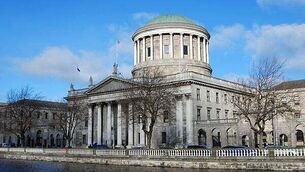
Patrick McGreal, 45, of Reynalla, Bracklyn, Mullingar, Co Westmeath, who appears on social media platforms to speak out on justice and constitutional issues, was arrested at the Four Courts for an alleged incident in the Court of Appeal on Friday morning.
He was then brought to appear before Judge Michele Finan at Dublin District Court, charged with an offence under section 6 of the Public Order Act for engaging in threatening, abusive, insulting words or behaviour.
Judge Finan heard that in reply to the charge, he told gardaí, “I received the documents”. The offence, on conviction, can carry a sentence of up to three months' imprisonment.
Garda Michael McGrath of the Bridewell Station told Judge Finan that he had no objection to bail. However, he applied for several conditions to be imposed on Mr McGreal, who declined the offer of a solicitor on free legal aid and represented himself.
Garda McGrath asked that the accused “undertake not to interfere with any legal practitioner” in the Four Courts or its environs. Judge Finan told Mr McGreal that she was imposing that term, and noted he nodded to indicate he had no problem with that, at which he then said, “I have no difficulty”.
The garda asked that he undertake “to behave himself when he is a party before any judge in the Four Courts”.
Mr McGreal said “Yes, I will act responsibly” but asked for it to be worded: “act with lawful authority and reasonable excuse”.
Judge Finan said she tries to make bail clear; instead, she phrased it as “do not address any court unless you have a formal involvement in the case”.
She also told him to confine himself to the bail terms rather than the underlying allegation.
He was warned to conduct himself in an appropriate manner in all cases, and to have respect for all parties in the court, including staff, judges and security personnel.
The judge also acceded to a request from the arresting officer to add a further condition concerning videoing gardaí in the courthouse. She expanded it to say, “Do not operate any recording device, including audio or video, in any courthouse”.
He has yet to enter a plea and was remanded on cash bail to appear again on March 6th, when the case will be listed for mention.
Disclosure of evidence, including the Court of Appeal’s digital audio recording on Friday morning, is to be furnished to the accused. He was warned that if he broke the terms, bail would be revoked and he would end up in custody.
The accused spoke up, saying that sometimes he liked to video outside the doors of the Four Courts, which was a public place, and that the judge had heard he wanted to use it as a backdrop. Garda McGrath said that was part of the issue.
Judge Finan told him that people would be entering and leaving the building, but she accepted his suggestion that he could film from the opposite side of the River Liffey nearby. The terms could be reviewed on the next date.
Mr McGreal sought a particular item of disclosure from gardaí. He said that the Director of Public Prosecutions prosecutes offences under section 9.2 of the 1924 Criminal Justice Administrations Act; however, he contended that the law was "not valid".
The judge said gardaí may not be able to provide that, and it could be addressed on the next day.
He then sought disclosure setting out the DPP’s authority, but Judge Finan said that was a matter for his trial as she adjourned the case.