Farrell faces delicate balancing ahead of Springboks visit
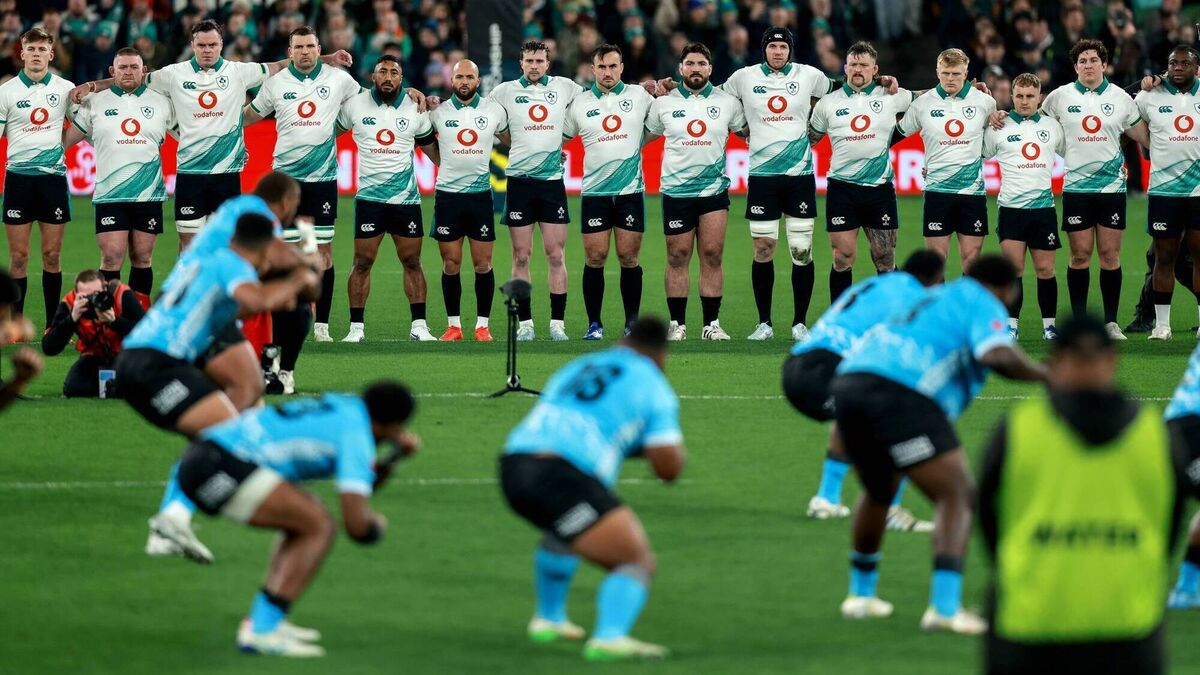
The Ireland players watch the Fji team perform the cibi ahead of last Saturday night's game in the 2026 Nations Championship Northern Hemisphere Series in Dublin. Picture: INPHO/Tom Maher
The wind came whistling through the old Lansdowne Road on a November afternoon twenty years ago last weekend, carrying with it the peculiar electricity that only a great sporting occasion at the old venue could summon. There was a World Cup on the horizon, a golden generation in green and a growing sense that Irish rugby was approaching something close to its apotheosis.
And for eighty minutes, the evidence seemed irrefutable.
Andrew Trimble tore through the Springbok defence for an early try. David Wallace followed him across the whitewash. Then, Marcus Horan barged over, and by half-time Ireland were 22–3 ahead, playing with the swagger of men who had begun to believe their own destiny was unfolding before them.
South Africa stirred after the interval, briefly threatening to spoil the occasion, but Brian O'Driscoll conjured a sumptuous back-handed pass to send Shane Horgan over for the final flourish. Ireland won 32–15. The old ground roared its approval.
Eddie O'Sullivan had a team brimming with talent and conviction and the sort of self-assurance that made the extraordinary seem almost inevitable. The World Cup was ten months away. It was tempting to see this as an augury of greater things.
And greater things did come.
Just not for Ireland.
The following October, it was Jake White's Springboks that were standing beneath the Parisian lights, lifting the Webb Ellis Cup. Ireland were long since home, their World Cup ambitions buried in the wreckage of a group-stage exit. That November afternoon belonged to Ireland. The following autumn belonged to South Africa.
White was back in Dublin on Saturday evening, this time in charge of Fiji, watching Ireland run out comfortable 43–15 winners. At least, comfortable was what the scoreboard suggested. For much of the evening, the reality was considerably less flattering.
Fiji brought a muscular belligerence that unsettled Ireland's rhythm, exposing familiar frailties and leaving Andy Farrell's side clinging to a slender 17–15 lead at half-time. The floodgates eventually opened, Ireland rattling off 26 unanswered second-half points, but the final score carried a slightly deceptive air of grandeur.
White, who knows a thing or two about constructing World Cup-winning teams, offered a pointed observation afterwards, suggesting that the Fijians had done Ireland “a favour”.
It was rather like being beaten at cards by your grandfather, who then has the decency to explain where you've been going wrong.
"I think Ireland deep down know that if they play like that against South Africa, they're gonna be up against it,” he added.
Meanwhile, in Paris on Friday night, South Africa had suffered a bruising 21–19 defeat to France. And yet there will be no existential crisis in the Springbok camp, no great reckoning over their place in rugby's hierarchy. Nobody in Pretoria will be setting fire to buildings or demanding Rassie Erasmus be marched through the streets in his underwear.
They have lost important matches before and emerged with the greatest prize in the game. They understand, perhaps better than anyone, how to build towards World Cups.
And that is precisely the distinction Andy Farrell must keep in mind as another eagerly anticipated showdown approaches.
For Farrell, the challenge is considerably more intricate than simply plotting the downfall of the Springboks. Ireland are still in contention for the inaugural Nations Championship, a new piece of silverware offering its own seductive promise of prestige. A victory over the reigning world champions would be a considerable achievement, particularly with a place in the final at Twickenham still within reach, albeit dependent on results elsewhere.
And nobody should diminish the significance of that ambition. International rugby is not a rehearsal in which the actors are expected to conserve their finest performances for some distant opening night. Victories matter. Trophies matter. The winning habit is not something that can be summoned at will.
But there is a delicate balancing act here, one that requires Farrell to possess the patience of a gardener and the ruthlessness of a general. Ireland must remain formidable in the present without becoming prisoners of it. They must cultivate new talent, deepen their reserves and develop the tactical elasticity to survive whatever indignities a World Cup might throw their way.
For all their brilliance over the years, Ireland have too often arrived at rugby's grandest gathering with their credentials exquisitely polished, only to discover that the tournament demands something altogether different.
White, of all people, could have offered Farrell a dissertation on the subject. His Springboks were hardly an irresistible force when they came to Dublin in 2006. Yet, only a year later, the Webb Ellis Cup was theirs. White understood that the art of building a World Cup-winning team was not simply about accumulating victories, but ensuring that the most consequential ones arrived at precisely the right moment.
The World Cup in Australia is now looming on the horizon. And while a Nations Championship triumph would represent another handsome addition to Ireland's trophy cabinet, it cannot be allowed to obscure the greater ambition.
Farrell must prepare Ireland to beat South Africa next Saturday. But the more demanding task is preparing them to beat South Africa, or whoever else stands in their way, when the stakes are immeasurably higher.
There is a world of difference between being acclaimed the best team in the world and actually becoming world champions.
Whatever happens on Saturday, there will be no shortage of people willing to interpret its greater significance. A victory will have the optimists reaching for their calendars and plotting routes to World Cup glory. A defeat will send the pessimists rummaging through the wreckage following another national catastrophe.
Farrell would be wise to leave both camps to their own devices.
He has rather more important things to occupy his mind. Finding players who can think clearly when their lungs are burning, developing a squad that can withstand the inevitable injuries and discovering whether Ireland possesses the ingenuity to escape when their carefully rehearsed plans begin to unravel.
November, after all, has become Irish rugby's great showhouse season. The floors are polished, the furniture is exquisite, every light is switched on and the neighbours are suitably impressed.
The trouble comes when the World Cup surveyor arrives, armed with a clipboard and an infuriating eye for structural defects.