Expansion of Irish Jewish Museum approved despite concerns of increased security risk
Seán McCárthaigh
Plans for an extension and refurbishment of the Irish Jewish Museum in Dublin have been approved, despite concerns by local residents that they pose an increased security risk to people living in the area.
Dublin City Council has granted planning permission to the charity which operates the museum to upgrade the existing building on Walworth Road in Portobello.
The plans also provide for the construction of a new two-storey building for use as exhibition, congregation, research and storage space following the demolition of a derelict house on an adjacent site.
The Irish Jewish Museum had submitted revised, scaled-down plans in response to concerns raised by council planners.
In approving the planning application, Dublin City Council said it was supportive of the continued growth and expansion of cultural resources within the capital.
The council noted that the Irish Jewish Museum has a long connection with Portobello and its building has previously been used as a synagogue since 1916 until it ceased regular worship in the early 1970s.
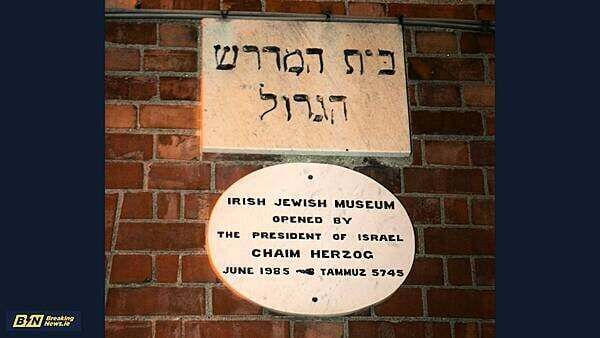
The museum was opened in June 1985 by the then Irish-born president of Israel, Chaim Herzog.
Several objectors claimed the expanded museum could pose an additional risk for local residents as it could become a target, particularly against a background of criticism of Israeli conduct in Gaza over the past two years.
One resident of Walworth Road said the expanded museum would stand out “as a conspicuous symbol” which would create “a new and serious terrorist risk.”
“Given the current volatile political climate in the Middle East, this prominent Jewish cultural building could become a very real target for politically motivated attacks, including terrorism, violent physical protests, or acts intended to make political statements,” the resident observed.
Another couple in a nearby street observed: “The war in Israel, and the absence of an Israeli embassy in Dublin means that protest may be directed at this new Jewish centre. Heavy security will be inevitable, and protest demonstrations most likely.”
Another local resident warned that there was “a genuine local fear that it could attract protests or political demonstrations, turning a quiet residential area into a security hotspot.”
However, a report on the application by a council planner made no reference to security concerns raised by objectors.
Among the conditions imposed by the council are a requirement for the Irish Jewish Museum to submit details of an operational management plan about the proposed hours of opening, staffing levels and expected daily visitor numbers as well as measures to control noise and protect the amenities of adjoining residential properties.
The museum has predicted that visitor numbers will rise to around 10,000 per annum from its current level of around 3,500.
At the moment, the museum opens one day a week and by special appointment, but it plans to open five and a half days per week in future.
Although it currently has no staff and is run by a team of four to six volunteers, it is proposed that the museum will operate with five full-time staff and five volunteers under the new opening hours.
It has also projected staging around 20 cultural events per annum.
The charity said the existing building which provides information on the social and political history of the Jewish community in Ireland, as well as an exhibition on the Holocaust, is too small for its current needs.
“The development will provide essential exhibition and conservation space, addressing the urgent need to protect a vulnerable and valuable collection of artefacts that tell the story of Jewish life in Ireland,” the museum stated.
It added: “This proposal supports the long-term sustainability of the Irish Jewish Museum by enhancing its public offering, safeguarding its collection, and reinforcing its role as a vital piece of Dublin’s cultural and historical fabric, all while remaining respectful of its neighbourhood context and community.”
The Irish Jewish Museum said it had been working in recent years on plans for a larger expansion involving other buildings on Walworth Road.
However, the charity expressed regret that it did not go ahead due to complications arising from two buildings left in a will to the museum which were subsequently withdrawn and instead acquired by developers.
Council planners also directed the museum to omit plans for a basement as part of the new extension because of concerns that it could have structural implications for the historic fabric of an adjoining building.
The museum had claimed the basement area was critical for the secure storage of archive documents.
Council planners had asked the Irish Jewish Museum to justify its proposal to demolish a building on Walworth Road which they claimed ran contrary to the policy of Dublin City Council Development Plan 2022-2018 to retain older buildings where possible.
While accepting the need for its demolition due to the extent of damage, they said it was regrettable that the building had been allowed “to get into this state of disrepair.”
In a submission to Dublin City Council, Labour leader Ivana Bacik, who lives in Portobello and who has Jewish-Czech ancestry, said she was supportive of the sustainable upgrading and development of the museum but also felt local residents needed further assurances to address their concerns.
Appeals against the council’s ruling may still be made by objectors to An Coimisiún Pleanála.